Saturday, August 31, 2024

We Can Drop The Rubber Balls

The facilitator for the once monthly support group for Parkinson's caregivers spoke about an article she  read a while back. She couldn't recall who wrote it but she brought it up when one of the spouses broached the subject about how best she can prioritize  her day-to-day schedule as a caregiver to her husband. The article was about, "what if life were a juggling act". Unfortunately, there was little discussion done on it and the group moved on to other subjects.  Soon the hour was over as was the exercise designed for those with Parkinson's in the next room.

At home later, after a quick online search, I found the article: "Work-Life Balance: Juggling Glass and Rubber Balls",  By Anna Baluch  (Updated on September 25, 2019). She wrote about a speech made by Bryan Dyson, former CEO of Coca Cola, at a commencement ceremony at Georgia Tech in September 2019.

The speaker closed by explaining what is now popularly known as "The Five Balls of Life".  

Mr. Dyson's message ran as follows: "Imagine life as a game in which you are juggling some five balls in the air. You name them—work, family, health, friends, and spirit—and you're keeping all of these in the air. You will soon understand that work is a rubber ball. If you drop it, it will bounce back. But the other four balls—family, health, friends, and spirit—are made of glass. If you drop one of these, they will be irrevocably scuffed, marked, nicked, damaged, or even shattered. They will never be the same. You must understand that and strive for balance in your life.”


Mr. Dyson was speaking to new graduates.  The message was profoundly appropriate for those about to face an entirely different kind of world as they "commence" life after college in the real world.

It should still resonate with everyone in the midst of their career or growing the business they started, if not more so.  It is or should be a critical consideration actually.  That drink or two after work with co-employees for the sake of camaraderie or sociability that has now become almost a daily occurrence must be quickly identified as a rubber ball. One must drop that ball once it  gets in the way of juggling the (other) glass balls. The obvious health hazard of a DUI, not counting the long term effects on the liver, the inevitable shattering of marital bliss by the last proverbial straw brought on by the now  once too often episode of coming home to a cold dinner that is still on the table that was painstakingly prepared by a spouse now too tired to even start an argument is one of the harsh realities of an unwillingness to drop the rubber ball, erringly construed as work related or required.  Mr. Dyson who himself reached the pinnacle of the corporate dream made it clear that work (and all work related) is a rubber ball. 

But what about those of us of a certain age when work (employment) is now a memory; retirement, hopefully, is blissful and affordably comfortable for body and mind? Well, not really, of course, because retirement cannot be dis-associated from living.   Nevertheless, let's just say we enjoy it and certainly more preferable than the daily grind of waking up to the alarm clock each workday morning, the commute to and from that one place we refer to as the compulsory place of home away from home.  Okay, so now let's just say we're  at a place where morning coffee can be made to linger for the better part if not entirely all of the morning. Let's say that.

Alas, we find we are still juggling balls in the air. Yes, because juggling balls in the air is pretty much a permanent chore we  have not completely gotten rid of even at a time when the accrued interest for the price of living longer is coming due every time we are reminded that growing old is a prerequisite to long life in this world . A world that is getting more complex even for those of a certain age, perhaps even more so. Oh, yes indeed, it still is. Like everything else, juggling is easier for some, more challenging for others if not nearly devolving into an exhausting predicament.  Not just physically but emotionally for those who live alone. And when not alone, juggling must be compulsory  when giving care to a companion - a loved one. That is what the lady in the paragraph was alluding to when she broached the subject that made the facilitator mention the article.

We find juggling different things now; those of us of a certain age, I must add.  There are good ways. There are wrong ways of going about it too.  The lady caregiver who brought the subject up has every reason to be stressed out.  You see, from my own personal experience, the male caregiver will have a much easier time adapting to doing the groceries and cooking and household chores than for a wife caregiver to do what used to be do-it-yourself chores of home and vehicle maintenance, and so many things well within the purview allowed for and  relegated to the male culture.  I am not saying this to sound sexist but simply to just say that traditionally male roles are less adaptable with women.  Take cooking, for example. While at home cooking is the domain of the wife we know that chefs at restaurants are predominantly males (a mystifying but undefinable phenomenon).  The same is true for dishwashing if one must observe behind the scenes of most restaurants - 80% of the dishwashers are men; so, why should that be so beneath us retired husbands when it comes to helping out in that department?  Doing a grocery run is about buying stuff.  Men are just as proficient at buying and shopping. So, it is not a big leap for the husband but clearly not  a given with the wife knowing what's wrong with the car or fixing a simple faucet leak or knowing what an Allen wrench is.  Okay, I'll stop with that because I think I have successfully presented a balanced argument so as to preclude any obligatory apology later on.

I personally feel that the transition to caregiving role has not been that terribly difficult for me.  It began with a sincere realization on my part that for the decades past from the first day to this day of our married life my wife had made many sacrifices of her own, too lengthy to detail each one here but taking care of the children and quitting her job when she was most needed at home while making the household budget fit with my ability to earn in the early years of our lives in a new country and culture, and keeping the house neat and clean every day were no small feats to have accrued for her a lifetime of one irrevocable credit balance on the big accounting book. Her sacrifices counted more than I can ever match despite the challenges associated with doing (only) some of what she used to do. And where many she is able to do she still insists on doing them.

Upon retirement I followed the sage advice to take up a hobby.  It was not difficult because I already had one all along so all I did was pick it up from the level it was while I was still working except with a little more drive and enthusiasm later. But when all is said and done it merely replaced going to work but less restrictively or compellingly so. Woodworking is an easy rubber ball to drop while caring for my wife as she deals with the burden of Parkinson's is a precious glass ball never to be dropped. I picked up swimming a few years before retirement for health and fitness.  These days it is to stay fit for the two of us because more than just as a personal goal, it is so I can be there - able to take care of her as well as myself.  But my swimming is not a precious glass ball because it can be dropped from time to time in consideration of my wife's condition. Swimming, therefore, is one tempered glass ball that can be dropped without breaking.

Most people, retired or still employed, can juggle more than five balls in the air, but they may find that the diminishing returns the extra balls may bring are not worth it.  I think Mr. Dyson hit on just the right number of five balls. Readers of this blog, you be the judge, but what is really important is recognizing which balls to drop, which precious ones to keep in the air at all times.

Always remember, with no reservations or doubt that when called for, We Can Drop The Rubber Balls!


Wednesday, August 21, 2024

"Learning To Dance in the Rain"

From an unlikely place one would expect to find a morsel of wisdom, I found  one posted on the wall of the auto service shop I go to for an oil change.  It is not even on a frame but on an 8-1/2 by 11 piece of paper, already yellowed with age, thumb-tacked to the wall.


I've been going to this auto shop for almost three decades now because it is located near where we used to live and for the two honest gentlemen in the auto repair business, if you can believe it, who ran it.  And this shop works only on one brand of vehicles exclusively. We've since moved  to another home over 15 miles away but I still go there for routine maintenance service because my wife and I continue to own vehicles made by the same automaker.  

As to be expected there had been some changes at this shop. First, one partner retired about four years ago. One of the senior mechanics bought the partner's share of the business. Last year the  older partner also retired and sold his share to the same mechanic who is now the sole owner.

The new owner and his wife now have two grown sons. The wife quit her old office job to help run the business.  The used-to-be all male office not only has a feminine touch now, there is a computer and printer and new furniture.  The wife catalogued customer data where  she can now retrieve all the information based solely on the license plate the same way that big franchise auto dealerships do.

I needed to go through the short narrative as a way to put some context to the quote above. The framed quote is just one of several - most are funny quips - that now adorn various sections of the office walls. Except for this one, all others are in  simple frames but this was the quote that caught my eye.

 "Life is not about waiting for the storm to pass but learning to dance in the rain."  

I was going to ask the wife why she picked that quote to be posted on that wall but she was not working that day. To pass the time while waiting I thought, or speculated, about what the quote must mean to the new owners - the former mechanic now owner of the business, the wife who now runs the front office. I imagined they had their share of stormy days of working for a living and raising those two boys well into adulthood and taking over a business in midlife. That quote must mean a lot to the couple.  I won't know until the next time which would be in a few months or 3,000 miles later on the odometer, whichever comes first.  Anyway, my imagined version of their story would be as good a facsimile of their real-life journey.

I assumed the quote was anonymously written.  What I found later through a quick search was interesting.  It turned out that framed versions of the quote are commercially available. Many  are anonymously presented and a few have an author ascribed to it. Vivian Greene - "is a visionary, artist, author and entrepreneur who spreads her messages of greater love and awareness to everyone on the planet.", according to  her Facebook intro - is credited for having written it.   

I encourage the reader to look into Vivian Greene's extraordinary life.  For me it is enough that she wrote that quote and her advocacy for young children around the world is commendable.

The quote will mean different things to different people.  Is it just another way of saying, "When life gives you lemons, make lemonade"? A quote that is also considered anonymously written, although Dale Carnegie in 1948 did say something similar.  Or, is it not just another way of encouraging positive thinking?

We have all gone through all kinds of storms throughout our lives.  Not the literal storm but as metaphorical manifestations of life's trials, challenges, relationship and emotional issues that seemed insurmountable if not paralyzing. Of course, as is often the case, since you are reading this, the storms you've been through did indeed blow over and you managed to survive them.  Sometimes, the storms were just made up of incessant worrying over something or many things that simply went away after some length of time had elapsed. Truth be told,  most of what we worried about never happened and there was not much we can do with those that did, so why worry at all?

There are instances, of course, where the storms are real. A failed relationship, loss of a loved one, a dead end job or worse a job loss, an illness, and so many other  unfortunate circumstances are a few we can cite.  We can wait for these kinds of storms to pass and they could or might blow over. However, if all we did was wait, the storms may linger in place to strengthen further or bring even more rain. On the other hand, if we merely waited for it to blow over and it did, was it not the thing to do?  

Or, there is another way - a more proactive, even productive way - which was perhaps what  Ms. Greene meant. Accept the circumstances that brought the storm, take shelter at the storm's peak and temporary ferocity, then go out and learn to deal with the rain; learning to dance in the rain is a powerful analogy of how one may cope with the challenges.

At the loss of a loved one, we take the time to mourn; allow for a moment to be angry at a failed relationship  at the storm's peak. The loss of a job will always feel like a failure but it must not be treated like the end of a career so one must allow for time to pass, but not for too long.  In other words one must not wait for puddles to be completely gone or for the ground to be thoroughly bone dry before stepping out. It seems like I am throwing in more analogies but  the quote can be a compelling guardrail to guide us along life's journey when encountering and coping with stormy days.

What about those born in the daily storms of abject poverty, or abuse and neglect, in  an inescapable environment of hopelessness and despair?  We hear and know of extraordinary individuals who managed to unshackle themselves from the grip of the daily storms and drenching rain.  For sure those who learned to dance in the rain must have been fortunate to have learned it from others who loved and cared for them. 

From one of the interviews, Vivian Greene answered when asked if she has any children with, "Yes! I even have some to spare for you! I first began in the early '80's with Foster Parent Plan which had about 200,000 children in the program. Then it was $22 a month to support a child. Today it's called Plan International and has about 55 MILLION children. Isn't that incredible?"

"Plan International is a development and humanitarian organization based in the United Kingdom that works in over 75 countries across Africa, the Americas, and Asia, focusing on children’s rights."
This is why I enjoy writing these musings because I often begin from somewhere, such as staring at that 8-1/2 by 11 quote on the wall of an auto shop to invariably end up somewhere else.

Actually, it did strike a chord for me personally after my wife was diagnosed with Parkinson's two years ago.  That was one unexpected storm. Six years before that she had to go through a lumpectomy on one breast.  Two big storms indeed.  Fortunately, long before I discovered this quote at an auto shop, both she and I had somehow learned to dance in the rain.  Not well at first and then as life goes on we try to cope as best we can and keep learning new dance steps as called for but we must keep dancing. 

As I've written in one of my earlier musings, the ticket price to living longer is to grow old plus the inevitable surcharges of aches and pains and the stormy visitation of an unexpected diagnosis followed by drenching rains. That's when we need to learn to dance in the rain.


Thursday, August 1, 2024

Intersections and Divergences

Mundane human experiences, extraordinary events that shaped and reshaped the world, ordinary moments along the path each of us takes everyday, and so on and on, are a series of intersections and divergences. Individually, that is life. Collectively - for the  families, communities, entire nations, all the regions of the world that can be summed up, made of and  ultimately viewed as a landscape  of a woven fabric stitched by intersections and divergences -  it is  the fate of humanity. 

Meanwhile - the future being what it is, unknowable - known history has time and again failed to teach. Not that history was a bad teacher but because man had always steadfastly refused to learn from it.

July 13 in Butler, Pennsylvania, an event occurred that was both an intersection and divergence  almost simultaneously. We can take the politics out of it for a different kind of approach beyond partisanship because this takes us to the inevitable realm of fate, faith, free will and the unfathomable questions, "What if, or what could have been?" or "Do we have a choice in the end?" The depth and breadth of the question is hard to grasp. But we try, anyway.  Let's see..

It is only fitting then that we keep politics out of this musing because what matters most will transcend beyond that and the present circumstances. 

I was encouraged to write this after I noticed a scattering of interests in readership lately of my previous musings, such as, "Year 2113", "2019 Flashback ... 2099 Predictions", "The Rise and Fall of Empires",  "All The World's A Stage", "USA, Don't Try To Be Argentina",  "MAD-deningly Unthinkable Road to Megiddo" - almost all about the past, except for "Year 2113".

Perhaps, the reason is some of the readers' concerns and trepidations about what is going on around the globe  today; the Middle East in particular.

Let's take a quick look back at certain events in history as we try to grapple with "What if?", or "What could have been?"

Alexander the Great died at 32 at the height of his power who planned to keep going after his empire had spread from the Balkans to today's area where modern Pakistan is. The cause of his death that followed days of excruciating pain is still being debated today by historians.  Did he die of natural causes or was he poisoned? Whatever the reason was, history was forever changed.  It was the beginning of the end of the once mighty Greek empire. But what if Alexander had gone on to live another ten, fifteen years? The world historical landscape may look different today.   

Alexander hastened the end of the Persian empire but did his abrupt exit ushered the birth of the Roman Republic and the creation of the Holy Roman Empire?

One undisputed assassination was that of Julius Caesar by conspirators right on the floor in the middle of the Roman Senate. That definitely changed the trajectory of world history as well as the beginning of the end of "The glory that was Rome". 

The assassination of Archduke Franz Ferdinand of Austria led to the first world war in 1914 that brought to prominence for the first time the military power of modern Germany.  But that was not the end of the story because in just one generation after its defeat, a re-invigorated and more powerful Germany launched itself into another war - WWII.

While personally directing military strategies at his bunker, Hitler survived the famous assassination attempt with a planted bomb, by a group of German military conspirators disillusioned by the conduct of the war. Actually, Allied military strategists, according to some historical analysts, were against any plans to assassinate Hitler because it was best that he stayed alive and in direct command of Germany's war effort because he was actually terribly inept at prosecuting it.  The fear was that if he was killed during the middle of the war, a more competent general or some other German leader in his place could have conducted the war more effectively.  While that was  unknowable, it was true that close to 350,000 British and French troops at Dunkirk were rescued because Hitler refused to deploy the dreaded Panzer division to finish off the retreating Allied forces in 1941; almost all of those troops rescued later went back through Normandy to liberate Europe. When the landing at Normandy was under way, no one dared to wake Hitler up from his sleep for permission to reposition the same Panzer division to thwart the invasion at its early stage. We are again left with, "What if, what could have been" questions. 

Less than a century earlier in the new republic and soon to be an emerging superpower that was America a horrible event occurred. The country's 16th president was assassinated on April 15, 1865. Abraham Lincoln was pivotal in the conduct of the Civil War.  We ask again, what would have happened to America's story if he went on to finish his term and got re-elected? Unknowable. 

"On October 14, 1912, former U.S. President Theodore Roosevelt survived an assassination attempt .. the bullet lodged in Roosevelt's chest after penetrating Roosevelt's steel eyeglass case and passing through a 50-page-thick (single-folded) copy of his speech.."

"Theodore Roosevelt had ascended to the presidency on the assassination of William McKinley in 1901, serving the remaining 3 years 6 months of the term, and was then elected to a full term in the 1904 presidential election. He refused to run for another term in 1908, in accordance with the tradition established by George Washington.."

He decided to run again, four years later in 1912 because he was not happy with William Taft whom he endorsed earlier.  Woodrow Wilson won that election, albeit by a narrow margin over the fractured candidacies of Roosevelt and Taft.

What if JFK's assassination did not happen and he finished his term; what if he was re-elected, thereafter? What about if RFK was not assassinated and won.  Two presidents in a row with last names Kennedy? Imagine what America would be like today.

Those are twists and turns and "what could have been" in history that make us wonder whether the fate of the world was shaped by a handful of intersections and divergences that even today continue to unravel. Or, is our "future history" already inevitably set either by prophecy (beliefs via religious adherence) or through the consequences of man's actions or inactions.

Let's have one more quick look, then we go to the intended thesis.

On March 3, 1981, barely months in office after the 1980 election the previous November, Ronald Reagan was almost killed by an assassin that rendered his press secretary, James Brady, permanently brain damaged and two others injured. It turned out Reagan almost died from his injury.  Now, had he died he would not have been able to make his famous speech at the Brandenburg Gate in West Berlin six years later where he famously said, "Mr. Gorbachev, tear down this wall!"  That speech precipitated the re-unification of both East and West Germany and the subsequent breakup of the old Soviet Union.

Intersections and divergences from events during the several decades  that followed brought us to where we are today. 

We have Russia trying to re-constitute its status in the world.  It was only a matter of time when a new leader would emerge, longing and pining for what used to be the old empire called the USSR.  The aftermath of the end of the cold war, the slow disintegration of the USSR for a decade or so that followed is now one bloody effort to put it back together. After Crimea, Vladimir Putin went for the biggest price.  He invaded Ukraine.  

While the west is busily saving the environment by curtailing the use of fossil fuel, Russia is using it to prop up its economy and finance its military while holding  western Europe hostage.  China, now a 21st century economic giant and arguably a military power, has in its best interest to secure a steady source for oil and an ally at the same time. Iran and its unwavering hatred for America and Israel became the inevitable third leg in the triangular Russia, China and Iran alliance. That is one powerful alliance that seems to have eluded notice and concern from the West, for now anyway,

Meanwhile, Germany, reeling from an economic downturn, is also finding ways to make alliances that (a) secures a reliable source for oil; (b) hedges its reliance from NATO (deemed untested, even unreliable in time of need) by going into a separate economic/security "arrangements" with Turkey and Syria. Both middle east countries have strategic seaports at both the Mediterranean Sea and the Black Sea.  Turkey is Europe's gateway to and from the middle east while Syria's oil will not have to go through the Suez Canal or the Persian Gulf (perilous Strait of Hormuz).

Why are these intersections important? Are these the precursors to what I referred to in, "MAD-deningly Unthinkable Road to Megiddo"? Indeed, why the concern for the middle east? The last two world conflicts, WWI and WWII, began and ended in Europe, with Asia in the second war a collateral participant when Japan allied with Germany. Of course, regional conflicts before and after had gone on for centuries where the so called theaters of war had no boundaries.  The Mongol invasion of Europe was cut short and stopped abruptly in Hungary upon the death of Ogedei Khan, son of and successor to Genghis Khan - first ruler of the Mongol empire.  

As I mentioned three years ago in an earlier note, "All the world’s a stage, And all the empires of men  merely players"; "They have their exits and their entrances". {borrowed from Shakespeare}

The middle east could be the final theater of war, man's last and final lesson because either we have at last learned or there is no one left to engage in any more battle. 

This next upcoming war is inevitable.  It will make all previous conflicts pale in scope and severity. But like all the previous conflicts during the last one hundred years, there will be signs of the tightening tension but we cannot know when it will snap.  

Iran is using its proxies to harass Israel, it has renewed its pledge of hatred against America, and it is awash with cash from oil revenues to fund its campaign. Its ability to acquire nuclear weapons is now enhanced by its alliance with two nuclear powers - Russia and China. Germany has made its strategic alliances in the middle east and if NATO fractures, it still has the option and ability to engage the European Union into a military alliance, free of influence from either the U.S. or Britain.  The U.S., England and the British Commonwealth (Canada, Australia, etc.) will remain tight with Israel.  

Using the 3-elements of combustion analogy we have  the Russia/China/Iran alliance; Germany/Turkey/Syria; U.S./British/Israel bond and along with each would be the other nations taking sides with one or the other two. If that happens the conflagration will be huge.

Antisemitism will escalate; there will be economic upheavals; food and resources shortage will occur; political instability will take place regionally. It will add fuel to the overheating tension.

Are those the players of the new world stage?  Will the unthinkable happen?  What significance, if any, can we attribute the intersection and divergence on July 13, at Butler, PA  to March 3, 1981 at the Hilton in Washington DC to the Brandenburg Gate in West Berlin six years later to  the world stage at some future date? The premise is neither here nor there outside of those who believe and whose reactions on July 13 and March 3, 1981 echoed the words, "providential, miraculous". Undeniably though, we know the U.S. is still very much a player in the world stage and the elected leader who will lead it will have a pivotal role.

We could easily run out of answers everywhere we look, except from the ones that we always fail to learn from.  When we run out of answers we are left with what was written centuries ago - history as written by man and the Biblical messages written for all of humanity (The book of Revelation, in particular).  It is a personal choice that I leave the reader to search on his or her own terms.


Saturday, June 29, 2024

What Happened to "The Greatest Good for the Greatest Number"?

The human experience begins with and is primarily about the individual. However, if it stops there, there is no humanity. Humanity is the persistent condition when in the end the individual is driven towards the greater composition of individuals.  Put another way, the individual's first responsibility begins with oneself, then to another, then to others (i.e. the family), then to the entire community and group of communities, and ultimately to the whole country of communities. At which point the greatest number must account for the greatest good.  The responsibility of the many is to seek, work and aspire for the good of the many.

When American democracy was born in 1776, it was hailed as a noble experiment by many around the world and an inspiration to those from the outside looking in who sought freedom from the bondage of monarchies and oligarchies that were then the prevailing systems upon which societies were held and under which individuals were the subservient entities.  American democracy not only survived its birth, it grew and flourished for almost two and a half centuries today. And today millions from around the world still consider it one of the places, if not the top destination upon which to anchor their hopes and aspirations for a better life than what they have at the present moment, wherever they are.

Two years from now in 2026 America will be 250 years old.  It will have reached that age of maturity when empires and regional civilizations attained their peak before waning; all of them  ruled either by monarchy or oligarchy. Indeed, America was the first world power to have achieved empire status that was not a monarchy or oligarchy and will likely, hopefully anyway,  defy the common path other world powers ended up with. Before then, it was Alexander the Great, Genghis Khan, the Caesars, the Tzars, the Queens and Kings of Europe that powers were projected from the thrones where they sat. 

America made possible for the will of its people to be collected and collated through regularly held elections to fill both legislative houses of Congress where laws are written, signed by the president (also elected) who then wields power through the executive branch while the judiciary decides when and where there are legal disputes.  It is important to have a quick review of how a republic government works lest we forget. Worryingly, civic classes are not exactly in the top 10 list of today's high schools' priorities.  And there lies the danger.

However, the greatest peril in a democracy is when the majority no longer realizes that it is what constitutes the greatest number and that its greatest responsibility is for the greatest good of the whole.

Today, America is the most diverse in terms of the makeup of its population when compared to every other nation in the world.  You will not find such diversity anywhere else - not in Russia, China, a lot less in N. Korea and Japan, and clearly not in many places in Europe. Of course, that does not say a lot if the rights of its citizens are not equally protected. In the early stages of its inception, for a new nation, its record for allowing for the rights of those in the minority to be recognized and given equal treatment under the law was not one of its proudest moments, i.e. in the treatment of the indigenous people and blacks during the years of slavery, etc.

However long it took, and however the many ways tried, the country made amends. It did take some time. A century and a half after its founding, the country made unprecedented changes.

For the record, because this is not well known, long before the Civil Rights Act in 1964, Historically Black Colleges and Universities (HBCUs) had already been established long before then; the earliest was in 1837, first as African Institute and now named the Cheyney University in Pennsylvania.  Of the 101 HBCUs today, most were founded by Protestant religious leaders.  Martin Luther King and Supreme Court Justice Thurgood Marshall were graduates of HBCUs.

By the time of the Civil Rights Act, the country's racial healing begun. Long before Michael Jackson and Beyonce and so many black luminaries who received the embrace of the general population, lest we forget, Nat King Cole was singing Christmas carols in the 50s that sold well in record (pun intended) number and Althea Gibson became the first African American to win the French Tennis Open in 1956 and 1958 and was voted the Best Female Athlete in that year by the Associated Press; before Arthur Ashe had his signature on what became a sought after composite tennis racket in the 70s and 80s.

The Civil Rights Act cemented the country's will and determination to end racial discrimination.  Despite that, there are still too many seeds being sown today - seeds of doubt, discontent and faithlessness in the system - and the danger is that the soil upon which the seeds are thrown are being cultivated and nurtured.  But we must ask, "Why?"  But first we ask why today's political divide is still fueled with combustible ingredients of racism and ideological differences that has kept the chasm  so far apart and ever widening.

Today, if we look around, read the headlines, listen to political and social pundits, scour the social media for named and nameless proponents of one cause or another, we see and hear a multitude of grievances and aggrieved pockets of population who feel oppressed or offended. What was created was a panoply of numerous minorities - though no longer about skin color or ethnicity - who claim to be oppressed and discriminated against who want attention and relief by special accommodations and specific legal and moral protections.  However, what is not often discussed is that there are already laws in existence protecting them and everyone else simply by being citizens and law abiding members of American society.

We should recognize that equality and equity are not synonymous. Nowhere else than here that equality of opportunity is available to anyone willing to work but it must be recognized that equality of results is not guaranteed.  Equity is only available to those who   have already willingly invested something they have already earned; hence equity is not a guaranteed result unless one took the opportunity to invest.

Forty five years ago a family of four from one of the Pacific Islands came with nothing but four suitcases of clothes and a few children's toys to avail of the same opportunity available to everyone willing to take it.  I can proudly say that we are enjoying the equities earned from all those years of investing in hard work and every opportunity available but always mindful that all along we knew that results were not guaranteed except for a chance to take part in one of the greatest experiments ever tried. And it still works.

How many more "less-than-one-per-cent" pockets of groups that the majority must create special accommodations for?  It is reasonable to conclude that this country has dealt with one too many already. But the perceived wounds are often created not from a blood-gushing injury but from what starts as a small itch, rash or inflammation that could have easily been mitigated by a simple salve of common sense. But as always the case, people find a way to turn it into an infection.

No wound will heal for as long as we keep scratching the scabs.  Old wounds will seem fresh every time we scratch them and it is as if we will not stop until it bleeds once more. And there will be no end if we keep creating new rashes and itches to add to the collective sensitivities.

I hope the reader will see that in between the lines of these musing are many snippets of common sense that are often missed or ignored.


Sunday, June 23, 2024

Can You See What I Hear, Can You Hear What I See?


Three years ago,   on my birthday, I wrote, "Why Growing Old Beats the Alternative?" I quote from that musing a paragraph, below:

If the price of the ticket to growing old are chronic pains, a bigger medicine cabinet, a thicker medical file, fading vision and straining to listen to normal conversation, or having hip or knee replacements, always keep in mind that that ticket is not due to be collected till towards the end.  So, enjoy the journey to its fullest.

I and so many of you and readers from different stages of their journey through time are now realizing, bit by bit, that the price of the ticket is accruing interest. That is because it was purchased on a term plan - paying as we go along on installment - since we couldn't have known then for how long we will use the ticket. So, we'd like to hold on to it, not quite ready to relinquish it yet,  but ever mindful of and are accepting the accrued interest as time goes by until it is due. 

Installment payments in this case are the way to go, accruing interests notwithstanding, because as always the alternative is not so great once full payment is due for collection. I hope that the reader can relate to what I write here - anecdotal episodes that make up the story of life - personal, yet universal in a way, as a basis upon which most of you may reflect on the many stages of growing old or older and how we deal with the inevitable challenges of aging. The good news is that we are living today in an age where technology and modern medicine work together to help us navigate the one and only direction available to us because no one is exempt from the movement of time.


It must have been close to four decades ago, still very much actively playing tennis, when I noticed little changes.  It was usually after work  that most of my tennis were played with the same players from my subdivision with similar work schedules, which meant playing as the sun was about to set. 

The tennis court lights which ran on timer and light sensors didn't come on until the sun did its  slow descent below the horizon. I noticed that I wasn't hitting the tennis ball as well as when I played on weekends which are usually in the mornings or mid afternoon.  

Some months later my driver's license came due for renewal about a month or so before my birthday.  The renewal letter required that I appear  in person (as opposed to renewal by mail) for a vision test since it's been years since the last one.  

"You failed the test", said the lady behind the counter. I protested that that can't be right.   "I drove to the license office, didn't I"? Then I quickly added, "I can read the words on that poster by the far end at that wall there and I can read the finest print you have".  She replied, "Go on, read it".  I did.

She took out her pocket Bible from her drawer.  She opened to a page I'm sure she was very familiar with - John Chapter 11.  She said, "Read the shortest verse you can find", handing me the Book.  I read on Verse 35, "Jesus wept".  I wept silently with joy for proving my case.

"Okay, I'll renew your license but I think you need to see an optometrist".

It was about three weeks later that I went to the optical clinic  just a block away from where I worked.  I was given a full vision test.  The optometrist said, "You need prescription glasses". I responded with the same tone I had at the driver's license office and asked, "Why?"

The optometrist replied, "It's  about getting old, welcome to the club. However, in your case, one eye became nearsighted, the other farsighted.  One in 30,000 adults get that, but don't hold me to the exact statistics. I mean it's rare but it happens. You were able to get by because one eye was seeing far and the other near, complementing each other, so to speak. On the other hand, you may have been born that way, perhaps. But you lack depth perception". 

Aha, I thought to myself.  That was why I wasn't hitting the tennis ball as well as I used to, especially at dusk as it got darker.  I agreed to have the prescription glasses. That was my first introduction to interest accrual in the bookkeeping of life.

Three weeks later, the glasses came. I picked them up and had another visual test and for some adjustment on the temple and nose bridge, etc. Back at the office, the  huge trading room, to my amazement, looked like a different place.  The whole third of the entire floor was open concept design where all the desks were arranged from end to end with only low dividers in between. Everybody's face at the far end of the room looked crisply recognizable. It was like everything was in 3-D. I might be exaggerating now but indeed it felt like I had 3-D glasses on, the way my views of the world around me had changed, literally speaking that is.

For years that followed, I kept playing tennis though with mixed results. Improved vision notwithstanding, aches and pains, my opponents were getting better, a few more birthdays and my reflexes were a tad slower, not as quick with my legs as I used to - became my new realities. But technology on eye wear continued to improve with featherweight frames and transition lenses (that would turn gray to dark when exposed to sunlight and back to clear once indoor), bifocals with no visible lines (for vanity sake, no doubt), etc. Not so bad, but with a lot of good.

One evening, it was late, a tennis buddy, who was originally from Holland, and I finished playing one sweltering July summer night when he suggested we take a dip into the adjoining community pool.  I said the pool was locked for the night.  He said, "So?". Like excited teenagers which we were not by two decades removed, at least, we climbed over the fence.  He dove first and I followed. I felt pain on my left ear when I surfaced.

I couldn't sleep that night from a throbbing pain in my left ear.  The next morning at work I went to the medical department that was on one floor of the building (this was in the early 80's when our company still maintained a fully-staffed medical office). One look from the doctor and he said, "What did you do to your eardrum?" He concluded that I  perforated my left eardrum when I dove into the pool, after I told him about the night before. I skipped the part about climbing over the fence.

That was accrued interest of my own doing that I found out later to have more lasting collateral effect.

A few more years later I had surgery on that ear to fix the hole because of chronic ear infection. The surgeon took a tiny tissue from the inside part of the ear drum to patch the hole that was on the outside, a complicated micro-surgery that decades earlier was unheard of. The scarred tissue on the eardrum is still noticeable to every doctor who looked into that ear years later. So they had to hear the same story, to their amusement except for  one doctor who was prompted to say, "I've heard of all kinds of stories from patients but this tops the cake. Not so much about shattered eardrums but  adults, who should know better, climbing over a fence to get into a pool at night is a first". I agree totally. 

Another decade passed.  I had surgery on my right wrist. So I can keep playing tennis. The surgery helped but another few years later I switched playing lefty because the right wrist can't handle it anymore. But it brought another problem. Changing my serving stance and hitting the ball lefty apparently did not set well with the other parts of my body - the one to lead the protest was my left Achilles tendon. This was accrued interest plus amortized asset depreciation.

The orthopedic doctor sat me down for some serious conversation after a third visit for the same problem. He asked, "How much do you want to keep on playing tennis?"  Silently I said to myself, "What kind of a question is that?"  But I said, "I love to keep playing  I even switched playing lefty when my right wrist no longer could".

The doctor said, "Wrong answer", he said. "Look, if you keep playing, your Achilles tendon will give up and the surgery I will do is not so you can keep playing tennis but just so you can walk. I strongly suggest you find another way to stay fit".  The office was quiet but I heard the thunder clap that followed when he said it. Accrued interest and some penalties for late payments?

The drive home was miserable but it called for some serious introspection. And by the time I got out of the car in our driveway I was at peace with saying goodbye to tennis. A few months later was when I switched to swimming. Of course, the painful memory of the perforated eardrum came to intrude but modern day ear plugs designed for swimming took care of that. I've been swimming for nearly twenty years now, doing the 1000 meters free style non-stop for 25 minutes, plus/minus a few seconds.  

I summarize that part of my life this way. I had  fun playing tennis and enjoyed it but the best that ever happened was when I could no longer play and quit and the best thing to have followed was when I took up swimming.

But the accrued interest over the left ear drum had turned red on the ledger of aging. Finally I agreed to have a hearing test.

The ear doctor had to ask, "What brought you in today?" I don't know why doctors still have to ask when they are reading the chart that says exactly why you're there. I said, "My wife says I need to have my hearing tested".

"Ah, yes, I know. I'm a husband too".

"Why is it that it is always wives that is the reason husbands go to see the doctor or have our hearing tested?", I exaggerated, hoping for the doctor to take sides with me.

"Well, it's spouses generally speaking but the majority of our referrals do come from the wives".

"Why is that?"

"For one thing, they want to remove any doubt you are not simply selectively hearing what they say. Secondly, they want to make sure, 'I didn't hear you', is no longer a valid excuse".  He was kidding, the doctor added. I know he wasn't.  Then he went on to examine both ears.

Again, the scar on my left eardrum did not go unnoticed. However, there was no time for me to tell the swimming pool story, as the audiologist came to whisk me away to another room for the hearing test.

The test. She had me wear a set of headphones.  I was to press a button on a hand held device every time I heard a sound which could come from either left or right of the head set at random. There were high pitch tones, middle range ones and low frequency notes. Some tones were stronger than others, and some were barely audible.  And for sure there were tones I didn't hear at all.

After several minutes of it the test was over.  The results were printed in a two-page chart.  I was able to click the buttons only 68% of the time on my left ear but better than 90% on my right. What I was missing the most were high frequency tones on my left and mid frequency sounds, typically of women's and children's speaking voicesMy own unbiased conclusion: I have unassailable excuse not to hear my wife very well when she is speaking to me because female and children's voices are in that critical frequency range my left ear had trouble picking up specially when she's in one room talking while in front of her desk top computer while I am in the next room.  By her account I should be able to hear if she can see me when she turns around.  It doesn't matter that I myself was focused on typing away on my laptop (like writing this musing, for example). I have not shared that conclusion with anyone till now.

First the eyeglasses, now the dreaded hearing aid? The audiologist explained to allay any apprehension on my part that today's technology has come so far from what it used to be. Advances in microchip technology, bluetooth pairing of hearing aids to smartphones, precise measurements, tiny rechargeable batteries so that the weight of the whole hearing device" is literally imperceptible to the wearer, etc., are all available.  While premature hearing loss has many causes,  everyone will have it in varying degrees with aging.  It is gradual, hardly noticeable by the individual because in one good way most will cope or get by. As with eyesight most will feel fine and not notice unless they go through the testing procedure.  In other words hearing loss is not usually earth shaking.

There are over ten million people in the U.S. today who have hearing aids, relatively a small fraction of the population. However, some estimates indicate that there are several times that number who have degraded hearing in various stages that, like me, get by in their normal daily lives with little serious consequences, indeed. This is one accrued interest that can easily be overlooked in the accounting ledger of aging.

The need for hearing aid is for the most part optional because one can always ask, "Please say that again", turn the TV louder or opt for closed caption; or both, unless it is so severe as to be classified from extreme hearing loss to total deafness. The latter is hardly the case.  The degree of hearing loss has brought three levels at which hearing aids may be prescribed or designed.

Three weeks after the audio test, the hearing aid I ordered came. It was in the middle range in sensitivity and pricing (naturally). The fitting session lasted for forty minutes.  First, the audiologist made calibrated measurements of the hearing aids with a machine that showed on the screen some sort of sine waves and numbers, attenuation data, etc. She made me practice putting them in and out of my ears, then a primer on how and when to charge them on the charger, etc. With one little instrument she measured the shape and volume of the ear canal (apparently because it's different from person to person, customization of the feedback is necessary).Then she made me wear a headband with both ends that touch both my temples as I looked in front of a screen. I was not to move, focusing on the blue dot, while she fiddled with different tones. Not quite sure what the test was for but it must have been that the hearing aid can be tuned so as to let the wearer discriminate sounds during conversation with someone while sounds and noises around, say, at a restaurant or any crowded places, are de-emphasized.  It was really quite sophisticated, it really surprised me.

She had to leave the room, briefly she said, while I had the aids on.  Her office was so quiet but then I could hear the ticking of the second hand on the wall clock. She must have left the room intentionally, I surmised. I told her about the ticking sound of the clock when she re-entered the room. I heard her footsteps on the padded carpet. She said, "You see, you can hear it and I don't anymore because my brain has come to ignore it.  You'll be hearing more than what you couldn't in the past but some of those your brain will learn to ignore, including what seems like an echo of your own voice. 

I could hear the paper when she slid them across  her desk for me to sign. I had thirty days to try the hearing aids and if I decided it's not for me, I can just simply return them, no obligations, no questions asked. She loaded on my phone an app for pairing the hearing aid to my phone and ran some tests. I was able to hear, loud and clear, without turning the speaker on and I can talk to the caller even if my phone was in my pocket or anywhere nearby.  No one else around me can hear the voice of the  person on the other end of the call but I hear it clearly and distinctly.  

The drive home was exciting.  I had to turn down the radio to a mere third of the volume and for the first time in ages I could hear the turn signal ticking even with the radio on.  I know my wife told me a few times in the past that I must not be hearing the turn signal ticking when failing to reset it after changing lanes.

I stepped out of the garage after I parked the car when I got home. Birds even from three houses away and around were audibly bantering about. 

I had to try the TV and the surround sound as soon as I settled inside.  That was going to be the ultimate test.

Let me backup for just a bit to show the point of this new hearing aid technology and why. When we moved into the home we're living in now, nineteen years ago, the floors in the formal and family room areas were all tiles - not ideal for TV and musical acoustics.  One audio company was the only one (at that time anyway) that allowed for the user to "tune" the listening area to one's personal taste or just simply to remove the "harshness" of the sounds because of too much reverberation from the tiled floor.

The technology was quite impressive. The "tuning" had to be done on a quiet evening. It required  the user or owner of the home to wear a head band no different from what the audiologist made me wear. They were not headphones with speakers. Instead, the head band had left and right tiny microphones on the user's temples.  A cable connected it to the stereo receiver. At one sitting position, the listener/wearer of the head band will have to sit still looking at the TV while the computer sends different frequency tones and loudness from each of the eight cube speakers back and front and one rectangular center channel plus the sub-woofer. The left and right microphones on the temple pick up the sound and feed it to the computer in the receiver.  The listener then may move to another location (five are allowed) and the process is repeated. After it's finished the computer in the receiver analyzes the data, then it will adjust the output from each of the speakers for an acoustically balanced reproduction of the sound to the listener's ear (from five different locations). In other words, five people at the five locations will hear the "tuned" output from the speakers.

The reason I went through all that is that today the microchips that were in the technology nineteen years ago were condensed to the size of the hearing aid that it is today.  And done wirelessly, at that.  That is the technology.  When I thought my old sound system was past its shelf life, it is still  capably performing as designed. It was my ears that needed rejuvenation.  Once again,  movie sounds are located where they come from, the sound stage in a jazz hall is up close while the concert hall would loom large with  direct and reflected sounds arriving milliseconds apart as they should be, the short strings of the harp, the high notes of the violin, the clear diction of a well played piano piece, sopranos and mezzo sopranos come alive, the TV anchor speaks like he is in the living room, etc., - that is how I am re-discovering what I missed.

The bottom line:  As mentioned I have a month to decide. For me, it is a "buy".  I'd recommend it to anyone who has hearing loss even if he or she is able to get by.  If for just one simple reason.  Hear how you used to when you were under twenty one.  Incredibly, I can even hear the house thermostat on the wall as it clicks on and off,

Now, we may realize that all the installment payments, accrued interest and all, may pay dividends because the longer we live is at least not quite the dreaded phenomenon that generations past endured.  I can attest to the fact that indeed we are living under very fortunate conditions our grand parents didn't have.  The added bonus to me is that I do not need either glasses or hearing aid to engage in swimming.  I do need glasses (safety and prescription) in my woodworking hobby but definitely not hearing aid.

So, accrued interests and amortized bodily asset depreciation we can accept in lieu of the alternative.  We should not easily relinquish the ticket to life, at least not yet anyway, because there is still plenty of time to relish it for as long as we can.  Remember, the more accrued interests can also mean that you've been current with your installment payments.

If only one reader is convinced, I think this was worth writing this musing. 

Below are what came with the whole package:


Below is what it is like next to a U.S. penny. The "in-ear" model and those you see in TV commercials work too but in my opinion this one is more capable for my needs.

Below is how the user can adjust the volume for each ear from a smart phone. 


P.S.  If you're wondering about the title of this musing, "Can You See What I Hear, Can You Hear What I See?", imagine what a dolphin or bat, or creatures that rely on sonar, might say when they can "see" with their ears. Bats can "see" with their ears a single mosquito in mid-flight.  On the other hand a viper, such as a rattlesnake, can "hear" a mouse moving about  as it senses infrared light exuded by the warm body of its prey.  Snakes do not have ears.


Tuesday, June 4, 2024

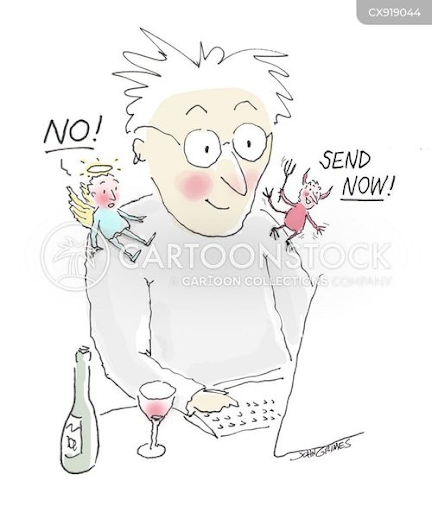
An Angel and A Devil Were Talking

Through a  rare cosmic oddity, unfathomably irregular if not  weirdly improbable, an angel and a devil were sitting at a table having drinks. The devil had one unimaginably strong cocktail while the angel settled for a tall glass of cold lemonade.  The devil (D) looked haggard but still menacing while the angel (A) looked calm but uncomfortably intent.  They started talking with each other.

D: What a day I'm having. I needed this drink.

A: Don't tell me. The furnace at the head office broke down?

D: Don't you dare tell a "Hell freezes over joke".

A: Sorry, what's the problem?

D: My boss has been on my case two days in a row now.  Says I'm not meeting my quota on recruiting sinners.  And he's criticizing my technique on how I dangle temptations.

A: Too bad.  Where has he been sending you? Any one particular place I should know about?

D: The worst place I was ever assigned to cover.  Tibet!

A: What? What's wrong with Tibet?

D: Those Tibetan monks won't hear or listen to anything once they get on that trance-like mode of meditation foolishness.  You know. They'd get into the meditation thing and no one can get through to them.  What happened to me was like sending a  do-gooder like you to Las Vegas.

A: Oh, I've been sent there.  Yes, right smack at the casinos. Did you know that on a per capita basis, you will hear more prayers there than in any cathedral? Or at the Vatican for that matter.  I was sent there as a neophyte early in my career. I once answered some desperate young man's prayer.  I tweaked the slot machine he was on which won him a $3,000 windfall.

D: Good for you.  I didn't mean good.  How devilish of you to do that.

A: Sadly,  he lost everything before midnight.  Including his tuition money for U.C. Berkeley.  You see, he was just passing through on his way to college.  That was a tough one. I think one of you guys took over but I didn't keep track.  I was told later in my assessment report  that that was a rookie mistake I made. I moved on.  It was almost as bad as my assignment to Congress. My other co-workers had the same experiences with all seats of government everywhere else.

D: I'm sure we hooked your Las Vegas kid. Especially if he was going to Berkely. Ah, Congress!.  Did you know that's where we send all our neophytes?  They go in as lobbyists. Then they think the devil's work is easy. Hah! Wait, till they get sent to Tibet.  

A:  Forget Tibet already. Be thankful your boss is not sending you to Antarctica?

D: What?  There's nothing there but penguins and smelly sea lions. Though I did enjoy once watching those killer whales tormenting those seals.  Penguins too.  But it was like munching on peanuts with those penguins. I'm still talking about killer whales.  You know, eating penguins. 

A: I got it.  You don't have to explain.

D: So, what's your problem?

A: I didn't like my last assignment.

D: Las Vegas?

A: No. Los Angeles. You know, I thought I was sent on vacation. Los Angeles - city of angels sounded .. well, angelic, you know what I mean. I thought I'd make a difference in Hollywood.  Nope.

D: Hollywood.  Do you know what we call that place?  The devil's playground.  Hollywood is our  R & R location.  You know, Rest and Recreation.

A: You don't have to explain that to me either.  I got you.

D: No, you don't. You think it's easy to be a devil or even just a devil's advocate.  People are mean. When they do something wrong, their first instinct is to say, 'the devil made me do it'. When something beneficial happens,  'a guardian angel saved that kid'. And they'd come up with expressions like, 'between the devil and the deep blue sea'.  What does that mean? You've not asked me, "How do I sleep at night?"

A: How do you sleep at night?"

D: I don't.  We all don't. Even associate devils don't.  Our boss certainly doesn't.

A: Is that hard for you?

D: Not sleeping? Nah. What's hard is when we're not appreciated.

A: You expect to be appreciated? 

D: Yeah, people are so ungrateful.  You give them everything they ask for and there's not even a thank you.  Serial killers are the worst.  They're never satisfied.  They keep doing it until they get caught. 

A: Listen, I can't say it's good talking with you.  You know what I mean.  I need to write a report and wait for my next assignment.

The two parted ways.  No handshakes; no "have a nice day"; no, see you next time either.

The devil reported for work the next day.  The boss wasn't around but the assistant boss was there who called him in before he could even settle in his chair.

"I heard you were talking with an angel. What did it have to say?"

"Wow, word spreads quickly, doesn't it? Why did you say, "it"?

"They are genderless, you know that, don't you? So are we all.  Only humans have genders.  And boy, don't they have more than two now. And they keep adding to it.  Our boss is happy.  Anyway, it's a small victory we don't celebrate over".

"Is that a win for us"?

"What do you think"? Don't worry about it.  The boss is sending you to your next assignment".

"Los Angeles"?

"No. By the way, we're done with Ivy League schools - in the U.S. and Europe as well.  Our boss is happy with our progress there.  We're sending you to the annual Competition for the Soul of Men. It's the Olympics for who can get the most number of sinners in the span of seven months. Or conversions, if you're working for the other side. This is one chance for you to excel. A promotion is at stake here".

"What? Where, when"?

"You're leaving today. But not before you've assembled your team of ten associates".

"Associates? To do what"?

"You'll know what to do before you leave.  Motivate yourself, for dear Satan's sake".


The angel who had met with the devil for drinks earlier was also summoned to report for the next assignment. The regional director spoke.

"You and a team of ten new angels  will be part of the Competition for the Soul of Men.  Your team individually will be sent to ten high schools in different parts of the world.  There each one of your team will be competing with a corresponding devil competitor.  The idea is to win over as many young kids as possible to our side. The devil competitors will do their best to tempt as many as they can.  Whoever can bring the most to one side or the other wins.  You will all have seven months each to accomplish the task".

"Soul of Men?  Those are young children!. And why only the male"?

"It's a figure of speech.  It's for all of humanity.  The future of humanity. Those children will soon become adults.  We  start early because by the time they get to college or the labor force or the military, it will be too late. Satan protested that part of the rules but he was overruled. But truth be known, Satan always start with young minds. He simply doesn't do it the same way each time".

"Okay, I'll start right away".

"Choose wisely. The specific schools and locations will be in the packet of information you will be receiving this afternoon.  Satan has an unlimited advertising budget.  You will not have any at all. Except for the fact that - you already know this - you have one advantage. You know that every human has both good and evil receptors in their minds. The one advantage you have is that there are twelve receptors for evil for each individual mind but there are thirteen for good. So, use that advantage".

The angel went to work.

That was a few days ago now.  It's an uphill battle for them. Actually, this has been going on throughout history.  These skirmishes are only a preview of what could become the final competition. But we can't know when that will be.  

We see everyday signs of these skirmishes. Every day we - all of us - are asked to take sides.  Choose wisely. 


"Who are you going to listen to. Me, or the boss from hell?"

Saturday, June 1, 2024

"What Could Have Been" Went into a Bar

"What Could Have Been" (WCHB) went into a bar.  He took the one empty bar stool, ordered a drink and while waiting, he struck a conversation with the one next to his right, "What Will Be, Will Be" (W.WBx2).

WCHB: "Been here long, it seems?"

W.WBx2: "Just my second drink, been nursing it slowly. What brought you in?"

W.WBx2: "Been feeling like Marlon Brando lately, everyday. Double scotch, or two or three makes the day and night easy.  What about you?"

W.WBx2: "Marlon Brando, whaaat?" (elongating the word, in obvious bewilderment)

WCHB: "You know, the movie 'On The Waterfront' where Brando famously bemoaned: 'I could have been a contender!' He won his first Oscar in that movie in 1954".

W.WBx2: "Not a big fan of movies but I know Brando.  But what has that quotation got to do with you? Me, I drink each night to prepare myself the next day for what will be, will be".

WCHB: Ah, you see that makes you Doris Day.  From "The Man Who Knew Too Much"

Within one and a half seconds, W.WBx2 got off from his stool, and blind sided  WCHB with a savage right hook to the jaw. WCHB was flat on the floor for a bit before the bartender broke through the crowd to break up what could have been a melee of some sort.


That evening the policeman who processed the assault charge and wrote up the report was having dinner with his wife.  Over dessert, he told her  about the incident and the report he wrote. He said, "I filed the report but here, read this alternate one I wrote for my eyes and yours only".

His wife read the exact ones that were italicized above. "Wow, you are one frustrated script writer, aren't you? I know you are a psychoanalyst too, that's in quotation marks by the way, just so you know.  So .. oh, the night is young.  The dishes can wait.  Tell me what's behind all these.  Tell me more. Help yourself to another scoop of ice cream while I brew some tea.

Over a steaming cup of tea and the scoop of ice cream now a mere memory on the saucer nearby, the policeman begun.

"WCHB is someone who is stuck with a life he keeps rehashing with myriad scenarios of what could have been.  I spoke with him as he was treated  on a stretcher at the EMT truck. He explained that all he did was spoke about his life. "What could have been if only this or that happened", he said.  W.WBx2 claimed it an insult that WCHB called him "a Doris Day and the man who knew too much".  Clearly it was all a misunderstanding.

His wife said, "That's it?  You have no psychoanalytical gems you want to share?"

"W.WBx2 could have shown some restraint, you see. But, talking with him at the precinct while I booked him for assault, he was nonchalant about it. He claimed that what happened occurred because it was to be."

"I have to ask", his wife had to ask. "What did he mean by it?"

"I will have to guess what he meant.  Unlike WCB who seems to live a life weighted down by the past or endless what-could-have-been scenarios, "W.WBx2 lives by a probabilistic future of what-will-be will-be. Or, put another way, I think he merely believes in future agnosticism."

"Wow!", his wife, seemingly feigning adoration, responded quickly.

"You're making fun of me.  Let me explain as I usually do when dealing with ordinary mortals.  Before you get smart alecky with me, you know you're a goddess to me, but try to be an ordinary mortal for a minute" his quick recovery was smart and effective because his wife smiled approvingly.

"Wait, explain Doris Day first".  Again, his wife had to ask.

"Doris Day starred with Jim Stewart in what was a suspense spy movie, "The Man Who Knew Too Much" made in 1956.  It was in that movie that she sung the song about the future to her son.  The song was "Que Sera, Sera".

His wife was squinting that familiar squint of, "I don't know what you're talking about".

"Ser is a verb for "to be" in Spanish. Conjugated to future tense, it is sera for will beQue sera, sera is what will be, will be".

"I see.  Go on".

"I looked this up on an English grammar reference website", the policeman admitted.

"What could have been is a standard phrase in references to things that do not actually exist, but which seemed possible at one time in the past"

"WCHB was apparently  projecting everything from the past.  He is prone to daydreaming in reverse".

"Wow, wow again".  This time his wife's adoring smile was genuine. "I adore you for coming up with that phrase, "daydreaming in reverse". What about W.WBx2"?

"W.WBx2 clearly does not care much about knowing the future because to him what happens will happen. He claimed that his present moments were all predicated from before they happened by a series of "what will be-s" that he had little control over and until they happened, everything was just simply a probability".

"So W.WBx2 not only doesn't care to know  about the future, he really does not care what happens at all, does he?" his wife asked.

"Perhaps, but not really.  He has a job and a family so he must care about the future.  I think it's just the alcohol that is doing it for him.  And the right trigger mechanism of some sort that sets him off".

"I think WCHB has real problems.  You made fun of daydreaming in reverse but it is real for some people.  We reminisce about the past, the wonderful moments or the no-so-happy ones and sometimes the sad ones too. We daydream only about tomorrow. We all have 'What could have been-s' but they serve very little purpose".  The policeman was done with his tea and was going to call it a night but his wife wouldn't let him yet.

"Were you serious when you said I am a goddess to you"?

"Yes".

"Can a goddess have wishes?"

"My goddess' wishes are my commands".

"Will you clear the dishes from the table? Wash them or get them into the dishwasher before going upstairs?  Please, please"? She had that smile that captivated him seven years ago and can still hold him hostage even now.

The policeman's reply - well tested through time - is the surest thing to eternal peace and tranquility in any household throughout human history.

 "Yes dear!"


"She always gets her way. Everything is always 'Yes, Deer.'"