Tuesday, June 4, 2024

An Angel and A Devil Were Talking

Through a  rare cosmic oddity, unfathomably irregular if not  weirdly improbable, an angel and a devil were sitting at a table having drinks. The devil had one unimaginably strong cocktail while the angel settled for a tall glass of cold lemonade.  The devil (D) looked haggard but still menacing while the angel (A) looked calm but uncomfortably intent.  They started talking with each other.

D: What a day I'm having. I needed this drink.

A: Don't tell me. The furnace at the head office broke down?

D: Don't you dare tell a "Hell freezes over joke".

A: Sorry, what's the problem?

D: My boss has been on my case two days in a row now.  Says I'm not meeting my quota on recruiting sinners.  And he's criticizing my technique on how I dangle temptations.

A: Too bad.  Where has he been sending you? Any one particular place I should know about?

D: The worst place I was ever assigned to cover.  Tibet!

A: What? What's wrong with Tibet?

D: Those Tibetan monks won't hear or listen to anything once they get on that trance-like mode of meditation foolishness.  You know. They'd get into the meditation thing and no one can get through to them.  What happened to me was like sending a  do-gooder like you to Las Vegas.

A: Oh, I've been sent there.  Yes, right smack at the casinos. Did you know that on a per capita basis, you will hear more prayers there than in any cathedral? Or at the Vatican for that matter.  I was sent there as a neophyte early in my career. I once answered some desperate young man's prayer.  I tweaked the slot machine he was on which won him a $3,000 windfall.

D: Good for you.  I didn't mean good.  How devilish of you to do that.

A: Sadly,  he lost everything before midnight.  Including his tuition money for U.C. Berkeley.  You see, he was just passing through on his way to college.  That was a tough one. I think one of you guys took over but I didn't keep track.  I was told later in my assessment report  that that was a rookie mistake I made. I moved on.  It was almost as bad as my assignment to Congress. My other co-workers had the same experiences with all seats of government everywhere else.

D: I'm sure we hooked your Las Vegas kid. Especially if he was going to Berkely. Ah, Congress!.  Did you know that's where we send all our neophytes?  They go in as lobbyists. Then they think the devil's work is easy. Hah! Wait, till they get sent to Tibet.  

A:  Forget Tibet already. Be thankful your boss is not sending you to Antarctica?

D: What?  There's nothing there but penguins and smelly sea lions. Though I did enjoy once watching those killer whales tormenting those seals.  Penguins too.  But it was like munching on peanuts with those penguins. I'm still talking about killer whales.  You know, eating penguins. 

A: I got it.  You don't have to explain.

D: So, what's your problem?

A: I didn't like my last assignment.

D: Las Vegas?

A: No. Los Angeles. You know, I thought I was sent on vacation. Los Angeles - city of angels sounded .. well, angelic, you know what I mean. I thought I'd make a difference in Hollywood.  Nope.

D: Hollywood.  Do you know what we call that place?  The devil's playground.  Hollywood is our  R & R location.  You know, Rest and Recreation.

A: You don't have to explain that to me either.  I got you.

D: No, you don't. You think it's easy to be a devil or even just a devil's advocate.  People are mean. When they do something wrong, their first instinct is to say, 'the devil made me do it'. When something beneficial happens,  'a guardian angel saved that kid'. And they'd come up with expressions like, 'between the devil and the deep blue sea'.  What does that mean? You've not asked me, "How do I sleep at night?"

A: How do you sleep at night?"

D: I don't.  We all don't. Even associate devils don't.  Our boss certainly doesn't.

A: Is that hard for you?

D: Not sleeping? Nah. What's hard is when we're not appreciated.

A: You expect to be appreciated? 

D: Yeah, people are so ungrateful.  You give them everything they ask for and there's not even a thank you.  Serial killers are the worst.  They're never satisfied.  They keep doing it until they get caught. 

A: Listen, I can't say it's good talking with you.  You know what I mean.  I need to write a report and wait for my next assignment.

The two parted ways.  No handshakes; no "have a nice day"; no, see you next time either.

The devil reported for work the next day.  The boss wasn't around but the assistant boss was there who called him in before he could even settle in his chair.

"I heard you were talking with an angel. What did it have to say?"

"Wow, word spreads quickly, doesn't it? Why did you say, "it"?

"They are genderless, you know that, don't you? So are we all.  Only humans have genders.  And boy, don't they have more than two now. And they keep adding to it.  Our boss is happy.  Anyway, it's a small victory we don't celebrate over".

"Is that a win for us"?

"What do you think"? Don't worry about it.  The boss is sending you to your next assignment".

"Los Angeles"?

"No. By the way, we're done with Ivy League schools - in the U.S. and Europe as well.  Our boss is happy with our progress there.  We're sending you to the annual Competition for the Soul of Men. It's the Olympics for who can get the most number of sinners in the span of seven months. Or conversions, if you're working for the other side. This is one chance for you to excel. A promotion is at stake here".

"What? Where, when"?

"You're leaving today. But not before you've assembled your team of ten associates".

"Associates? To do what"?

"You'll know what to do before you leave.  Motivate yourself, for dear Satan's sake".


The angel who had met with the devil for drinks earlier was also summoned to report for the next assignment. The regional director spoke.

"You and a team of ten new angels  will be part of the Competition for the Soul of Men.  Your team individually will be sent to ten high schools in different parts of the world.  There each one of your team will be competing with a corresponding devil competitor.  The idea is to win over as many young kids as possible to our side. The devil competitors will do their best to tempt as many as they can.  Whoever can bring the most to one side or the other wins.  You will all have seven months each to accomplish the task".

"Soul of Men?  Those are young children!. And why only the male"?

"It's a figure of speech.  It's for all of humanity.  The future of humanity. Those children will soon become adults.  We  start early because by the time they get to college or the labor force or the military, it will be too late. Satan protested that part of the rules but he was overruled. But truth be known, Satan always start with young minds. He simply doesn't do it the same way each time".

"Okay, I'll start right away".

"Choose wisely. The specific schools and locations will be in the packet of information you will be receiving this afternoon.  Satan has an unlimited advertising budget.  You will not have any at all. Except for the fact that - you already know this - you have one advantage. You know that every human has both good and evil receptors in their minds. The one advantage you have is that there are twelve receptors for evil for each individual mind but there are thirteen for good. So, use that advantage".

The angel went to work.

That was a few days ago now.  It's an uphill battle for them. Actually, this has been going on throughout history.  These skirmishes are only a preview of what could become the final competition. But we can't know when that will be.  

We see everyday signs of these skirmishes. Every day we - all of us - are asked to take sides.  Choose wisely. 
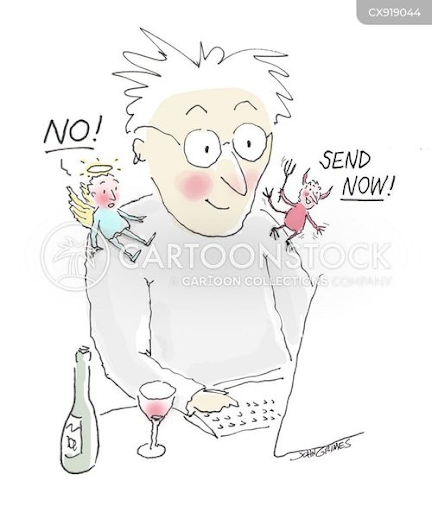


"Who are you going to listen to. Me, or the boss from hell?"

Saturday, June 1, 2024

"What Could Have Been" Went into a Bar

"What Could Have Been" (WCHB) went into a bar.  He took the one empty bar stool, ordered a drink and while waiting, he struck a conversation with the one next to his right, "What Will Be, Will Be" (W.WBx2).

WCHB: "Been here long, it seems?"

W.WBx2: "Just my second drink, been nursing it slowly. What brought you in?"

W.WBx2: "Been feeling like Marlon Brando lately, everyday. Double scotch, or two or three makes the day and night easy.  What about you?"

W.WBx2: "Marlon Brando, whaaat?" (elongating the word, in obvious bewilderment)

WCHB: "You know, the movie 'On The Waterfront' where Brando famously bemoaned: 'I could have been a contender!' He won his first Oscar in that movie in 1954".

W.WBx2: "Not a big fan of movies but I know Brando.  But what has that quotation got to do with you? Me, I drink each night to prepare myself the next day for what will be, will be".

WCHB: Ah, you see that makes you Doris Day.  From "The Man Who Knew Too Much"

Within one and a half seconds, W.WBx2 got off from his stool, and blind sided  WCHB with a savage right hook to the jaw. WCHB was flat on the floor for a bit before the bartender broke through the crowd to break up what could have been a melee of some sort.


That evening the policeman who processed the assault charge and wrote up the report was having dinner with his wife.  Over dessert, he told her  about the incident and the report he wrote. He said, "I filed the report but here, read this alternate one I wrote for my eyes and yours only".

His wife read the exact ones that were italicized above. "Wow, you are one frustrated script writer, aren't you? I know you are a psychoanalyst too, that's in quotation marks by the way, just so you know.  So .. oh, the night is young.  The dishes can wait.  Tell me what's behind all these.  Tell me more. Help yourself to another scoop of ice cream while I brew some tea.

Over a steaming cup of tea and the scoop of ice cream now a mere memory on the saucer nearby, the policeman begun.

"WCHB is someone who is stuck with a life he keeps rehashing with myriad scenarios of what could have been.  I spoke with him as he was treated  on a stretcher at the EMT truck. He explained that all he did was spoke about his life. "What could have been if only this or that happened", he said.  W.WBx2 claimed it an insult that WCHB called him "a Doris Day and the man who knew too much".  Clearly it was all a misunderstanding.

His wife said, "That's it?  You have no psychoanalytical gems you want to share?"

"W.WBx2 could have shown some restraint, you see. But, talking with him at the precinct while I booked him for assault, he was nonchalant about it. He claimed that what happened occurred because it was to be."

"I have to ask", his wife had to ask. "What did he mean by it?"

"I will have to guess what he meant.  Unlike WCB who seems to live a life weighted down by the past or endless what-could-have-been scenarios, "W.WBx2 lives by a probabilistic future of what-will-be will-be. Or, put another way, I think he merely believes in future agnosticism."

"Wow!", his wife, seemingly feigning adoration, responded quickly.

"You're making fun of me.  Let me explain as I usually do when dealing with ordinary mortals.  Before you get smart alecky with me, you know you're a goddess to me, but try to be an ordinary mortal for a minute" his quick recovery was smart and effective because his wife smiled approvingly.

"Wait, explain Doris Day first".  Again, his wife had to ask.

"Doris Day starred with Jim Stewart in what was a suspense spy movie, "The Man Who Knew Too Much" made in 1956.  It was in that movie that she sung the song about the future to her son.  The song was "Que Sera, Sera".

His wife was squinting that familiar squint of, "I don't know what you're talking about".

"Ser is a verb for "to be" in Spanish. Conjugated to future tense, it is sera for will beQue sera, sera is what will be, will be".

"I see.  Go on".

"I looked this up on an English grammar reference website", the policeman admitted.

"What could have been is a standard phrase in references to things that do not actually exist, but which seemed possible at one time in the past"

"WCHB was apparently  projecting everything from the past.  He is prone to daydreaming in reverse".

"Wow, wow again".  This time his wife's adoring smile was genuine. "I adore you for coming up with that phrase, "daydreaming in reverse". What about W.WBx2"?

"W.WBx2 clearly does not care much about knowing the future because to him what happens will happen. He claimed that his present moments were all predicated from before they happened by a series of "what will be-s" that he had little control over and until they happened, everything was just simply a probability".

"So W.WBx2 not only doesn't care to know  about the future, he really does not care what happens at all, does he?" his wife asked.

"Perhaps, but not really.  He has a job and a family so he must care about the future.  I think it's just the alcohol that is doing it for him.  And the right trigger mechanism of some sort that sets him off".

"I think WCHB has real problems.  You made fun of daydreaming in reverse but it is real for some people.  We reminisce about the past, the wonderful moments or the no-so-happy ones and sometimes the sad ones too. We daydream only about tomorrow. We all have 'What could have been-s' but they serve very little purpose".  The policeman was done with his tea and was going to call it a night but his wife wouldn't let him yet.

"Were you serious when you said I am a goddess to you"?

"Yes".

"Can a goddess have wishes?"

"My goddess' wishes are my commands".

"Will you clear the dishes from the table? Wash them or get them into the dishwasher before going upstairs?  Please, please"? She had that smile that captivated him seven years ago and can still hold him hostage even now.

The policeman's reply - well tested through time - is the surest thing to eternal peace and tranquility in any household throughout human history.

 "Yes dear!"


"She always gets her way. Everything is always 'Yes, Deer.'"


Wednesday, May 29, 2024

Who Will Tame The Beast?

Historically, the world has had its share of heroes and villains. Heroes were enshrined in monuments and public altars that proclaimed what was good with the human spirit: unquestionable bravery, steadfast morality, personal sacrifices, and unselfish devotion to serve others. Villains, the world had its share too of those who caused so much anguish, cruelty, death and destruction, desolation and the indelible definition of  human suffering.

A popular quote of anonymous origin, popularized on T-shirts for merchandising, says:

"The Greatest Trick the Devil Ever Pulled Was Convincing the World He Didn’t Exist."

From generations to generations the world had seen one and several versions of the likes of Atilla the Hun, Hitler and Pol Pot and many others too long to enumerate here. History as written about those men tells us of the horror of their reign that as a consequence they were and are remembered by those who survived directly from their cruelty to depict them as the worst of their nightmares - they were "beasts" that continued to haunt them for as long as they lived.  If we were to lump together everything  that had been written, told and retold in the past about the beasts referred to across centuries and many generations ago to as late as the 1970's, they will apparently pale in comparison to the beast yet to come in our future if we are to subscribe to the idea of the "ultimate destiny of humankind"

Almost all faiths - certainly for Jews, Muslims and Christians - have their versions of the end time, defined as eschatology, the "branch of theology concerned with the final events in the history of the world or of humankind".

On one hand, we've had two major world wars and not only are we still here, the world's population has quadrupled since the last one. Could this be  justification to harbor skepticism over the end of time as depicted in both Biblical texts and messages from the Quran that are the source upon which the three major religions rely for guidance and predictions?  

Or, does  the ever increasing world population over the projected shortfall in food and water supply create the kind of turmoil for the possibility of the "Four Horsemen of the Apocalypse" in our future?  Is there a way to look at this objectively?  We can without attaching, even just a little bit, our own personal inclinations toward one or another belief system. We can, say, view current events and what can be reasonably projected into the future based on the present conditions. More on this in a bit.

There is no doubt, there had been much fascination with the "Four Horsemen of the Apocalypse", fearfully or as a matter of religious resignation to the eventual fulfillment of prophecies. Additionally, doomsday movies on screen and TV are feeding into the collective psyche, stoking fears with zombies, environmental disasters, and invasion by extraterrestrial beings, etc.

In the midst of WWI (1914-18), a Spanish novelist, Vicente Ibanez, wrote in 1916,  a book with the subject title,  "Four Horsemen of the Apocalypse", depicting a storyline around 1914 and WWIIt was made into  into a "blockbuster" movie in 1921 that propelled the career of Rudolph Valentino as a superstar of silent films of the time. A remake of the movie was made in 1962, updated to depict the story beginning in 1939, before and at the beginning of WWII.  It was a critical and commercial flop despite an all star cast and premier direction.  Another movie was made with the same title, different plot, in 2022, which also received  lukewarm reviews.  

The sign  The End of the World held up in caricature has also both become fodder for humor and cynicism. 

Today, "wars and rumors of war" persist but the subject of the end time is hardly a topic of regular conversation on any given day but once broached, it can be a contentious one among those who are dogmatic about their beliefs.  We can look at where this all began.

One of the Christian disciples in about 90 A.D. named John was attributed to have written the entire manuscript of the Book of Revelation while in exile on the island of Patmos (now part of Greece) although there are a few scholars who speculate that there may have been others who contributed to the writings.  At that time Patmos was under the control of the Romans who exiled John to the island.  That was ninety years after the crucifixion at Golgotha and two hundred years  before the reign of Emperor Constantine who converted the Roman empire to Christianity.

What John of Patmos (as he came to be known) wrote were about the visions shown to him supernaturally by his recollection. He described what was foretold to him that were predictions of the future state of humankind filled with detailed symbolic references about how it will happen at the end and the return of the Messiah but not specifying when.  It must be noted that all three major religions subscribe to the idea of the messiah or promised redeemer or expected savior. 

The Four Horsemen of the Apocalypse from the symbolism they represent as in the visions of John can be all too real.  Unsustainable growth in population, political instability, unpredictable resurgence of virulent microbes and resistance to antibiotics, war mongering from states with powerful weapons indeed make the scenario of the Four Horsemen to occur within the lifetimes of at least 60% of the people alive today. 

Luke Kemp, a researcher  at the Centre for the Study of Existential Risk at the University of Cambridge and others like him have written about past collapses of civilization regionally and by eras and the projected collapse of the entire world population in the future.   

"Our tightly-coupled, globalized economic system is, if anything, more likely to make crises spread".        

".. the world is becoming increasingly complex, and our demands on the environment are outstripping planetary carrying capacity."

 -- Luke Kemp

"Studying the demise of historic civilizations can tell us how much risk we face today", says collapse expert Luke Kemp. Worryingly, the signs are worsening".

Put another way, what researchers like Kemp and others are saying can be consistent with what John of Patmos saw in his visions.

Let's put just one present day world context to wrap around just one of those that John wrote about in Revelation, specifically in Chapter 13. Keep in mind that John wrote in symbolisms and if we allow that the visions he saw were incomprehensible to him, he was describing them with images he could only put context to  that which were familiar to him as indigenous people in the American west first described the locomotive as iron horse, or guns as thunder sticks.

John wrote about the beasts (not just one but two) right at the start of the chapter in verse 1: "Then I saw a beast come out of the sea with ten horns and seven heads; on its horns were ten crowns, and on its heads names of heresy".

Did the ten crowns mean kingdoms or nations?

Verse 3: "I saw that one of its heads seemed to have been mortally wounded, but this mortal wound was healed.* Fascinated, the whole world followed after the beast".

If it were a nation, did that mean that "this mortal wound was healed" refer to one nation that earlier had suffered a serious defeat in its history but has now recovered? A past empire, or one nation like Germany after WWII, defeated, mortally wounded but now fully back as an economic power? Is it regaining military development and regional leadership?

Verse 11: "Then I saw another beast come up out of the earth; it had two horns like a lamb but spoke like a dragon".

Earlier in Verse 4: "And they worshipped the dragon which gave power unto the beast: and they worshipped the beast, saying, Who is like unto the beast? Who is able to make war with him?"

This is where present day context will seem to be meaningful.  If the so-called beast is a group of nations, i.e. the European Union, for example, or NATO for that matter, or some yet to be named organization of nations, it would make sense that if such a group becomes a strong and cohesive military alliance, its power could be so overwhelming that no one nation can make war with it. It will also by necessity become an economic power, as in ..

 Verse16: "It forced all the people, small and great, rich and poor, free and slave, to be given a stamped image on their right hands or their foreheads".

Verse 17: "so that they could not buy or sell unless they had the mark, which is the name of the beast or the number of its name".

During John's time, he could not have understood identification through credit card numbers or some other coding systems that would allow people to do business or engage in commerce. 

This is obviously an abbreviated contextual explanation which the reader is encouraged to further read up on and perhaps come up with other interpretations but the key is to put present day context for any of what John saw in his visions if indeed he was writing about events way, way into his future at the time.

The reader may take this with a grain of salt and that is fair and fine but let's get back to the earlier quote, "The Greatest Trick the Devil Ever Pulled Was Convincing the World He Didn’t Exist."

1. By that, if the devil were real but a deceiver then most of the atrocities and horror he wanted to do will be through "men committing them against other men, people against other people, nations against other nations, etc. and by wars and rumors of wars" only perpetuates his goal.

2. By convincing the world he does not exist is his most potent argument for God also not to exist either. 

But then ..

3. “God never talks. But the devil keeps advertising, Father. The devil does a lot of commercials.”     ― William Peter Blatty, The Exorcist  

True to one of the goals of this musing, to put forth, "provoking issues you did not have the time to consider but now you may want to look into because you have a moment or two to spare or you just want some of your brain cells to be tickled out of slumber", I hope this is one of those

Now, as to the question, "Who will tame the Beast?", your answer is as good as anyone else's.

{By the way, most recently a new book just came out, which I haven't yet read, written by Randall Sullivan, "The Devil's Best Trick", with sub-heading, "How The Face of Evil Disappeared".  Looks intriguing and the good reviews, so far, makes it probably worth a look}.


Wednesday, May 1, 2024

The Serpent's Trail of Dan

From "Maddeningly Unthinkable Road to Megiddo", we can look into more additional history. I found the explanation of the path that the presumed lost tribes of Israel took to make good the promise of, "a nation and a company of nations shall be of thee" even more intriguing. If anything, the predictions surrounding their plight and eventual fate may have at the very least a host of circumstantial evidence or to the skeptics a bunch of coincidences.  A little more digging and I think I found both.

But first another historical example of migrations from a relatively earlier era to put some context and insight.

From 19,000 to 11,000 years ago during the last ice age, also known as the Last Glaciation Maximum (LGM),  sea levels went much lower than it is today when much of the water was frozen at both polar regions, resulting in "land bridges" that connected many island archipelagos and present day island nations from Japan to the Philippines to Indonesia.  During that time those bridges enabled ancient migration on foot from island to island.  The Philippine population today traces its roots to Indo-Malay origins. In fact, Filipinos and Indonesians even today are indistinguishable from one another in physical features and skin color.

At the end of LGM as the planet warmed up, sea levels around the world rose again (there were a total of five glacial and warming epochs in earth's history) thus isolating the present day island nations.  Not only that, but island nations like Indonesia and the Philippines presently have 11,000 and 7,000 separate islands, within each country, respectively.  People, pockets of populations, as a result were isolated from each other from island to island.  Language and culture evolved.  In the Philippines, distinct "island languages", not just  dialects, are spoken today.  For example, in one of the central islands where I grew up, we speak one particular "language" different from the other side because at one time the mountain range in between separated the people from the west to the eastern side of the island.  On the other hand, we speak the same "language" as those from the island directly across from our shores because trades existed between both sides through sea going vessels.

Today, lots of words have common etymologies between Indonesian and Philippine languages.  

That little backdrop from one side of the world gives us a comparative perspective to the plight of the Hebrews from the time of the exodus from Egypt, the exile that followed and centuries of population growth, relocations, displacements, assimilations, political and cultural, even religious turmoil that fueled conflicts only to be settled by warfare, subjugation that led to enslavement, in many cases.  Keep in mind we are talking about a time frame that took centuries of history. 

As depicted in the Biblical story, Jacob was the son of Isaac, grandson of Abraham.  Jacob's name was later changed to Israel and he had  12 sons from whom descended the 12 tribes. While Reuben was the eldest and Benjamin was the youngest, we will only focus on the fifth son named Dan and what happened to his tribe.

Dan's  lineage was a warring tribe, adventurous and prone to restless movement to other lands.  Genesis 32: prophesied that "Dan will be a serpent by the roadside, a viper along the path, that bites the horse's heels, so that its rider tumbles backward".  

One interpretation of the first half of the verse, "A serpent, when it slithers and crawls, leaves a trail or track in the sand. Even so the tribe of Dan would leave signs or "waymarks" showing where it had journeyed. They tended to leave their "name" behind as an identifying sign!" More on this in a bit.

The Danites were descendants of Dan.  For centuries that followed they ventured into lands farther away.  They, among some of the other tribes who did stray from their faith and traditions, were the most to rebel. They developed a close affinity to the Phoenicians with whom they battled against for a period of time before making peace with them.  The Phoenicians were pagans, master shipbuilders and experts at navigation.  Danites worked in shipyards and on ships, perhaps as slaves in the beginning but later acquired the skill to build their own vessels and mastery of seafaring to further their restless and adventurous nature. By that time, they had become idol worshipers and practiced paganism.

Do we see the signs and waymarks that Dan's tribe left behind?  In prophecy, the Israelites were to follow "Road Signs' and "Guideposts", to pave the way for those who were following behind. The tribe of Dan was the trailblazer and the path they took was dubbed the serpent's trail.  Now always remember the timeline to be centuries long.

{Note: "In ancient times, when the Hebrew writing system was developed, vowels were not used. Native speakers could understand the words without the use of vowels, just as you can probably make out this sentence:

Tr wrtng wtht vwls. (Try writing without vowels."}

So, the name Dan would have been written simply as DN, or its equivalent in Hebrew.  Phonetically then, Din, Den, Dan, Don, Dun would have all correspondingly represented the name Dan.

A quick look into the World Atlas will show us a possible route the Israelites took from the time of the exodus from Egypt.  They spent forty years "in the wilderness" that would have placed them in and around the area of Mt. Sinai. They could not go east from there because they would have faced hostility from the people that occupied those lands that earlier had pushed them towards Egypt in the first place. Those land areas that prevented the Israelites from going east then are the same places today occupied by Syria, Saudi Arabia, Iraq and Iran, just to name the major ones.

What follows are what I've read from a few sources who espouse one area of history apart from what is generally accepted.

So, they could have traveled up along the coastline to reach what is now Turkey and by sea to reach Greece.  Let's get the quote earlier: Even so the tribe of Dan would leave signs or "waymarks" showing where it had journeyed. They tended to leave their "name" behind as an identifying sign!" Along the way, territories changed hands through tribal skirmishes and all-out warfare.

A quick look at the map of the upper Middle East and Europe helps to see the trail they took and the waymarks along the way.

The Strait of Gallipoli in northwestern Turkey is also known as The Dardanelles.  Easterly, still along the coast is today the fourth largest city of Sidon in Lebanon.  By sea to Greece and from there they would have reached a place later named Macedonia.  Thus begun the naming of "waymarks and guideposts"

The island of Sardinia may have come from Shardana or Sardana. In Hebrew Shar or Sar meant princely, or chief from which the words tsar, Caesar, kaiser came from.  The Shar Danas were the prosperous Danites that occupied that island for a time.

They moved east and north reaching what is now Germany, Poland, Ukraine and Russia.  Rivers like the Danube and Dnieper are still called that today; so is Gdansk, Poland. Before the state of Israel was created, it is widely known that the known Jewish population was in all places in Europe. Hence, preceding  WWII, German and Polish Jews suffered the most from Hitler's regime.

But here is something even more intriguing. The tribe of Dan kept moving and northerly they settled in what we now know as the Scandinavian countries; most prominently, Sweden and Denmark. Today citizens of Denmark are called Danes.

From there they went down southwesterly in ships.  They reached Ireland first.  In Irish folklore we come across the "Tuatha Dé Danann".  There are many explanations for that phrase, such as to describe tuath Dé as the tribe of gods; Tuatha (plural) Dé for tribes of the gods. In Irish mythology, supernatural beings are described as well in reference to the same. On the other hand, a more natural explanation could be that Tuatha de Danann simply referred to "the tribe of Dan".

Now, there are so many places and names in Ireland and Scotland and throughout the British isles with dan, dun, din, etc. but just to name the popular ones, we see that the capital of Scotland is Edinburgh and of course we have London.  

All of these are circumstantial when taken alone or simply coincidences?

The Roman geographer Ptolemy described northern Scotland as Caledonii or Caledonia, "such as Dùn Chailleann, the Scottish Gaelic word for the town of Dunkeld meaning "fort of the Caledonii".  In Ptolemy's map was a region there called the Otadini.  Further down into the "lowlands" of Scotland we find places like Averdeen, Dundee and of course the capital named Edinburgh.

The last one geographical patch I see that was a pivotal place in English modern history was a place called Dunkirk, France, when in May, 1940 close to 350,000 British soldiers were rescued with British ships and civilian vessels who risked their small boats to cross the English Channel to ferry the survivors of a defeated British force back to England.  'Operation Dynamo' was hailed as a miracle or providential because for some reason the Germans did not pursue the British soldiers to their end as they were fleeing. Many of those soldiers went back on D-day to liberate Europe.  It was at the end of the war when the world found out about the concentration camps and the death of six million Jews.

Do these places prove the prophecy about Dan's tribe/s fulfilling their task to name "waymarks and guideposts" to pave the plight of the lost tribes of Israelites?  The reader can look up the maps, as I did, and one may take the position that these are all circumstantial or total coincidences or perhaps mere misinterpretations.  Are Biblical prophecies, such as, "for a nation and a company of nations shall be of thee"  (Genesis 35:11) to be interpreted as Great Britain (British Commonwealth to mean company of nations?) and the United States just lucky guesses?  Where does that put the rest of the world? That will be for another day of discussion.

From today's headlines the world seems headed towards an unprecedented escalation of antisemitic protests as a result of Israel's push against Hamas in Gaza. Some of the chants heard were, "Go back to Europe'', a clear reference to where most of the Jewish population used to reside.   This takes us back to an Old Testament prophecy, “For I will take you from the nations, gather you from all the lands and bring you into your own land” (Ezek. 36:24), fulfilled in 1948 on the creation of the state of Israel.

Unfortunately, history has provided us, time after time, humanity's proclivity for conflict that goes back  thousands of years. However, lessons remain unlearned, forgotten and ignored. My previous musing on the road to Megiddo is not an exaggeration if only to agree with this quote, "The history of man is a history of war."

Perhaps, "wars and rumors of war" (Matthew 24:6) will finally end in that one last battle at Megiddo if only for that to be the last war man will ever have to fight. And never again because either we have at last learned our final lesson or because there is no one left  to do any more battles. 


Sunday, April 21, 2024

MAD-deningly Unthinkable Road to Megiddo

"MAD-deningly Unthinkable", two years ago, was a cautionary tale  I wrote about the possible rekindling of humanity's greatest fear of a nuclear war where "MAD" stood for Mutually Assured Destruction. For decades it was what reassured world leaders, politicians, military strategists, even philosophers that WWIII will be avoided because none of the nations who will engage in it will survive.  But what does that really mean?

It is not even a valid point of re-assurance because for MAD to work, everybody (from all opposing sides) should be convinced that each other's capability is exactly equal in magnitude and infallibly effective in every measure that no one side can survive. But we know that all it will take is for one or the other to believe that they have a winnable position through miscalculation, misinformation, self delusion, fueled by a misplaced sense of national pride or misguided  national hatred  towards the other side; just a few that can cause the perceived balance to tip disastrously. The news cycle, currently in today's geopolitical turmoil, does seem like a daily refrain constantly stoking that fear.

So, we have that and the history of humanity from which we are supposed to learn from but which we ignore or neglect to acknowledge. Either history is a poor teacher or man is a horrible student. If real events in history are not worth the pages they are written on, what are we left with to rely on to help us navigate through and prepare  for a future that is yet to come?

The future.  We can skip the so-called "think tank" projections, game theory probabilities, even artificial intelligence-aided scenarios because they are still based on human calculations and human parameters that we cannot trust.  What are we left with? Nostradamus, Jeanne Dixon, doomsday prophets..?

It appears then that many attempts by us to govern or assemble a sustainable order for all of humanity to live peacefully with one another have failed throughout our history.  From the time of the Magna Carta to all peace treaties that were signed and torn asunder to the Geneva Convention to the League of Nations to the United Nations, failure was a constant end to achieving eternal peace. Where else can we turn?

What we have not included from the first paragraph at the start of this musing (above) are the words from those who espouse predictions from the different points of view beyond what can be naturally explained - from the realm of faith-based or religious (if you will) prophecies.  We might as well, since so much has already been  tried but which has failed to live up to sustainable peace and harmony.

Referring to the first paragraph again, we may now include the religious leaders who were and still remain much less optimistic of the prospect of man-made solutions because ancient prophets have foretold the eventual end of the world from a different perspective.

Of late, we see and hear of the Middle East as the powder keg that can no longer be ignored that once lit could very well be the beginning of the world's real existential threat never once seen or experienced, except as depicted in Biblical prophecy.  Has the fuse already been laid out? Is there hope it can still be defused? Or, is there little we can do?

What different contexts can we then extract from a never tried source before?

The two major faith-based sources that were written from ancient times were the Quran and the Holy Bible subscribed to respectively by Islam and the combined designation  that we know as those belonging to the Judeo/Christian faith.  Both written references are considered by their respective adherents as divinely inspired and direct messages from God.  

It is critically important to note that, "The Quran assumes the reader's familiarity with major narratives recounted in the Biblical and apocryphal scriptures".  Furthermore, "The Quran contains references to more than fifty people and events also found in the Bible". The Quran was written centuries after the Holy Bible was already in use by the faithful who switched from believers in multiple-god-worship to monotheism - the belief in one God.

Most, if not all, who read this will be from the Judeo/Christian faith so we will focus only on the perspectives from the Bible (Old and New Testaments). The contents of the Bible may be divided into historical events, moral and ethical prescriptions for righteousness and piety, the  Gospels (New Testament) that pertain to the Messianic teachings, His life, and eventual return for the final battle between good and evil, prophecies of events yet to come.

It will take a very long foray into historical and Biblical research to get into the nitty gritty of how this leads into making the Middle East as the center for much of what is predicted to be an all out conflict to end all wars. We will take a short cut because, for one, I am not a Biblical scholar, and two, neither is the reader. There is a short version from countless Biblical scholars whose conclusions on the validity of the predictions I leave to the reader to assess. Let's just take the following that scholars use as proof.

1) Before 1948, there was no state of Israel but its establishment was prophesied in the Old Testament Book of Ezekiel, “For I will take you from the nations, gather you from all the lands and bring you into your own land” (Ezek. 36:24). Thus followed one extraordinary migration of Jews  after the war (WWII) when in 1948 the state of Israel was created.  They came from almost every patch of Europe, the U.S., Great Britain and from refugee camps everywhere.

2. Jacob was renamed Israel by God. Out of that lineage were the 12 tribes that spread from the time of the exodus from Egypt into the desert then followed by centuries of migration to places farther away that later became what is now known as Europe.  Only a portion of those tribes kept practicing what is now the Jewish faith to retain their identities as such.  The rest are what historians would later refer to, rightly or wrongly, as the lost tribes of Israel. But they have kept their affinity to the Bible for their faith so that even after centuries of migration  and assimilation and the spread of Christianity, these people adhered to what is now known as the Judeo/Christian faith that retained the Holy Bible central to their beliefs and for spiritual guidance.  

Centuries later the constant movement through either migration on their own or banishment through political persecutions, many went to settle lands of Scandinavia, later crossing the channel to settle westerly into what is now known as the British Isles. From there came the settlement of the New World, later to be called America.  Biblical scholars, not all but some, proclaim that the creation of the British Empire and later that of the USA is fulfilment of the prophecy that was God's promise to Abraham, "Also God said to him: “I am God Almighty. Be fruitful and multiply; a nation and a company of nations shall proceed from you, and kings shall come from your body.  (Genesis 35:11)

The same scholars claim that "a nation and a company of nations" refer to what would become the British (commonwealth) Empire and the United States, that helped liberate Europe that  saved the Jewish survivors and kept its iron clad support of Israel even today. Farfetched?  Debatable? Believers in it cite the rapid growth in terms of political, military and economic prominence of Great Britain and the USA as nothing short of miraculous in the time frame and scope that they occurred.

This takes as to today.

Megiddo from the title of this musing refers to the Biblical prophecy that is a real geographical location "as the site of the final battle between the forces of good and evil at the end of time, known as Armageddon. (Revelation 16:16). The word is mentioned only once. Today it is believed that, "Armageddon comes from Har Megiddo—Hebrew for the “mound” or “mountain” (har) of Megiddo".

Presently, it is a kibbutz in Northern Israel, created in 1949.

3. "You will hear of wars and rumors of wars, but see to it that you are not alarmed. Such things must happen, but the end is still to come" (Matthew 24:6). From today it will still take a long time before Armageddon.

It will perhaps take a decade or more before Megiddo becomes the central point of conflict.  That is how long it will take for the conditions to happen  before the final war.  Meanwhile, regional conflicts and rumors of conflicts will continue.  Anti Semitism will continue to escalate here and abroad (particularly, Europe).  

Germany will once again become a military power and so will Japan.  Why?  In Europe, NATO will continue to be under pressure from Russia which will impose real economic blackmail through the oil and gas supply to western Europe and the constant threat of the use of nuclear arms.  Germany  will use its technology and economic leadership to re-arm.  Japan is concerned about China's military and economic power in the region, so it too will re-arm.  Both countries have in their constitution that prohibits them from re-armament, except for civil defense. That prohibition will be waived by  conditions that will make re-armament a necessity.

One crucial thing to watch is the alignment between Russia, China and Iran. Oil - Middle East oil - will play a key role. 

All of these shall come to pass first. But not sooner than a few years from now or at least a decade or two.  At that point, other things will happen.  Food will become a major issue for much of the world  population, recurrence of health threats (regional or worldwide pandemic) will re-immerge and there will be turmoil in governments from many areas of the world.

Britain and the U.S. will by then be perceived to have weakened from within - cultural divisions, moral degradations, political turmoil and economic hardships, perceived erosion of their military - that will result in the other nations to miscalculate and misinterpret as to embolden them into the unthinkable.

That is how we will get to the end before eternal peace can begin.

Now, we can ignore all of the above.  We can treat this as nothing more than a thesis. Of course, it will also mean continuing with what had gone on for millennia; let history continue to be unlearned; let the future unfold purely from human machinations. We can  take that position.  Actually, we have done that exactly for all the centuries that have already elapsed. As such, it will have to take a catastrophic event  for humanity to learn its final lesson with or without spiritual or faith-based introspection. The question then is, "Are we ever going to learn on our own and only through our efforts without supernatural intervention?"  


Wednesday, April 17, 2024

The Empty Nesters' "Privilege"

Or, is it the perquisite well deserved and unique to the so called "baby boomers" of our time.

According to the Nasdaq data, 50 percent of the wealth in the U.S. are held by the baby boomer generation, more than any one generational sector of the population. 

"Americans have roughly $156 trillion in assets, according to Visual Capitalist, but half of that wealth — $78.1 trillion — belongs to the baby boomers. The rest is spread out across Generation X, the Silent Generation and Millennials".  

The Gen Z generation is blaming the baby boomers for the tight housing market by holding on to their homes - now predominantly giant empty nests that, according to the young generation, are real estates that could be put to good use, if only the baby boomers vacate them and live out their sunset years in designated retirement communities, where homes are mere fractions of the size. 

Does the young generation have a point?  First of all,  Gen Z must wait their turn because Gen X already has first dibs on the wealth that the baby boomers had accumulated.

Breakdown of Wealth by Generation

"The Visual Capitalist used the Federal Reserve’s data from the final quarter of 2022 to provide a general breakdown of generational wealth. Here’s what they found:

Baby boomers: $78.1 trillion (50%) (Born (1946-1864)

Generation X: $46 trillion (29.5%)  ( 1965-1980)

Silent Generation: $18.6 trillion (11.9%)  (1928*1945)

Millennials: $13.3 trillion (8.5%) (1981- 1996)

Generation Z: Insufficient data (1997-2010)

Generation Alpha: 100% Dependents, Pure Nesters (2010-2024)


So, the baby boomers have become  Gen Z's boogeyman for their travails and inadequacy at dealing with their place in society. Let's look at the baby boomers from the perspective of several angles.

They were born after the war (WWII). Their parents have seen the war, their fathers fought in it, their mothers worked at the factories in the absence of many men who were away on foreign lands they didn't know till then where and who it was they were fighting for. 

Of course, it was worse  in places from many parts of the world - from the plains and mountains of Europe to the oceans and jungles of Asia that made up the so-called theaters of war. It was in Asia I and my generation grew up in.

Demographers labeled it the population explosion, although in the west they’d coined the phrase “baby boom” to describe the decade and a half following 1945. There was a reason for the distinct labels, I soon learned, because a generation of baby boomers in post war North America had so much to live for, along a path of opportunities set up by their parents who became the first generation to pave the road to untold personal affluence and national wealth in a relatively short period of time for America and Canada, while Europe was still struggling to clear the rubble of war.  

On the other hand, in much of Asia, the newborns must first survive birth without prenatal care or benefit of sterile maternity wards in the harsh conditions of a war-torn environment where lack of medicine, doctors and nurses meant that health care was as primal as survival of the fittest.  Everyone was born at home, delivered by the local midwife. Surviving the first-year increased survivability significantly but growing up past that was like fish swimming upstream, against a current of poor nutrition, inadequate natal medicine, pediatric care and horrible sanitation. Countervailing those odds were the indomitable determination of the mother and the instinctual fervency of the child to survive.  I did not know about baby boomers until much later in life so the generation I grew up with was a collective story of survival as every child in a post war environment fought dearly to make it past the ages from seven to the pre-teen years.  

The succession of infants and toddlers that followed, year in and year out, made up the inevitable phenomenon of nature filling a vacuum. We had a population explosion; the west had a baby boom.  I and my family were fortunate later on to have immigrated to a country that is  America.

The baby boomers were likely the first to go to college in their families. Those who didn't went to work after high school.  The latter were the definition of what became the blue collar workers, after WWII. By late 60s and early 70s the boomers filled 75% of the workplace.

The boomers were also the first generation to have participated in the saving and investing spree brought on by 401K and other workplace enhanced savings programs (such as matching, or at least through company/employee jointly-participated contributions and stock ownership participation).   These programs, as a result, brought on not only an exponential growth in savings and investment participation by employees but also a dramatic increase in capitalization of businesses and industries.  The baby boomers were in no small measure responsible for the unprecedented economic boom in the U.S.

The baby boomers are the Generation W, superseding the XYZ generations, and should instead be the Wealthy generation that is not likely to be matched anytime in the foreseeable future.  How did they become that?

There was an earlier generation who were born between 1901 and 1927. "They were shaped by the Great Depression and were the primary generation composing the enlisted forces in World War II. Most people of the Greatest Generation are the parents of the Silent Generation and Baby Boomers.."  This was true not just in the U.S. but for those born in other parts of the world affected by the depression and the last great war - Europe, Canada,  Asia and Australia.

Soldiers came home to find work, start a family while young women became mothers forever reminded by the depression and still recovering from the ravages of war, indirectly or had lived it in their personal experiences. They were the parents of most of the boomers who grew up remembering the hardships their families went through.

By the early 60s, the boomers started to work after high school, followed by those who finished college by the late 60s. Many lived through credit financing to buy their first cars and settled in their first homes.  Those who made it unscathed by the financial burden were frugal and  savers even as the economy was growing to unprecedented heights.

By late 80s they were saving even more through 401Ks and other investment programs. At the turn of the century through the first decade, the boomers start retiring.  Money to travel, purchases of nicer vehicles took little dents into their savings, most of which were kept in investments while day-to-day expenses were taken off pensions (those who had them) and Social Security benefits and interests from investments.  Many went for their versions of their dream homes upon realizing they still had enough retirement years ahead of them (clearly more than the last generations had).

By 2010 and forward, all boomers have become empty nesters. But they kept their homes.  The very same homes the Gen Z are complaining about and clamoring for (though it's a mystery how they can afford them in today's market).  

So, why are the empty nesters not relinquishing their grip on their (now "empty") nests?

1. They are living longer, relatively feeling better about their health compared to their parents. They have access to modern medicine, medical care and health related technologies.

2.  Unlike the previous generation they can afford the upkeep of a big home when previously property taxes, energy and maintenance costs were real deterrents to keeping them.

3. They can afford to pay for house cleaning, yard work and even home delivered meals. They've upgraded their bathrooms with all the safety and convenient features and walk-in tubs that not only make soaking baths safe and convenient but come with the wonders of aroma, music, hydrotherapy and micro bubbles, temperature control at the touch of a button. 

4. Their mobility is unhindered even if they no longer drive due to ride share services like Uber and Lyft.  Some healthcare advantage services offer rides to and from for outpatient procedures (colonoscopy and the like) and there is a new service provided where health personnel will come to the house instead of a trip to urgent care facilities. Online stores are their shopping malls, so what is there to miss in going shopping.

5. Boomers are not giving up their hobbies at home, their knick-knacks, photo albums, and collectibles even if they are not worth much except for the priceless values of memories they held. At least they do not want to have them disposed of until they are gone; at which point they could care less.  Boomers don't go to movies anymore when movies come to them "streaming" that allow them unlimited trips to the bathroom or refrigerator without missing a scene or misunderstanding a dialogue, courtesy of close captions and the rewind button.

6. Retirement homes/communities are no longer the attractive denouement to those facing the sunset of their lives.  The Boomers believe that retirement homes have become rules-laden, even inconveniently restricting places for a generation of people who went by the rules all their lives.

7. Boomers, in short, will stay in their homes because they can and deservedly so. Most of all, they spent a good portion of their lifetime saving for it.


And just like that .. 1969 

was 

55 years ago

But who's counting?

😎


Saturday, April 13, 2024

STRESS: The Good, The Bad & The Ugly

Eons ago while still a new denizen of the "Corporatory" (not a real word but something I just made up since Purgatory would be too severe to describe the workplace), I inquired from the other "seasoned" co-workers  about a particular manager.  Everyone said, "He is not known to suffer from stress himself but he is definitely a carrier".  As a new immigrant then, I was still processing every nuanced message from native speakers because often I would misunderstand idiomatic expressions.  That was one of the funny  but also often true expressions, albeit a polite assessment of one manager's Draconian management style that I soon realized.

Stress, I  surmised, is either a builder of character or destroyer of an otherwise sound physiological system, let alone a psychological torturer, the anathema to mental serenity.  Now, that was heavy.  Let's start from somewhere lighter first.

How about high school physics, where formulas were usually made up of no more than three letters. F=p x a, the force applied to a surface is equal to the amount of pressure multiplied by the area; alternatively, p=F/a.  Air pressure is a good  example, aka barometric pressure, that we are all familiar with when talking about the weather. All it means is that if you draw a one inch square on a flat surface, say on a table or pavement, and extend it imaginarily upwards to the limits of the atmosphere above, it will encapsulate a column of air that weighs (F) on average a total of 14-15 pounds, thus exerting a pressure of say 14.5 pounds per square inch (a) - a typical atmospheric pressure (p) at sea level; which, by the way, at ground level, we are literally at the bottom of the ocean of air.  That is why pressure at higher elevation like a mountain top or where airplanes cruise, is a lot less - the column of air as in the previous example is a lot shorter, shallower if you will, or less of it, up there.

Well, that was a convoluted way to get to one definition of pressure.  But it is one way of defining what could possibly be a precursor to stress. A weight pressing down from above; such as the boss I described earlier. He may not suffer from it but he was a carrier that conceivably caused those under him this well known malady of modern society - the weight of stress. It too can be from unreasonable deadlines or workload or unclear objectives.

In 1965 Len Deighton's spy novel was made into a movie, "The IPCRESS File" that starred a young Michael Caine. It was, representing the genre of its time - the 60s - a story about brainwashing and mind control in espionage. The title was an acronym for 'Induction of Psycho-Neuroses by Conditioned Reflex under Stress'.  Indeed, fiction or in real life, stress can alter narratives, at least as to how people cope, when under psychological pressure. In other words, stress can indeed have physical and psychological effects that can be employed against susceptible individuals.

One of my favorite authors, also in the 60s,  Alistair Maclean wrote "The Guns of Navarone", also made into a movie, starring Gregory Peck, about a secret mission to destroy the big guns that the Germans used to thwart Allies shipping in the Mediterranean during WWII.  When the commanding officer of the mission was injured, the commando team was forced to leave him behind to be captured by the Germans.  Before they left him, they gave him information on the change of plans, while in reality pursuing the original strategy.  They knew that once captured by the Gestapo, he will succumb to  torture. He was going to give up under stress the information fed to him.  The rest was the story of a successful mission that depended on the commandoes skill and abilities to operate under stress and on the Gestapo's faith in extracting information under the stress of extreme torture.

Our real lives are not driven so dramatically  as in the above examples but, nevertheless, the effects of stress, or the day-to-day accumulation of stressful conditions in our lives, do have similar manifestations to lesser or sometimes somewhat greater degrees.  Stress from work, personal relationships, money issues, a chronic illness, etc. are real but there is no clear straight forward formula in dealing with it because it affects individuals differently, or some are able to deal with it differently from others.

But that's all bad and ugly, what's the good?

Stress was "baked into" both our physiological and psychological makeup. Physical exercises and mental activities through learning and memorization create stresses to better prepare our bodies and minds from the moment of our youth to adulthood (which includes the sunset years). It is not just for the average life but more so for those in the military.  Navy SEAL and Army Ranger training are examples of rigid, robust and sometimes torturous training to better prepare these men for all kinds of stresses in combat.  

Workouts through strength and stamina training are forms of stresses athletes put their bodies through to meet the challenges of competition.  The Spartans trained for extreme survivalism against tremendous odds. Stress conditions the mind and body to respond instinctively without hesitation or doubt.  In metallurgy, knives and all types of cutting tools are stressed through high temperature heat treatment, then quenched in either oil or water to relieve the stress. The metal is hardened as a result.  Another example of stress being applied even on inanimate objects changed large structural construction when in 1886 an American engineer patented pre-stressed concrete.

"Compressive stresses are induced in prestressed concrete either by pre-tensioning or post-tensioning the steel reinforcement".

Stress has  positive impacts even in our daily lives.  The fear of failure in one undertaking or another creates stress that can be put to good use.  We study more, we learn new skills, we are careful because fear of not being up to the task creates stress that makes us work harder.  The stress from fear of danger triggers us to be careful or we take safer routes or take the time to think first before "jumping".

In my woodworking hobby where power tools, sharp chisels,  drill and router bits rotating at high speeds are constant reminders of potential injuries, the stress level at first was high where most hobbies are supposed to be fun.  But that is why when confronted with doing something more hazardous than usual, I either do not do it or I create a jig to make it safer.  Often, I would spend time making one jig even for one operation.  That is a good stress because not only do I learn to avoid dangerous pitfalls, but the jigs serve others willing to copy the contraption (I had a few tips published in Woodsmith Magazine).

I guess we can say this. Stress that used to only play a role in our early ancestors' lives as a matter of "fight or flight" response trigger, we can still put it to good use in one positive form or another in our present society.  One thing we cannot do is let stress hold us back from trying new things or paralyze us into inaction because of it.  On the other hand, "paralysis from over analysis" is the weight that stress sometimes puts on any kind of decision making.

There is no such thing as a stress-free life.  Anyone who claims that, is not telling the truth.  Even so called stress-free vacations are not real expectations.  In fact, worrying about what could possibly go wrong is stressful in and of itself.

In conclusion, stress is and will always be part of our lives.  The secret is in managing it.  Those who manage it well are guided by the recognition that stress has its good, bad and ugly features we can live with. And commit to deal with it as best we can.

Remember you have the power to go from this:


To this:

Your Call