Saturday, March 9, 2024

The Caregivers: The Other Side of Illness

Doctors, nurses, therapists, and all those serving in every medical and recuperative facility are all caregivers.  What they do cannot be minimized.  The significance of their roles in health care and health management serves a far greater impact in today's society despite  and apart from what technology has done to modern medicine. Having said that, it is also worth as much to say that there is one area of caregiving that is not part of the regular conversation but is becoming more and more common as the percentage of the aging population and long term survival ratios from serious ailments are increasing.  

While nursing homes and other iterations of assisted living are now integral to societies in the "First World" countries (a rarity, if non-existent, in "Third World" societies),  there is a statistical, perhaps a noticeable phenomenon of more and more folks electing to remain at their own homes. This is looking through the lens or prism that  has to do with caregiving  that involves a family member towards another who has  medical or health issues living at home.  It does not matter what kind of health problem is involved, the family member/s who take/s up the role of caregiver in the day-to-day activity within that household is what I refer to as the other side of illness.

Just last week my wife and I were in the waiting room in one area of the hospital where they do specialty scanning and other radiology testing (including the somewhat ominous sounding section - "nuclear medicine").  The DAtscan procedure that my wife was going to have was for thirty minutes but the total time we were scheduled to spend there overall was for four to five hours. There was one hour of wait time after she had a full glass of water, before a radioactive tracer can be injected intravenously. Then we had to wait for three more hours before the actual brain scan which takes about another half hour.

In the first hour of wait time another couple came in.  The wife was the patient but we at first couldn't tell  by her cheery demeanor and a smiling face as she talked.  She was scheduled for a series of tests. After a few more minutes, a mother and daughter came in. Naturally, conversation in a small confined area took on its humanly natural  spontaneous course.

The older couple - I say older but I surmised we were about their age once they revealed they had been married for 53 years!; they in 1970; my wife and I in 1971 - were the epitome, just like my wife and me, of a growing number of couples living at the same home long after it had become the proverbial "empty nest".  

The mother and daughter had a profoundly sadder story in caregiving. The daughter who has had cystic fibrosis since childhood just graduated from high school via homeschooling. Deeply heartbreaking was that the mother herself - the caregiver - was  diagnosed with muscular dystrophy (MS) not too long ago.  Needless to say, the mother intimated, both of them are frequent visitors to the diagnostic wing of the hospital. In her own words, "we know the drill" as they were ushered in and out by one technician or another to go from one test to the next.  Every time they were back at the waiting room the poor daughter would just lie down and take a nap on the couch, only to be awakened again for the next test.  One can't help but feel  for both of them. But anyone who sees them go through it will have to  be in awe of the mother.  She worries, of course, about what it would be like once MS takes its toll on her.  Her faith, she said, was what kept her going.  She is the caregiver who sooner or later will need one herself once  MS takes its inevitable progressive stage. 

Every Friday from 10-11 a.m. at the local  Baptist church I take my wife to a group exercise that is designed for those with Parkinson's under the auspices of the Houston Area Parkinson's Society (HAPS).  There's about a dozen or so who attend; naturally, each is at different stages of Parkinson's and at varying ages.  About half are men, although  men with Parkinson's outnumber women by 2:1 in the general population. A physical therapist leads the chair-bound exercises although standing up and down is part of the routine. 

Every third Friday of the month, in the adjoining room, there is a support group meeting for the caregivers while the patients are doing their exercises.  

As in every support group meeting, the seats are arranged in a circle. The moderator sits in one of the chairs and we all can see and hear everybody.  This was my first time attending. Every caregiver was a spouse - six husbands and six wives (in this particular session). 

One husband came even though his wife was not there for the exercise because their daughter took her to attend another family member's social function.  He obviously did not want to miss the support group meeting and I think I understood why from a one-on-one conversation with him later after the session was over.  He found solace and comfort from the other caregivers like him - he sort of said that much - and perhaps he simply needed a break.

In cases  when the caregiver is dealing with a significant other who has dementia or Alzheimer and other cognitive difficulties, the  emotional and stressful complexities take their toll.  It is so much tougher for the caregiver once what used to be a vibrant, conversation-filled relationship is no longer there while the afflicted partner may not be completely aware of what is going on to be emotionally or cognitively connected.

One caregiver husband is 87 years old whose wife is wheelchair-bound from a progressively advanced Parkinson's. In one of our conversations, he recalled that his friends back in the early stages of his marriage teased him about marrying someone quite a bit younger than him, a nurse at that, ensuring himself of a caregiver in his old age. Instead he became  the caregiver from the day his wife was afflicted with Parkinson's from nine years ago. At 87,  is he not one likely to have a caregiver himself soon?  Such is another side of caregiving.

It is heartening that we see couples remaining in their homes, managing and coping as best they can. But it was heartbreaking to hear one of the wives talk, "Now, I find myself the one talking to service men, repair people and handymen who come to fix things in the house.  It used to be that all I ever did with the car was put gas in it, drive and park it. Now, I'm the one talking to the mechanics and always worried about its maintenance. I am not just the primary, I am the only driver in our household".

There are obviously many more stories about caregiving, extraordinary sacrifices and the inevitable phenomenon of so called role reversals. Role reversal as in the example from the previous paragraph is also one circumstance seen where and when the children take on the role of caregiver to aging or ailing parent/s.  Usually, this role is that of a daughter taking care of a parent; but daughters do not have a statistical monopoly of that role because sons are known to assume what is now referred to as reverse parenting. The challenges associated with role reversal are not so much about taking the parent to the doctors, making sure they are taking their medication or for them to be eating properly and on time, but dealing with the emotional conflicts that accompany "parenting in reverse".

Most common in role reversal is that of simply taking on what used to be the other spouse's role.  Again, as exemplified in the paragraph earlier, there are challenges.  Obviously, not only can we not cover everything on the subject, we cannot reasonably find one common rule to apply because each situation is different from the next. There is not one particular way anyone can claim will work in one situation to apply universally.

In caregiving within a household, the greatest need is of course that of the afflicted.  That is what gives caregiving its nobility of purpose. And it is  through the caregiver's embrace of the responsibility and dedication that allows for that nobility to endure.

Why it works cannot be explained in words.  It is the summation of a shared life from the moment both promised each other, "for in sickness and in health", however many years ago that was.  Below is a quote where I end this musing.

"Love is an action, but it is also a choice.  Loving another sometimes means laying down the self and choosing the needs of another. When the rubber hits the road so to speak, it is then that these vows matter most".

----- Michele Treacy


What of my own personal perspectives, or views through the prism and lenses of my experiences?  Regular readers have had a glimpse. These  are in the Archive: 

{Parkinson And  "The Other Side of Day" 12/19/2022;  "The Other Side Of Morning" 12/28/2022;  Through The Eyes See You 07/11/2023; "For Kindness Begins Where Necessity Ends" 02/04/2022;}

What of those living alone?  {The Vigil of the Lonely  07/24/2021}


Saturday, February 10, 2024

Of Our Thoughts, Cats, Cobras and Chopsticks

We think because we can. We all do. But what about the other living organisms? Elephants, lions, wolves, hyenas; they must, don't they?  Closest relatives to us - gorillas, chimpanzees, bonobos, what about them?

Cats.  They spend a lot of time napping and often when they're awake, they can be seen motionless staring at something, or are they pondering? Here is one of their favorites.  More like a ponderous daydream for a cat.

"A German shepherd, a Doberman and a cat die and go to heaven.  They are greeted by God, who asks each of them what they believe in.  The German shepherd goes first. 'Discipline, training and loyalty to my master', he says.  Good, you may sit on my right.  Now, Doberman, what do you believe in?' The Doberman answers, 'Love, care and protect my master'. 'Excellent', says God. 'You may sit on my left.  Now, cat, it's your turn. What do you believe in?'

The cat replies, 'I believe you are sitting in my seat'."

        --- This was submitted by Merry Pruitt of Columbus, OH (to a nationally syndicated magazine) 

A regular cobra pondered this.  It is wondering why a close relative - a spitting cobra - would resort to spitting its venom when it is prone to spray  wildly, especially on a breezy day.  Why not just sink its fangs and deliver the venom like all self-respecting cobras do?  But  the regular cobra's greatest peeve is why a rattle snake would make such a racket if it has every intention to strike. 

California condors had been waiting for sometime, having spent countless hours looking for carrion or for some other creature to die.  One thought loudly for everyone at the condo to hear, "I can't stand all this waiting. I think I will have to kill something." {Wait, a condo refers to a group of condors in general; for California, it should be a scarcity of California condors; the proper grouping of them.  By the way, a group of crows are called a murder of crows. I wonder what those poor black birds think about that}

So, yes, our animal friends do think and they ponder.

But we are the best thinkers.  We could be the worst too but we will skip those in this musing.

Whoever thought of spoons and forks deserves a lot of credit.  What could be better than that?  I mean, that's about as close as we can get to what directly affects the very idea of existence.  If we must eat to live, to continue to exist, we might as well come up with the best apparatus for consuming food.

"Now, wait, wait, just a minute!", I just heard a loud protest from almost two billion people. Oh, yes, indeed, how can we ignore them and the chopstick?

From China of about 1.4 billion folks, to Vietnam to Thailand to Japan and several other countries in between, the protest can be hugely in favor of the chopstick.

Of course, there are still places where eating with one's fingers are acceptable norms either out of necessity or as dictated by traditional culture.  And, while spoon and fork etiquette is commonplace, there was a time when chopstick etiquette was strictly prescribed and adhered to both in China and Japan.

The evolution of human thought can be traced along many paths in our development except for one inexplicable phenomenon set by the use of eating utensils.  You see, spoons and forks typically require the use of both hands, although one hand may do so by simply using either spoon or fork; on the other hand (no pun intended), chopsticks that come in pairs require using one and only one hand. But the latter requires the dexterity of a violinist's one hand (the one that is on the fingerboard).  Handling or gripping the chopsticks have their own peculiar differences now classified by convention.  Counterclockwise from the top left, they are known as the (1) Vulcan; (2) Chicken claws; (3) Dangling stick; (4) Scissorhands 


Chopsticks therefore allow eating with one hand.  But what about when soup is on the menu? A European might ask.  The direct mouth to bowl, or bowl to mouth is not only allowed, it is highly recommended.  A steaming bowl stimulates three senses at once - the sense of smell from a steaming aroma, taste and the warmth or heat of a bowl of soup that enhances the slurping experience. Slurping is by the way not frowned upon for it is an indicator of approval because bad tasting food will not garner that kind of enthusiasm, a cultural truism in parts of the world.

As an homage to Chopsticks, a few years back I actually did a woodworking project by making my own with a stand. 


I use it sparingly but practiced a lot to where I can pick up a single green pea with ease.  Chopsticks make a good exercise for dexterity and hand eye coordination.

Now, we must not forget that eating utensils must have come only after we started cooking our food. We owe it all to the first moment when our ancestors first discovered to make fire at will. Kudos among our first ancestors for thinking about cooking the first ever food.  Would you know it was by accident?  At least according to a story I concocted seven years ago (12/07/2016, "Of Mice and Lo Mein", my apologies to John Steinbeck).

"..So when Grog and his tribe were dining mainly on raw meat, leaves and berries, their average IQs for millions of years remained at barely above cave temperature until one day Grog came upon an aurochs (believed the ancestor of the modern cattle) that was struck by lightning.  It was still smoldering where a nearby bush was still burning. Grog stumbled upon the very first barbecue and warmth from fire, soon followed by an exponential growth in brain size and power (better nutrition?).  The rest is history.  I wasn’t there when it happened but an idle mind is awash with speculative imagination unfettered by evidence or fossil fragments".

A hundred thousand years or so later homo sapiens came up with the first eating utensils to deal with hot food items.

I had meant for this musing to have the title as in the first sentence above, "We Think Because We can", and make it a philosophical discussion.  But after the cat in heaven story, things fell apart that caused the original train of thought to go off the tracks - totally derailed!). But, hey, I got you to think about a thing or two, didn't I?  So, if indeed this made you think then it is because you can.


Sunday, February 4, 2024

It is Always the Littlest of Things

Next time you are waiting in line at the grocery's checkout station make a note of the cashier's name tag (they almost always have it) and when it's your turn, greet him or her by their name, "Hi Alice", "Hi Todd".  9 out of 10, you will notice a change in their facial expression or they'll respond with a sudden happier look on their faces.  If they have a unique name, like Luzanda, or one spelled a little differently, as in Carlee or Kirbe (with an 'e" instead of a 'y' in a typical Carly or Kirby), let them know you noticed admiringly at the uniqueness.  Whether they started at their station just minutes ago or are in their fifth hour, chances are your greeting made a difference.

Often, it is the littlest thing in the world that often matters.  

I just learned that from someone years ago.  "You see",  someone told me, "there is no sweeter word in any language than a person's name, when he or she hears it said in a friendly, happy tone with a dose of sincere feeling attached to it".  In fact, hearing their name said by someone they don't know, a customer, who took the effort to greet them that way goes a long way to picking their spirits up.  That alone makes them realize you cared enough to greet them and say their name in a gleeful way.  And, you know what, it didn't cost you anything.  It was just one little thing.

Often, it is the littlest thing in the world that often matters.  

But, we should be mindful too about the trapdoor that little things can do. Do you know that 99% of the time a huge argument - to the point of yelling, cardiac inducing screams - almost always start  from one little thing?  Do you recall arguing over something that was merely about a subplot, not the main plot mind you, of a movie, or  how to load a dishwasher, or arguing over one purchased piece of merchandise hardly worth the price of one casual discussion, or even how to get to a place that both looked forward to go for a good meal?

Five years ago I wrote, "Anatomy of the Argument", a portion of it I quote below:

What perpetuates an argument lies in the eternal view that winning is paramount when, in fact, nobody really wins. The ecstasy of victory only lasts for a moment, a battle won is not worth the agony of regret. Below is a popular quote whose authorship or endorsement is no longer acknowledged by either man or woman. But it's truth remains.

"A woman has the last word in any argument.

Anything a man says after that is the beginning of another argument."

Please simulate dead silence for a moment because I share the only antidote known by man.

Thus, all I have to say now is "Yes Dear".

I recommend reading the  quick and short musing at:

https://abreloth.blogspot.com/2018/03/anatomy-of-argument.html

It's the littlest of things indeed that really matter.  No matter how huge you think your world is, or how we perceive our infinitely huge universe is, it is the little thing where everything begins.  Wealth begins and ends with a penny, every year starts and ends with a second. When we discovered that the atom was the smallest particle of matter, where atom is from Greek, "atomos" which means indivisible, we found it was made up of a nucleus and electrons around it.  Today, we know there are even smaller subatomic components that even electrons are made of.  Now, we know there are quarks, six of them with names like charm and strange, and recent theories say subatomic strings whose loop can only be imagined in eleven dimensions are even imaginarily smaller still.  Weirder still is that fundamental matter may exhibit wave-like properties.  All minutely little things.

Little things like taking the trash out  with no prior prompting from your wife or even emptying the clothes dryer or dishwasher is enough to melt a wife's tired heart after a long day's housekeeping.  This little thing speaks loudly to the husband's unspoken appreciation of his wife's often thankless job of keeping the household in order.  Did it cost a lot? No, it was nothing.

Likewise, one little thing a wife may do is remind him what it was that made her say yes in the first place.  Husbands are more sensitive to ego boosts and it costs little for a wife to, even if only once in a while, reinforce that coat of armor or polish it to shine if only for a bit at a time.  One little dose that cost so little.

Don't we know that a cup of water will put out a fire quickly and effectively when it starts but not after it is now the proverbial conflagration to each one's regret?  As always that big fire of an argument started as mere spark from nothing.  Don't we remember a time one peaceful afternoon or one quiet evening ruined by one silly argument?  Think back to every argument that spread like one wildfire between  two people that could have been prevented if in the beginning one of two took one step backward to say, "I'm sorry, we don't need to argue about this.  I'm here to listen to your side if you're willing to listen to mine as well".  Do you know that that is the one time a soft, almost monotone of a few words will be louder than a thunder clap, only perceptible through the heart?  It didn't cost much energy either.

But like everything, there is a flip side even for one little droplet or one leaky faucet.

One droplet may cause one little dripple. A hundred of it may fill a glass but trillions upon trillions of it may cause a flood. One leaky faucet is much easier to fix but it will fill a clogged sink in no time and ruin the kitchen or bathroom floor. Often, it is us who clog our mind when all it could have taken was to let one  drip of a comment go by.  Lest we forget it takes one tiny grain of sand under our eyelid to blur our vision or cause one irritating episode of discomfort and pain.


Let not our hearts be troubled by the littlest of things.  On the other hand, it is also the littlest of things we can do to unburden someone of one heavy load.  If we do that even if only from time to time, another person's day is made brighter no matter how gloomy the forecast is.


Thursday, February 1, 2024

How We Remember, How We Forget is in The Hips

"The Hippocampus Hips and the Amygdala's Tres Amigos". It is a mouthful, and if you've only casually encountered this awkwardly put together jumble of words and recall it exactly in its entirety a day or two later, spelling and all, then you have an impeccable memory.  You may not need to read this any further. But, if you are one of a certain age, emphasis on age, then you may want to because every now and then you find yourself helplessly grasping to recall something that defies recollection no matter how hard you squint and grimace.  This makes a growing sector of the population fearfully dreadful of memory loss while advances in medicine have allowed for people to physically live longer. By the way, those jumbled words I put together were for a reason, that we will get into later.

The good news, an excellent one actually, is that not only is that recent studies show that however alarmingly frightful we've been led to believe, only 10% of 65 and older folks will develop dementia or Alzheimer's. More significantly, there are now  proven ways to improve memory effectively as we advance in age.

However, it is part of our aging reality  that forgetfulness is one inevitably acceptable part of growing old.  We accept it, but should we take that without a challenge, as if to simply agree and surrender?  "Accept", in this case, can arguably be defined as one defeatist attitude simply because we forget names so easily or where we last put our keys or wallet and why we sometimes go to the garage and we find ourselves standing there and realize we don't know what it was we were there to get  or do.  Or, we see a famous actor's face on TV that we know we used to know so well but can no longer recall his name.  And what about the so called "tip-of-the-tongue" phenomenon that exasperates us to no end until we make the recollection.  

Our brain is the single most powerful part of our anatomy if we are merely ranking magnitude of importance when it comes to function.  Let us not forget though that without it, existence is absolutely impossible.  People can go on living with missing limbs, one kidney or one lung, one eye, etc.  Artificial hearts, kidney and heart donor organs have prolonged countless lives, heart/lung machines can temporarily keep people alive, people can go on living through dialysis machines, and a few more other advances in medicine will someday allow more replacement organs possible.

Indeed, there are hopeful practical possibilities.  But a brain that is partially functioning or even temporarily affected as in a concussion or mental trauma is a critical anomaly.  Brain damage as generally defined is a serious normal life ending condition.

If we worry about forgetfulness we should first and above all be in awe of how and why we remember. Quickly, let's make one quick comparison. 

A supercomputer "Deep Blue" that beat a human chess champion (for the first time ever) was a roomful of high end CPUs (Central Processing Units) linked together into a powerful "thinking machine" that required a lot of electrical power and robust cooling system against  2-1/2 pounds of living tissue. All that Kasparov had to rely on was his experience as a chess player, what he had for lunch, some water and reserve energy in whatever body fat he had in store.  Deep Blue had the support of several technicians during the match and a chess program put together by several engineers, programmers and chess players who used volumes of references of matches played by human chess champions in the past - an artificial array of memory.

We need to go over that to show that our brain is no slouch when it comes to memory and computing power while at the same time do all the simultaneous orchestration of the functions of every body part that must all work together to sustain one complex physiology.  

We will not talk about the entire brain for that will be one gargantuan chore. Instead let's just focus on the two crucial components that are the repositories of how memories are created, sorted and recalled.

1. Hippocampus is from the Greek where "hippos" is horse, "kampos" for sea monster.  Early physiologists/anatomists saw, as in the photo below,  the hippocampus as looking like a seahorse.  Within the folds of the brain's temporal lobe is a seahorse-like tissue that is responsible for creating and retrieving declarative and spatial memories; or, simply put, remembering facts and events and routes, pathways and directions.  It is where we remember lines in a poem, dialogue in a movie, speeches, etc. and how we get back to our seats in a theatre after an intermission.


2. The Amygdala refers to two almond-like structures next to the hippocampus, so named because in Greek it means almond. They're tiny, relatively  smaller parts of the brain (the graphic below is exaggerated for emphasis).


The amygdala is responsible for storing and retrieving memories involved in processing emotions, behavior, emotional control and learning as parts of the brain's ability to empathize, react to fearful stimuli and control of our emotions. Unfortunately, the amygdala can also be responsible for obsessive thoughts, harbor uncontrolled and unexplained phobias, or engage in aberrant behavior, for example.  But without a doubt the amygdala pair is one powerful "computer chip" if we must relate our brain to a machine.

There is a long list of human mental powers, as in total recall, musical abilities to play an entire piano concerto from memory, or the conductor knowing exactly when the notes from a bassoon will be wafting above a field of swaying violas and violins in a 100-piece orchestra and ever always aware of every instrument's role  and so on and on,  but let's pick one other example.

When an NBA player makes a 3-point jump shot attempt, those two components of his brain enable him to leap from behind the 3-point line, make a correct orientation of where the  hoop is, be mindful of the defender wanting to block the shot, release the ball  with just the right trajectory and force from his fingertips and remember to land correctly back on the floor to avoid a twisted ankle and be ready to move again whether he made the shot or rush forward to recover a missed attempt. All of these happened within one second because the player's hippocampus and amygdala (H and A) learned, committed and processed to memory, practice after practice, to recall, adjust and execute the shot.

For us ordinary folks, what can we do to help our H's and A's make us better memory champions?  Maybe, not champions to the point of reciting the value of Pi to the nth digit . Ordinary folks can easily recite the value to four decimal points, as in 3.1416 - enough for 99.9 per cent in solving math problems. The world record today stands at 70,030 decimal digits. Why?  Because Suresh Kumar Sharma from India can.  Keep in mind this is just one example among countless others who exhibit extraordinary feats of memory.

Cliff Klaven, the much maligned, often derided character in an erstwhile, popular TV sitcom, "Cheers", was a U.S. Postal worker whose role at the bar almost always revolved around his mastery of trivia, deemed by his friends as useless facts. Truth be told, there is nothing so trivial about trivia if you are a "Jeopardy" contestant along with millions of fans of the  show around the world. I could be among those closet trivia fans although my reason for being one may be different from most.

Knowing, committing to memory, retrieving information as trivial as trivia is no different from lifting weights or running on a treadmill as in physical exercise.  Our muscles are indifferent or oblivious to whether we are only lifting weights or laying bricks, cutting timber with an ax or saw, just as our leg muscles are not aware if we are running in place or away from predators or going after prey.  They get exercised.  Our H and A are exercised whether we are doing a crossword puzzle, playing bridge, chess, or committing to memory useless digits of Pi after 3.14159 26535 89793..

Now, we are told that exercise, literally the physical one, is a memory booster. Studies have shown that seniors engaging in ballroom dancing or line dancing have helped in improving their memories.  If that is so, where cha-cha, Samba, Mambo, etc., are good for improving our memories, then I call these forms of exercises  as involving the "hippocampus hips". 

Any exercise that raises our heart rates and consequently blood flow to the brain helps in boosting memory retrievals and long term retention. Our brain may only be 2-2.5 % of our body weight but it demands 25% of the total energy consumption.  Blood flow is the only way oxygen gets delivered to the brain, so the more we get that going the healthier the brain is in performing its functions.

The amygdala twins need their three friends - the Tres Amigos - to be in top shape:  Diet, Exercise (that hippocampus hips provide) and Sleep.  To aid us in remembering, we will go by the acronym, D.E.S.

Diet goes with little reminding on how important it is for our general health and overall maintenance of our physiology, but one caution is to avoid over indulgence, particularly in alcoholic consumption, marijuana, and other drugs. They are memory busters.  There is little we can add to what has already been said about the right balanced diets for nutrition.

"Sleep, perchance to dream" from Shakespeare's Hamlet has more to say than the Bard of Avon may have ever imagined.  As a species, a third of our daily existence, more or less, is to sleep. It cannot be underestimated nor ignored. Our H and A demand it.  It might be the  downtime for most of our body but H and A use the time to sort, organize and file memories we've experienced throughout the day.  I am simplifying here but that explains dreams and why we have them. Now, how do dolphins and whales sleep? They are water bound air-breathing mammals, so what is their secret? Read up on it and begin your treasure hunting for trivia.  Your H and A will appreciate the exercise.

We do not have to remember the jumbled words above.  Just remember to move those hips and what D.E.S. stands for.

I don't or, more likely, can't dance but I hope my swimming routine gives enough hip actions for my hippocampus. We all would like to believe our D.E.S. levels are adequate but we should always be mindful of that.

Let's be mindful too that every modern invention or amenity in life almost always has another side, often in shades darker than gray. The couch and television are two of those that as a pair will likely be responsible for creating a path for an evolutionary diversity that in a thousand years (assuming our species will still be around) future anthropologists will identify as  a new sub-species: "homo couch potato modernis". Please take this with a sense of humor, or instead simply realize that the couch and television are memory busters if used for far too long every day.

So, because I do not have total recall, below is how I make sure I know exactly where my wallet, driving glasses and  car keys are at any moment I need them.  My cell phone would be there too except I used it to take this photo.  And this took my go-to hand eye coordination activity that is woodworking to make them.


One more thing.  Our H and A are not only in charge of one enormous filing cabinet, they catalogue them for easy retrieval.  When we were young we hardly forgot new stuff we learned as our H and A had relatively fewer files to work on.

We can imagine that as we advance in years, H and A will have a need to work harder in sorting new files or retrieving old ones. But it is also the accumulation of those files that allow us the privilege of having this most important attribute that comes with aging - wisdom.  We have H and A to thank for it. H and A also have a way of filing away bad memories to the back of the filing cabinet, and in extreme cases simply fail to retrieve them, often for good reason, or it shuts down the entire retrieval system and that is how some folks suffer from amnesia.  In other cases, bad memories are kept in front of the filing cabinet and that is how grudges remain a corrosive part of memory.

Our H and A will serve us well when they arrange for good memories to remain in front of the filing system for ease of recollection when we need to lift our spirits or to just feel good with little effort.

There is so much H and A can do for us and all they ask is regular exercise, a healthy diet and a good night sleep. The message to us is that we should never stop learning past the retirement date.  H and A still have enough room to file literally to last a lifetime. Find joy in learning new stuff for H and A to file.  We keep them busy that way. Encourage them to keep the happy files up front of the filing cabinet.

Let us look below at a few lines from Andrew Lloyd Weber's "Memory" from his musical, "Cats", 

"Memory, all alone in the moonlight
I can smile at the old days
I was beautiful then
I remember the time I knew what happiness was
Let the memory live again"

Keep the hippocampus hips moving and enough, good quality D.E.S. for our H and A to keep working for a long, long happy time.


Saturday, January 27, 2024

Message in a Bottle from 2087


I found it at a flea market.  That is about the quickest way I can begin this story. 

That’s part of the flea market allure, not knowing what you might find and making sure you’ve looked with the intensity and patience of an archaeologist.

Then, just like that, I found it. It was a bottle of sort – a cylindrical glass about two and a half inches in diameter uniformly from bottom to top, not your typical bottle indeed, and about ten inches tall with a flared rim at the mouth plugged by a glass stopper sealed by some kind of epoxy material.  It may have belonged in a laboratory or some chemistry department from some high school. Inside were rolled up pages of paper, yellowed or off-white as seen through the transparent glass.  The young seller with a ponytail joked about what I might find inside while pretending to ignore my half-hearted haggling.

It was two months later on a lazy rainy afternoon, after a boring football playoff on TV, when I decided to open the bottle. I cut it open near the bottom end with a diamond cutter. 

I was sort of disappointed that it was not parchment paper or even yellowed in color once outside the bottle, to indicate age.  There was a blank page on the outer roll that obscured the type-written documents on the inside pages of ordinary 8-1/2 by 11 inches bond paper.  The papers were way too modern though and the type set had to have come from a high end printer in clear, easy to read fonts. It established without a doubt that I was definitely suckered into a piece of junk and a not-so-funny hoax.

I unfolded several pages and began to read. It was addressed to no one in particular, not even a “to whom this may concern”…

So the message begins.

Whoever you are, wherever you are now, and whenever in the future you are, I hope you are well and found this bottle at a better time than when I wrote this message.  I am thirteen years old and I’m a girl.  Today is the year 2087, October. I cannot wait to fast-forward from these troubled times and I hope that since you found this message you are at a better time and place in the future, better than the present where I am now.

(Wait a minute!  What is this girl talking about?  Today is just 2024, January.  What is going on?)

I continued reading.

My father is a physicist at a super-secret lab here in the state of California nearby where we live.  My dad practically raised me by himself since I can remember from when my mom became sick.

My country – I do not know where you are from – is in big trouble.  The world has changed so much and is changing ever more.  Why do I worry about these when I should be having fun like all the boys and girls I know.  Well, truth be told, I just know them but we’re not friends.  Actually, there are just a handful of them (literally in one hand) I consider friends.

There are three USAs today as I will explain below but this USA, my USA, is not number one any more, although I really don’t know what that meant, except when my dad’s old friends would talk about it.  Our country was always number one in the Olympics, they’d say, for example.  I only read about it but the Olympics are no longer.  There has not been one held anywhere for years before I was born. 

My USA is not number one anymore.  I read that neither is Russia or any part of Europe. China had a good run but fizzled after more of its billion people had enough of its government. The million people protest in every major city from week to week crippled its manufacturing economy and today China is turning into agriculture just to feed its people. India tried to fill the void but its own exploding population was a drag to its development.  These were not trivial changes, so when these countries kind of failed, I am told, the Olympics that cost billions to host became frivolous and went out of style, my dad’s friends would say.

I may just be thirteen but I understand world politics better than I knew what teenagers love or talk about these days.  I wanted to grow fast and grow old, ever fearful of my mother’s fate.  I worry like no teenager should.  I worry about the future but my dad and his friends talk about the past as much as they talk about their project – the big project - which is about the future.  So I learned history so I can keep up with them.  But trust me I knew too about what they were working on.

History told me that Japan was written off five decades ago as a nation of any significance due to many setbacks in its past.  Just after I was born I was told that Japan came back like it had never before.  It formed a group of nations, a United Southeast Asia (USA) that is now the economic and military power in the region. It achieved what the EU (European Union) never did or could. Almost 90% of Japanese brands are manufactured outside of Japan, now deeply rooted all over Asia; over half of Japanese born from two generations ago were either born outside of Japan or are now living or working around the region.  For the first time one currency and borderless economy (even across open seas) has worked. An island nation of Japan and across a vast region from Thailand to Tibet is one unstoppable power.  

The other is the United Sovereign Alliance (also USA) – not exactly a nation or group of nations but rather an international entity with no specific national identity.  That much I understood about the new balance of power.  Asia and an ideology of people are the two other powerful USAs. Asia, I understood because numbers like gross domestic product, import/export ratios, currency values, etc. are expressed in numbers and I knew and loved numbers.  Ideology, I did not care much about because they were mostly words with very little numbers although this entity of people were in all governments and they wielded power in more secretive ways that I never took the time to understand.  All I know is that my USA is in trouble. 

How you got this message in a bottle is perhaps my USA’s last contribution to science and technology.  By the time you read this, you will have understood how it was done and you may even know what happened to me and my dad and his friends.  Or, perhaps this may not make much sense to you at all.  It is also impossible for me to know when in the future my message had gone to or where geographically.  Meanwhile, let me take you back to my time and explain as best as I can.  

She went to explain but it was way too complicated for anyone, like me, with 2024 knowledge of technology and zero understanding of  a yet to be discovered branch of physics 

There was a lengthy, very technical story behind how the message was sent by the thirteen-year-old girl.  She thought she was leaving a note for someone to read in the future. which would have been no different from how historians read leftover manuscripts from long ago in ancient ruins. 

Unbeknownst to the young girl, she thought she was sending her message to the future in a machine that was being developed by a government entity headed by her dad. The idea was to develop a technology that can establish contact with the future to solicit help in solving problems at the present time.  Money ran out and the project was about to shut down.  The young girl, worried for what was happening, convinced her dad to let her try to send the first test message, even though the machine was not fully tested to work. But then the funding ran out.

The message did not make it to the future.  Instead, it was transported back to the past - her past - and to the 2023-2024 present.  It is still a long story as to how, but here we are with one wild cautionary tale.  Farfetched, you say?  Is it not that history, from which we have not learned very much, simply kept repeating itself?

Back to me now. I can't quite explain why and how I came to write the sort of fantasy fable of a story above but it is not so outlandish if indeed we found something written by someone, say, from the city of Thebes at the height of the Egyptian Empire; or Athens or Rome; or by some scribe from Angkor Wat at its peak during the time of the Khmer Empire; or by a young student from sometime between 1368 to 1644 at the zenith of the Ming Dynasty, and so on and on.  The one big difference, of course, is that we could be reading them all from the perspective of history, messages from the past about each writer's concern for what was happening to the once powerful homeland they grew up in.

What we have here is merely a "future" history that is about just as repetitive as every history we know about so well.  A once and future cautionary tale about another repetition, just another historical stage play with different actors and players, different scenes and locations but the plot is the same.


Monday, January 22, 2024

Resolved? To be Resolute? :2024 Resolutions?

At some point or another, if not a regularly recurring pledge from one year to the next, we have committed to one or more New Year's resolutions in our lives.  At one point we actually resolved to be resolute in achieving our resolution/s. Can anyone be more empathic than that?

Apparently, despite the low success rate, a mere 8% according to one research, if we can believe that, most folks still make New Year's resolutions anyhow on a regular basis at the turn of every new year.  But, when asked based on their personal assessments, 45% believed they succeeded.  We can leave the disconnect there because it would be neither here nor there to dispute what is often one of a personal nature.  

Actually, the origin of resolutions was not rooted in personal pledges if we go back to ancient times. And I mean, as ancient as about 4,000 years ago.  Known to be the seat of civilization, according to most historians, was the Mesopotamian region that was where the ancient Babylonians lived.  Their new year did not begin in January as presently celebrated but sometime in the middle of March, approximately the Spring Equinox, when planting of new crops began.

The Babylonian subjects of the empire would renew their allegiance to the reigning monarch or celebrate the crowning of a new king, as the case maybe, to coincide with the Spring Equinox.  The people would also collectively promise to their pagan gods (plural) to pay their debts and return the things they borrowed, followed by a 12-day religious celebration welcoming the new year.  It is believed that that was the forerunner of what we consider today the traditional new year's celebration and resolutions. But why is it January now and not in March as the Babylonians did?

After about twenty centuries, the Babylonian empire long gone, emerged the Roman Empire.  Julius Caesar tampered with the calendar and made January the beginning of the year.  Janus, from which January originated, was one of the pagan gods whose profile had one face looking back and the other looking forward, symbolizing a look at the previous year in preparation for what was ahead in the coming future year. If anything, this tells us the arbitrariness of the calendar.  Why so?

Well, the calendar year, as the ancients fully knew, was one earth revolution around the sun - a circular orbit that those living in the northern hemisphere understood to be divided into four seasons as the earth's tilted axis changes the orientation of the area's exposure to the sun.  The really ancient people of Europe actually believed that the sun  actually disappeared in the winter time and re-appeared in the spring - the celebration of its reappearance - which ushered the beginning of the growing season.  It was natural for people then to believe that the new year would begin in Spring.

The Julian calendar changed all that.  January 1 became the beginning of the New Year.

Technically speaking, because the earth's orbit is a circular one, we may begin the year at any point along the circle.  Imagine earth's orbit as configured on the platter of a turntable.  Individually, each individual's year begins at birth.  After one revolution, a year had elapsed and the individual was a year older.  Now imagine further that the platter on that turn table is now like a revolving giant carousel of the world's entire population. A baby's birth is the equivalent of one individual life hopping onto the carousel; an individual hopping off the carousel signifies one's passing.  That is the circle of life and the passing of another.

Perhaps then, shouldn't the New Year's resolution be a pledge at each individual's birthday.  It does make sense if we are to make our resolutions a personal one.  The question then becomes:  What do we try to resolve in the next 365 days? Furthermore, does that mean then that if one were born on February 29 (there's a number of you out there) he or she only gets to pledge once every four years?  But then ..

How serious should New Year's Resolutions be?  

"My new year's resolutions is to stop procrastinating.  I am not starting until next week though."        --- Anonymous


But this too is a resolution, isn't it?

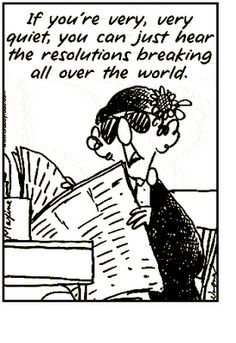
Exercise more .. or less .. Gym enrollment peaks in January/February each year in the U.S.  


--- Maxine

Sale of exercise equipment reaches a crescendo in December, and then .. the best time to buy them is:

"And though you’re likely to see the deepest discounts in January, deals may well extend or revive in February. About 80% of Americans ditch their New Year’s resolutions by February, so you have potential to buy recent returns that are priced attractively to resell. In addition, more retailers are participating in Presidents’ Day sales events—so fitness gear may be on sale then, too".

--- NY Times "Wirecutter"


I mentioned in an earlier blog that weight gain is primarily a First World concern and a pesky problem for some. Weight loss in extreme cases can become an obsessive burden - mentally and/or physically.  In underprivileged countries, weight gain is a welcome symbol of high status, a visible sign of plenty.  It is a mother's wish for a growing child. 

In the developed countries, at every start of a new year a collective gasp can be heard:


But, to be fair, there is a fine line between being overweight and under-height  😎.  But is it fair that for a creature that swallows its food whole without chewing would be the epitome of "slim and slender" - namely, the snake; while a long distance swimmer that is the blue whale that can swim  between Alaska and Hawaii has little to show for a waistline? 

And there is no truth that there is a talking scale, when strained, will say, "Step on the scale one person at a time, please ".  Or, the one that says, "Surely you knew that a pound cake really weighs more than one pound, didn't ya?

Maxine has another statement:


Where does this leave us?  "No more new year's resolutions!"  You see, even Congress that passes all kinds of resolutions, is never accountable for any of them.

A more appropriate summation, perhaps, is that in the course of a year, "we gain some, we lose some".  We gain more knowledge, maturity, deeper insights, and who cares if we gained the dreaded pound or two?  We gain as in more money saved, or lost as in the devaluation of our savings in one form or another.  We gained a friend or lost one; sadder when we lose a loved one.  

We can plan, we can dream even. We can work towards achieving something new or different.  We can aim.  All of these do not need to be resolutions. They can be in the category of just simply living a life.


Tuesday, January 16, 2024

One Flu Over the Cou-Cough"s Nest

I can make light of it now.  But not over two weeks ago.  (My apologies to the producers of the classic Jack Nicholson movie, "One Flew Over the Cuckoo's Nest"). The New Year, starting on the eve of the 31st, ushered one of humanity's oldest punishers to visit and  inflict a successful invasion into one's physiology (namely mine) that from long ago had already forgotten what it was like to suffer from it.

Ordinarily, coughs and sneezing do not necessitate a doctor's visit.  Two days and nights of chills and achy joints will.  

After a 30-minute wait for the lab results the doctor came in, "I have good news and bad news.  The good news is that you do not have Covid.  The bad news is that you have the flu".

"How is that possible, Doc? I had the flu shot as I always had annually for over a decade now between Thanksgiving and the start of winter".

"Well, it's not always a 100%. Look at it this way.  Your symptoms could have been worse had you not had your flu shot." He replied. 

Since I had the lab test and was prescribed medications (2), I made it to the CDC statistical data bank.

From October, 2023 thru Jan. 6, 2024, CDC estimates said that there were 14-26 million cases of flu. I was one of 12 million who went to the doctor, but not one of 320,000 who had to be hospitalized; thankfully, not one of as much as 28,000 who did not make it through.  CDC states that these are estimates because it has no way of capturing all the cases. Take it for what it is - one of a few annual cautionary tales about this or that seasonal contagion.

This invasive visitation requires re-visiting the age-old question: Is a virus a living organism?  If not, what is it really? There was not a whole lot a flu-sickened person can do but to immerse oneself into the hidden micro-world of these tiny creatures.  

The Invisible Body Snatcher


Yes, indeed!   Standard light microscopes, using only natural light and a lens to magnify tiny organisms were all that were needed in 1675 when Anton van Leeuwenhoek invented the first device.  Bacteria for the first time was revealed. But it took another three centuries before scientists could have a grainy picture of the "invisible" virus. Viruses are so tiny that it took cutting edge microscopy to get a glimpse of it, namely, the electron microscope.

Whether a virus is a living organism has always been debated.  It does not fit the standard definition of a living entity because it is not able to reproduce on its own and it does not really metabolize nutrients like every living thing is able to do.  Below is one unique description by a research paper from the prestigious Cleveland Clinic.

"A virus is a small piece of genetic information in a “carrying case” — a protective coating called a capsid. Viruses aren’t made up of cells, so they don’t have all the equipment that cells do to make more copies of themselves. Instead, they carry instructions with them and use a host cell’s equipment to make more copies of the virus.

It’s like someone breaking into your house to use your kitchen. The virus brought its own recipe, but it needs to use your dishes, measuring cups, mixer and oven to make it. (Unfortunately, they usually leave a big mess when you finally kick them out.)"

It is not a parasite the way parasites affect their hosts.  But a virus is the ultimate survivor, a true alien invader and very resourceful at adapting to its environment for something so invisibly tiny.  How tiny?

A human hair is 75,000 nanometers; however, one nanometer is only  a billionth of a meter.  A virus is only 120 nanometers. Roughly, a virus is over 600 times smaller than the width of a human hair.  But how can it cause so much damage to animal physiology (birds, monkeys, humans, etc.) billions of times bigger than it is?  And why does it try to and at times actually does destroy its host?

Indeed, why?  It is both a scientific and philosophical question.  Let's set that aside for now.

Not only have we coexisted with microbes throughout our evolutionary journey for thousands of years, tiny organisms occupy our entire body, inside and out, and our very survival depends on over a 1,000 different species of trillions upon trillions of them residing on our skin, mucous membranes and in our gastrointestinal tract and gut. Not only do they present a barrier against harmful organisms, they actually synthesize vitamins and breakdown food into absorbable nutrients but stimulate our immune systems as well.  These organisms are so tiny that in sheer number (not by weight or volume) there are ten times more of them than there are human cells in our body.

We've cultured, synthesized, developed antibiotics against bacteria but not against a virus. But we can "train" our immune system to recognize, neutralize and attack viruses through prior exposure.  Exposure means our immune system recognizes the invader once an earlier assault was thwarted (and we survived that attack); or our immune system is exposed to a weakened strain of the virus in vaccines which  equates to a controlled exposure.

Interestingly, genetic researchers discovered that the human genome contains genetic codes associated with viruses in our distant past developments.  It is not too far fetched to conclude that in some ways or another, viruses may indeed have contributed to our development as a species. It would seem that our immune system today is what it is because  generations after generations of warfare and battle experiences have produced a standing army of reservists and veterans (whose traits, training and resolve became part of their nature) ready to defend. Or, like Spartans retaining the tradition of courage, physical traits and bravery handed down from parents to offspring, fathers to sons over generations of tradition. Okay, I was too over dramatic there but lightheadedness from the meds will make one's mind wander off. 

One important question is how does the virus manage to get through?  Is a virus a Trojan horse? 

Viruses actually have an easier entry than Homer's depiction in the Iliad of a giant wooden horse filled with Spartans left by the Greeks that the Trojans brought inside their fortress.  

Cold, flu and Corona viruses enter into our system as easily as we breathe in, as if by invitation. There is no quicker way to get to our circulatory system than through our noses, then into our lungs and through our blood stream.  Cleverer entry is via a hypodermic needle of the mosquitoes' proboscis through the pores of our skin, as in Malaria and dengue fever invasions.  The AIDS virus can literally be transmitted via an actual hypodermic needle in blood transfusions.  So, there it is.

New studies have postulated a new insight (new to me anyhow) into why colds and flu show up during the cold weather.  Supposedly our first line of defense relies on the warm interior of our noses and mucous membranes for our immune cells to work at maximum level for total readiness in combating microbial invaders. Exposing ourselves to the cold weather outside reduces that temperature that makes our immune cells weaker than usual. Viruses may enter through the air or, i.e., through door knobs, for example, and the moment we have our hands touch our noses, a few viruses can gain entry to do their mischief. We can take that theory with a grain of salt because viruses spread as easily in tropical weather and in relatively warmer climates.  We don't know what to conclude.  But  mothers have always warned about children and adults staying too long outside when the weather is cold.  And hence, the common cold illness.  You, the reader, be the judge.

Now, is the virus a living entity?  Not if we look at it from the perspective of how we define life.  It is just an entity, a genetic code, precluded from being a living cell. But it depends on a living cell to propagate itself. 

We can go off-tangent, and I mean really off-tangent. It is not just a survivor, it can lay dormant for years in any organism's lungs and when the conditions are right, it activates itself.  It can also move intra-species, as in the AIDS virus jumping from monkeys to humans, or the bird flu, or for Malaria transmissions via mosquitoes and microbial transfers from tsetse flies to humans, etc.  It is off-tangent to think that a virus is an extra-terrestrial invader.  It can survive under harsh conditions, it can mutate to fall under the "radar screen" of our defense system and what a clever way to replicate itself by tricking our own cells to make copies of itself.

However, the virus can also be deemed to have helped us along our evolutionary journey.  There lies the ambivalence of the nature of the virus. There also lies the conundrum for those who believe in The Creator, when asking the purpose of creatures deemed harmful to human life can lead to philosophical questions that will ultimately challenge one's faith.

On the other hand, for those relying mainly on the principle of the greatest good for the greatest number, the virus can be viewed mainly as an accessory to our development, except for the collateral hurt to the few, relatively speaking, for the greater good of the many.  The argument is that despite all the pandemics from the bubonic plague to the Spanish flu that killed millions, the human population is now at 8 billion from when it was a mere 450-475 million, that was drastically reduced by about 50-75 million after the plague.  Some people argue that viruses and bacteria may have killed so many but the survivors were made strong as a result.  And who knows before written history, how many virulent visitations had occurred without really hindering population growth.

Life has and has always found a way to survive. We are not equipped to fathom the mind of The Creator but to accept, if we adhere to the concept of creation, the idea that creatures great and small  each has a purpose we can never fully understand.