Friday, April 22, 2022

Electric Shock

As a blog-writer of average skill and talent I love this two-word phrase.  It is a rich source for analogy; a base root from which one may grow a cluster of metaphors.  But I will try not to over harvest it.

In California - where else - there is one public agenda, "Under a proposal by the California Air Resources Board, the state would require 35 percent of new passenger vehicles sold here to run on batteries or hydrogen by 2026. To give a sense of scale, in 2021, 12 percent of new car sales in the state were zero-emission".

"The proposal would gradually raise the sales of zero-emission vehicles—electric, hydrogen-powered or plug-in hybrids—to 100 percent of new vehicle sales by 2035."

"The proposal would also ban new gas-fueled cars by 2035, although it would not be illegal to own or sell a used one after that".  Now, what does that really mean? If it was meant to take a huge bite into the air pollution debate in the Golden State, it is about as toothless as a baleen whale.  But it will be one whale of a conundrum for the tax paying commuters of the state.

The electric shock will be real to the average California driver if this were to become a legislative reality. However, why should the rest of the country or the entire world be concerned with what happens in that state? Given the "right gestation" period, it could spread like a runaway infestation, couldn't it? 

The average cost of the five cheapest electric cars in 2020, way before today's inflationary levels, was $33,000.  Tesla's Model Y and 3 will set the consumer back by $40-45 K, plus tax and a higher insurance premium.  Who knows what these prices will be by 2035.

The electric shock to confront the California tax payers begins at building 250,000 charging stations (presently 80,000) state wide; charging stations that will be fed from existing power grids that get most of their electricity from power plants that run on fossil fuel (natural gas and coal and a small percentage from nuclear power).  That is shocking.

Even more shocking is that solar and wind power will barely get the state into clean energy independence.  Not by a long shot and clearly not even long after 2035.  So what is this electric car initiative going to do for the state? Image.  

Image, created by and for those obsessed with climate change but oblivious to those among them who are least likely to afford the price of electric vehicles.  On average, the second car in a two-car family in California is likely a used car (called for when a son or daughter gets a driver's license; a second wage earner; for the soccer mom, etc.) because two new cars are a huge burden, when you take into consideration the price of homes, gas, higher cost of living, and now inflation.

Clearly that proposed initiative for electric cars is almost detached from the realities of the average family condition. One may grant that the proposal was done with robust introspections by the esteemed proponents of the initiative, but one would be wrong.  One may even conclude that such a move by the Board and, possibly, later by the State legislators is likely one that is unencumbered by logical thought.  Significantly, that would be right! 

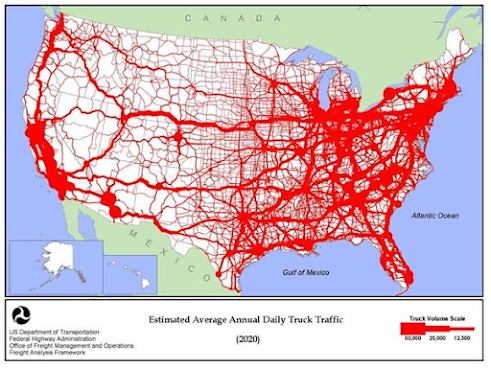
Please inspect the image below.  They look like blood vessels, each section a segmented artery. Staying with the analogy, the entire network is the lifeblood of the U.S. economy.  More notably, however, it represents the daily annual truck traffic - 18 wheelers and delivery trucks, including  vehicles that haul our trash.  One must also include ambulances, firetrucks and emergency vehicles.  Don't forget tractors, graders, harvesters, mining vehicles, etc. Should we aim for them to run on batteries and hydrogen fuel cells as well?  Note how heavily red is represented by the state of California (left of the chart).
How about those coming from producers of the largest carbon footprint in use today.  45,000 daily flights over the entire country.


Image.  If that is what we need to focus on, then we are highlighting a portrait detached from reality.  The taxpayer who help pay (most of it) for the roads and air traffic infrastructures are asked to sacrifice the most.


Webster Dictionary defines climate: the average course or condition of the weather at a place usually over a period of years as exhibited by temperature, wind velocity, and precipitation. 

These are questions we need to ask at the same time that we acknowledge that climate change is real. 

Lest we forget, from the above definition, the central over riding component of climate is weather.  As real as the weather is, climate change is real but we must put it in that context and a frame reference that encompasses millions of years of climate changes and evolutionary adaptations among organisms.  But from that to segue the change into an existential threat in the timeline that activist proponents claim is a huge jump from what is real to unhinged alarmism.

Let's ask these questions first.

Is it not better to focus more money on research and initiatives to make combustion engines to run more efficiently and cleanly?  There must be more that can be done first before we go all in with all bets on electric vehicles. Combustion engines last a long time.  EV batteries and electric motors do not and the issue of the amount of waste in disposing them is not fully known. Most lithium and other elements for batteries are mined in hostile places and under horrible labor and human conditions. Wind power is at best erratic, kills a lot of birds (including endangered ones) and the jury is still out on its effects on the environment and wide swaths of land allocated and sea lanes appropriated for locating them.  Solar panels use up a lot of rare earth elements as well and disposal of old components past their useful life (how long is not quite known yet) has not been addressed.

Meanwhile, we have made cleaner fuels, better and more efficient internal combustion engines.  We eliminated leaded gasoline, made cleaner burning engines by eliminating carburetors, switching to fuel injections and now to direct fuel injections, catalytic converters, computer managed engine and transmission systems, lighter engine and body parts, etc. Funding increase in research and development is likely to usher additional efficiencies.  As it stands, the U.S., Canada and western Europe have by far cleaner air due to those developments.  Unfortunately, the two largest countries of about a billion each that rely on fossil fuel to run their industries have the most polluted air and water.  Add to that the other surrounding countries getting more involved industrially in Asia, and the world is faced with an ever burgeoning problem with air pollution. 

How about privatizing the mass transit systems. Amtrak has not had a black-ink year in decades.  How about the U.S. Postal Service?  We didn't know how inefficient and budget draining their service is until we saw how Amazon and other internet sellers showed us. We didn't know how NASA overspent taxpayers money until Elon Musk and Jeff Bezos launched SpaceX and Blue Horizon within budget and in time.  It is about time we end the legendary mishandling of taxpayers money by the very government that pushes the climate change initiative down the throat of ordinary citizens.  There is enough that can be saved to fund research into much safer, compact nuclear power generators. Nuclear powered submarines and aircraft carriers have proven the power capability of small reactors that can clearly power small cities and towns. An aircraft carrier can go for months without refueling, yet 5,000 military personnel , enjoy unlimited energy to maintain a small-size town, including unsurpassed capability to launch aircraft anywhere in all the seven seas. 

Climate utopia, if ever there is going to be such a thing, can never be a localized phenomenon.  A "clean" North America and western Europe are of little use on a globe that circulates the same air over and over.

The entire planet is better served to help those regions that need it most in improving their path to cleaner industries.

The planet had survived eons of climate changes, organisms survived and thrived due to evolutionary adaptations far more powerful than we can ever imagine.  Here's a quick look:

The evolution of the atmosphere could be divided into four separate stages:

1. Origin

2. Chemical/ pre-biological era

3. Microbial era, and

4. Biological era.

The entire solar system is approximately 5 billion years old, give or take a few million.  The Biological era (humans and oxygen breathing organisms) came only during the last 2 billion years.  Our ancestors did not even show up until the last 100-200,000 years.  During all that time, all organisms (plants and animals alike) went through millions upon millions  of changes, each subsequent change due to mutation and adaptation resulted in better suited life forms.

Shockingly, those that survived and thrived did it in the absence of climate activists, alarmists and unnecessary legislation. 

What is needed is sane, well thought out legislation or regulation to pave the way to cleaner atmosphere for the entire globe - not just California.  Now, whether we like it or not, the planet is indifferent to our meddling - well intentioned or not.  We may be saving ourselves but we cannot be too presumptuous as to say we are saving the planet.  Earth can take care of itself as it had for eons, long before we were even here. The planet will be here for quite a while and we are merely temporary occupants. 


Wednesday, April 20, 2022

It's Hard Not to Blink ..

I was settling down at the eye doctor's exam chair when she noted that the nurse took several tries to get the eye scan done on me previously in the other room. Indeed, that was true, because apparently the chore took longer than the usual number of attempts to get it just right.  The eye scan is an eye exam device that is non-contact, non-invasive, except that the patient must sit still and not blink.  You'll hear the refrain of the nurse's constant admonition, "okay, now take a breath, blink twice, and now, don't blink". This is so she can get a high resolution 3-D microscopic cross section photo of the eye. I thought she came close to the point of exasperation, as in a photographer using up an entire roll of film (ages ago when cameras still used film) to get a couple of still photos just right.


I commented back to my doctor that, "It's hard not to blink when you're told not to blink". She burst out laughing like that was the funniest thing she heard that day.  She said, "I know what you mean but it's just hilarious that you phrase it that way".

In my defense, if there is one, it's not easy to sit still with your chin set tightly against one of two chin rests, hunched forward, and to remain focused on that green cross hair that is located on either corner of the video screen.  And do it again using the other chin rest, focusing on the mark now located at the other corner. This test is done once a year, together with a session with the phoropter - for refractive error and prescription. Quarterly and no less than every four months, I get a regular session with the tonometer. "A tonometer measures the pressure of the eye by very gently touching the cornea".

Before I go any further, as a  public service message to the readers, please have a regularly scheduled yearly eye exam, especially for anyone past his or her 40th birthday. Today's routine eye exam screens for cataract and glaucoma - number one and two main causes for blindness, in that order, later in life.  Yearly screenings will catch either one in the early stage and both can be corrected either with eye drops (for glaucoma) or simple out-patient surgery for cataract.

Now, why is it so difficult not to blink; especially when told not to.  Well, physically it is impossible not to, because it is one of those near involuntary reflexes, since "blinking releases a tear film — which mostly consists of water, oil and mucus — to keep the surface of the eyeball smooth. It also prevents the eye from drying out, which can be uncomfortable". 

Blinking is naturally counterweighed by staring.  Oddly enough there is such a thing  as a staring contest and the record, so far, is 40 minutes and 59 seconds. I know you are now, right at this moment, actually staring at this page to see how long you can keep doing it, then you quickly realize it is not easy not to blink.

When we are faced with all the bad things that occur around us, by rising crimes in some of our cities, unprecedented squalor in our neighborhood, atrocities of war in far away places like Ukraine, it is hard not to blink. But we know blinking does not change or erase anything away.

"How many times do we blink in, say, a day? Researchers apparently spent a good amount of scientific funding into just that.

900 – 1,200 times an hour

14,400 – 19,200 times a day

100,800 – 134,400 times a week

between 5.2 and 7.1 million times a year

Each blink lasts between 0.1 and 0.4 seconds. Given how many times the average person blinks per minute, this makes up about 10 percent of the time you’re awake". 

Astoundingly, our brain does not "record" all the blinking we do because our memory of every day is a seamless panorama, whereas a computer or camera will have seams that delineate images between blinks. Probably not much of anything, but it's good to know.

Now, we segue to something else. 

It is not easy not to worry too when you're told not to.  In fact, it seems that the intensity of our worries is directly proportional to how much and how often we're told not to worry. An adage says, that the less we know about something, oblivious even, the less we worry, or not at at all.  Some of us will go as far as to say, "I don't want to know" - as a near perfect insulation from worry.  Or so it seems. That is because for some, the conditions that brought about, "I don't want to know", in the first place, are what purvey the paths to worry.

Children - humanity's ultimate carriers of happiness (until they reach adulthood, of course) - have the least of worries because they still know so little, and what little they know about what to want is the key to their happiness.  Notice though that they may blink a lot when they're excited and they stare when they are awed; either way, they look cute.  We lose that as we age.  Recovering that childlike state of mind might be the ticket we all could use.

The less often we convert what used to be mere "wants" suddenly into "needs", the less we worry.  In fact, the less we search for what we think we will want, the less we become needful of them (whatever those are).

And I say,

"The state of Happiness is at its greatest maximum when worry is kept to a minimum".


Saturday, April 16, 2022

Musk Oil Named Elon

There is so much going on, the average consumer of news is inundated with a cacophony of input from so many sources.  24-hour cable news and entertainment, social media churning 24/7; yet, it seems, people are likely to be ill-informed. "Ill-informed" can simply stem merely from too much of one side and little else from the other. From so many, there's too much, yet so few are of little value from the perspective of a truly functioning democracy.

"Musk was a name originally given to a substance with a strong odor obtained from a gland of the musk deer."

What do we have here? A source for countless metaphors, for one. Musk oil, long before it was synthesized from other material, was originally a very expensive source for the perfumery business since it meant killing the musk deer. Later, it included other animal sources to extract a substance to be used as a carrier of inducing scents, albeit for no other purpose than to smell fragrantly attractive to another.  However, it was also at one time used to attract wild animals for hunting. At one time tigers were lured with musk scents. On the other hand, if one were a hunter, he or she is discouraged from wearing  perfume or cologne on a hunting trip, lest their intended prey will sense them long before they can come close to unleash the perfect shot.

A multi-billionaire named Elon, with a last name Musk, is raising up a stink in the media world,  at a place symbolically imitating the sound of a bird's tweet. Twitter,  phonetic play or not, is accurately imaged however:  


The social media giant appropriately symbolizing a tweeting  little bird was meant to be a sounding board for anyone and everyone, wasn't it?  Like the bird's tweet, wasn't it meant so it can be heard by anyone and everyone, from everywhere? I do not  have either a Twitter or Facebook account so I am just another bystander asking a question.  What is all this stink churned up by a man named Elon, with a last name, Musk?

As metaphors go, it seems like a fly just landed on what used to be one smoothly spread ointment called Twitter.  If it is true that Twitter had also become a censorship platform, denying the participation of those whose ideas and opinions are contrary to the one espoused by the few in its leadership board, then perhaps they are only to blame for attracting an unlikely fly on their ointment.

Seven years ago I wrote, "When Rattlesnakes No Longer Rattle", but today it seems like one cannot be silenced anymore.  A quick quote from what I wrote then:

"Now we have a moral lesson – a metaphor of a sort in social and political discourse.  One of democracy’s most important attribute is freedom of speech.  It is because a democracy works when all sides are heard, discussed and decided upon by the people.  It ceases to be one when a monolithic voice takes over because that almost always happens when the government turns into a dictatorship that strives to silence any and all opposition.  It comes either from the persecution of the press or the press becoming an ally to restricting the voices of dissent with the aim towards the final eradication of anyone who opposes the prevailing ideology.  It works badly for either side of opposing ideologies when one tries to suppress the other’s ability to express".

I warned further,

"When one ideology prevails lopsidedly over another, the danger is that the latter will lose its ability to rattle.  The silence will have serious repercussions.  A monolithic society or government will always turn into an indivisibly and inflexibly oppressive aggregation of people when reason and dissenting voices are diminished if not entirely silenced.  That is a dangerous condition.  Whoever is in power must be aware that silence does not mean the demise of an opposition.  It must understand that it is easier when opposing voices are heard – not just for the logical reasons – because that is the best way to understand and know them and perchance to work with them (one can only wish).  Worse than hearing the opposition is the silence that percolates underneath.  History teaches us that political power changes hands, dictatorships are toppled and ideologies change or evolve   even amidst every effort to silence the opposition.  Worse than hearing too much out of the political and sociological discourse is when one side no longer rattles".

We can't probe, not accurately anyway, into Elon Musk's motivation to first buy up enough shares of Twitter to become its single largest shareholder or his now recent offer to buy up the whole caboodle. One thing he did make clear was that he would let Twitter become a true sounding board for everyone, without censorship. We can take his word for it, the same way most folks took Jeff Bezos' words when he bought the newspaper, "The Washington Post".

It is possible too that Elon Musk merely did one clever business jujitsu to raise the value of his investment.  One thing, for sure, it would seem, that to expect Twitter board to sit still and not create a defensive wall from a Musk takeover, is to expect that Musk will abandon SpaceX to probe the heavens.

But let us not perish the thought that censorship of free speech is the beginning of the end of democracy.


Saturday, April 2, 2022

Our Greatest Fear Should Be Here

Whenever we see each other I have this almost always interesting conversation with Sam. That is his anglicized name when he became a U.S. citizen.  He came in the late seventies from China as one of a select group of a hundred or so young Chinese students  accepted to come and study in the U.S., under the auspices of the State Department, in line with the Nixon administration's diplomatic intercession for China's inclusion into the world's stage, politically and economicallySam became an engineer and stayed and worked here after graduation.  He is retired now and a very vocal critic of the Chinese government.  He makes his opinion known loudly to anyone who'd listen and woe to those who'd dare say good things about the regime of his old homeland.

We both swim  at the local gym but we see each other only sparingly.  Yesterday, I opined to him that it looks like China might invade Taiwan.  His immediate response was, "Nope, that's not going to happen". He was willing to bet some amount of money that there is no chance of that happening. He went on to enumerate many different reasons why, not the least of which is what is happening to the bogged down Russian invasion of Ukraine; the  immediate world wide outrage that followed; the fact that Taiwan is a lot more militarily prepared and the Taiwan Strait (also called Formosa Strait) that at its narrowest gap between the two coasts is at least a 100-mile treacherous strip that is essentially still part of the Pacific Ocean that could present problems to naval crossings. There is also, of course, the semi-formal commitment of the U.S. and Australia to defend Taiwan from invasion (however, soft or "hardly cast in stone" that commitment is). Add to that the uneasiness Japan and the other ASEAN nations feel about it and the added concern for a potential domino effect on the region.  China also risks its commercial and trade relations with the world at large. We should keep in mind that China does not have oil or some other natural resource that it can leverage like  Russia has over Europe. China's best advantage of cheap labor is at best tenuous. Think Vietnam, Cambodia, Indonesia, India and Bangladesh, The Philippines and others which are only too willing to take up the "slack" if the need or circumstances arise.

Sam, however, told me that what we should really worry about is what is happening here. Now.  "Our greatest fear should be here", Sam said with his index finger pointed downwards toward the ground. And he had a litany of "this and that" that we in the U.S. should worry about by first looking no farther than the natural state of the union. "What union?", Sam asked rhetorically.


This country is almost inextricably divided politically, socially, sociologically and culturally, Sam observed. 

So, is Sam right?

Well,  politically, for sure, this country is most certainly 50-50 divided. But that division now runs so deep that friendships, the work environment and even family interactions have become painfully untenable. A far cry from when people used to be able to tolerate the differences without affecting their overall relationships. The chasm has widened. Gone is when people with varying political persuasions can go to lunch, play sports, go out for drinks after work together, each other's opinion freely spoken and tolerated. That had become more of an exception now.  Even in large gatherings, people tend to immediately gravitate into globular clusters of people with the same minded beliefs and ideas.

Political differences have always been around since the birth of democracy. In fact, it is an essential component.  Where it becomes a problem is when people are so dug-in that opinions and ideas become inviolable dogmas. This condition negates the idea of meeting in the middle. Each other's "way or the highway" does not tolerate meeting halfway in the middle. Political parties in power, whether locally or nationally, aim for total control of the agenda.  That is how the seed to totalitarianism begins to germinate.

That is just one beef Sam has on what is going on. There is a fracturing of America's social and cultural backbone.  Long held values of family and civility are eroding right before our eyes.

What seemed like an easy question about "how do you define a woman" now appears to be so complicated.  A Supreme Court Justice nominee found that so difficult to answer, falling back on, "I am not a biologist" retort.

Women have come a long way to breaking all kinds of social and cultural barriers only to hit a staggering stumbling block, more powerful than the corporate glass ceiling, in women's sport.  Sports history is being written about how women athletes are losing in unfair competition to competitors who were born male.  Women's track and field and swimming records are being broken by biologically male athletes.  Where is NOW, the National Organization for Women.  The silence is deafening when they used to be the loudest and very effective advocate for women.   

High school girls and college women had seen decades of their opportunities and equitable rewards elevated  to unprecedented heights never seen before only to be dashed by unfair competition from those who shouldn't be in the same playing field.  How many young women's dreams of future scholarships or even just the chance to make the team will unravel because they would lose to the superior strength and speed of biologically male competitors.  

What is happening?  "Woke-ism happened.  The Supreme Court nominee and NOW were intimidated by a sinister force used and applied but never acknowledged by those who practice and employ it.  It is so subtle, yet powerful, that it would only take a handful of voices and keystrokes on social media to intimidate otherwise strong willed individuals and powerful corporations, and even seasoned politicians to cower in fear.

Disney that used to be the steady platform in entertainment to espouse the old traditional values of family and moral certitude is the latest to declare open city to the woke crowd. Disney now finds it necessary to do away with "boys and girls", "ladies and gentlemen" in welcoming its customers or announcing what's next in the program.

The country's politicians and businesses are now so mired with gender multiplicity that they are willing to sacrifice the rights of the majority, who are clearly and simply identified as male and female, on the altar of the woke faith.  Look at the following quote below, from one study:

"The estimated proportion of gender-diverse individuals (those who are not cisgender) varies between 0.1 and 2% of the population, depending on the inclusion criteria and where the studies were held."

The backbone of the U.S. and all other nations are 98% of the traditional male and female classifications  In other words, the country's economy that produce goods and services, the national provision for its defense and security are pretty much carried out by 98% of the population.  Yet, a lot of social changes are now geared towards appeasement of and bending over backwards to accommodate the 2%.

It is one thing to be tolerant and accommodating but it is another to be practically subservient to the minority.  Long strides have been taken to protect the rights of minorities, including those who identify with non-cisgender identities, and laws are in the books to ensure it.

This is just one of those that worries Sam.  He worries that the government now allows "X" on the box for gender in U.S. passports. Ironically, since women inherit only the X chromosome, so facetiously, in a manner of speaking, anyone who will mark their passport X, is for all intents and purposes a woman.  Just saying.

So, where did this leave Sam? He finished our conversation with a defeated shrug.


Sunday, March 27, 2022

Year 2113

It was the year of the Great Revival, following the Great Survival. It was to replenish the earth.  Replenish it of every life form possible - plants on the ground, fish in the waters, birds and insects in the air; and people, of course.  The last great war happened in 2067. 

The tragedy of wars was proven once again but the greatest tragedy of all are all the wasted lessons written on the pages of history. Is it because history is usually written by the victors?  Or, is it that victors soon forget but the vanquished, never? Or, is it the viciousness of the cycle of history to blame? Is it that defeat is not soon forgotten by the vanquished while the victors fog their memory so quickly with the sweet nectar of euphoria from victory. Victors always forget that winning is always temporary.  

Whatever is the story, one thing is for certain. Not a century had passed during the last six thousand years of recorded history when there was no human conflict of some kind on the face of the earth. Below is just what foreign policy experts are watching at the present moment. The proverbial Biblical listing of "wars and rumors of war".


Then,  we are met with:

The New Geography of Conflict

Michael T. Klare

Foreign Affairs
Vol. 80, No. 3 (May - Jun., 2001), pp. 49-61 (13 pages)
Published By: Council on Foreign Relations

Abstract

"As last year's global shortage of petroleum and natural gas showed, the world can no longer keep up with the demands of continued population growth and economic expansion. Indeed, the competition for natural resources is intensifying. And with four-fifths of the world's oil reserves lying in politically unstable areas, with diamond and timber wars already raging in Central Africa, and with many regions suffering persistent drought, resource competition could easily turn into open conflict. Governments now see the acquisition and protection of natural resources as a national security requirement--and one they are prepared to fight for."

Back to "whatever  is the story", where all existential threat that we  worry about, none can be more devastating to life and property than the outbreak of a war.  Whether it is a limited war or one that encompasses territorial boundaries, the tragedy is frightening to contemplate; to experience it is direfully horrifying.  Along with the physical pain for those who survive is profound mental anguish that is almost impossible to assuage.  A nuclear war is unthinkable even from the most hawkish of politicians and pundits.

Added to that are threats forced upon us since the 70s, when we were warned about destroying our environment, when in 2010 we were told we had just twelve years before the catastrophe of climate change will be upon us.  Rising sea level, melting ice caps, flooding, drought, diseases, crop failures, etc. - all manifestations of our profligate use of fossil fuels, we've been told. Failed prophecies were unclaimed except that new ones are hoisted upon us once the prophets were proved wrong with such "inconvenient truths".  Again and again.

From the italicized quoted paragraph above we see instead the need for fossil fuel to sustain each nation's economy and the commercial demands for it that will persist for decades to come.  The debate continues without resolution because each side, however many sides there are, will always be only partially right.  The war on fossil fuel is not only unfair, it is not winnable.  On the other hand, an all out assault on renewable and alternative sources of energy is also a fool's errand.  The failure to compromise, lest we forget, dooms all sides.  The political rhetoric on a campaign to win votes by promising to put the oil industry out of business is an outright lie to win an election. And on and on it goes. 

Let's zoom out from here and out into the far reaches of space, as far as we can imagine. Imagine an observer from somewhere out there looking into our spot in the universe. All they will see is a swirling smudge of light.  


Our entire solar system is represented, generously I might add, as the red dot half way up along  the center vertical line (image below).  Earth is on that red dot. If the observer is told that inhabitants on that little invisible dot do not get along for some reason  and every now and then they resort to killing one another, they will find the tragic pettiness of it all.  


You know, let's imagine that we are at the place of the observer looking back at us.  It would be the same sad image that we will see.  Indeed. Yet, back to where we are today, up close on television, we seem to have become numb from the daily "breaking news".  What of the people and children and the elderly up close to where it is happening?

It is sad indeed that this tiny flotsam of a habitat in the context of the entire universe, inhabitants do not get along.

So it was in 2067 when the Great War begun. Unlike the previous wars, it ended quickly.  In less than a year it was over.  And there was no visible victor but losers all.  

There were survivors. There were those from above the foothills of the Himalayas, the interior rainforests in Brazil, and scattered along island chains in the Pacific, and remote areas of the Arctic.  2113 plus a thousand years later and the Great Revival was well established. By the six thousandth year, the world had become like it is today.

An absurd scenario?  Yes and No. Yes, by the story we've always known about how the last several thousand years went.  No, if by then, as if by some miracle or by the much hoped for Divine intervention, future generations did at last learn.

It is up to us the living who see it today to make sure that those who follow will be on a path away from 2067 and find 2113 an unnecessary chore that future generations have to endure.


Wednesday, March 23, 2022

Confessions

It is time to finally put in writing the things I've always wanted to confess about.  Or, should it be "to confess to"?  At this particular moment in time it is with effortless eloquence that I am able to say, "Does it really matter?" That is, of course, a far more polite version of, "Who cares?"  What am I talking about here?

Well, I wanted to make the reader guess with a few tantalizing clues. For example, I'm still in my pajamas. What's so remarkable about that? Well, it's 10:00 a.m.  And it's Tuesday. I can't be.  What? 

If you're reading this instead of a memo from your boss, you need to stop now; or, if you're mulling over a packed itinerary for a dreadful business trip on which your boss decided to tag along because he wanted to meet with your clients, some of whom you're not on a first name basis with, or worse, some don't even really know who you are, then close this page; or, reading this instead of the latest packet from HR that is required reading for the next sensitivity training where your attendance is absolutely and unconditionally required, then perhaps you had better focus on the reading material.  That is because  you're still at work, and if you must insist on reading this, then you had better be bullet proof.  Otherwise, for now, make sure you remain employable. Or, at a bare minimum, try to keep this job. Remember that if it's Tuesday and it's 10:00 a.m. and you're reading this, it is the moral equivalent of a bureaucrat reading a subversive material in Moscow in the 1950s that could result in a hasty train ride to Siberia. Or, it could be more severely punishable if you were reading this during your 15-minute break at a factory in Guangdong during the Cultural Revolution.

You know why? You're at work and you need to stay employed.  By the way, "bullet proof" only means that you are fully vested in your pension plan and that your Individual Retirement Account is to be envied by any financial adviser worth his or her salt. And you're literally months, or better still - weeks - from getting that retirement watch or some kind of memento they dole out these days commensurate with your rank and seniority in the proverbial corporate totem pole. If you are that bullet proof, then keep reading.

To the other readers: If you are like me, and unless you're planning to go somewhere, PJs and bathrobes can be normal apparel till lunch time, slippers are optional accessories. That's because, like me, you too are retired.  

To all currently employed, you had a taste of this, albeit temporarily, during the Covid lockdown.  Those pajama days are now over. Time to get back to work and insure that Social Security remains solvent; at least, for it to stay afloat for the foreseeable future of at least ten more years.  That takes care of all of us - the first and last of the baby boomers.

But what's with the confession? Sometimes, it is about guilt.  I retired on the month of April (been years now since) - and it was a particularly rainy month.  One morning, it was probably 5:00 a.m., I woke up to some distant thunder that seemed to roll ever closer like a herd of stampeding buffalos during a Serengeti migration. Then, it started raining.  Buckets. I forgot to turn off the alarm radio - again - that is tuned to the local station. It was the weather report, "We have a weather advisory. It is unseasonably cold this morning in the mid 50s and wind chill in the 40s and we expect all-day rain and thunderstorm .."  I was still half awake and dreading the prospect of having to drive on a day like that.  Then, suddenly like a lightning flash that had been getting through the blinds, I realized I didn't have to go to work that morning.  Or ever again! 

Now, you know what it is to be both feeling guilty and ecstatic at the same time.  I warned you dear reader.  If you're at work reading about this, you were warned.  I felt bad that you had to go to work today.  Drenched. Miserable too because half your co-workers didn't come to work.  The half that heard on the radio about school closings and potential widespread flooding.  Oh, well.

But it is not all that rosy for us retirees. I have nightmares.  Other retirees have confirmed this phenomenon. The dreams are vivid. I am about to make a presentation where high ranking execs will be in attendance. I was not only unprepared, I had no Power Point slides or notes.  Worse, I had no idea what I was going to talk about.  Sometimes the dream is a business trip. There would be me and other co-workers  at the airport waiting area. We were about to board.  Everyone had their tickets and boarding passes. I didn't have mine. And I had no idea why. Then how was I going to manage getting one? Sometimes, it would be about a business trip where I didn't know how to get back to the hotel.  Of course, all of these are mercifully interrupted by waking up. I was in bed at home. To any armchair dream interpreters or retired psychologists, I am open to hearing your diagnosis. Not really. Well, you can send comments.

But, surely I must miss something about not going to work.  Oh, yes, naturally. I will enumerate them without being facetious. I mean, using the true meaning of "miss". I don't want to flavor it with "I don't miss" them stuff.

1. I miss the daily commute. I miss seeing my tax dollars in action  to repair potholes or  on never ending road repairs as I drive through them.

2. I miss the bad coffee at the office and the occasional birthday cake, or leftover slices of them later in the afternoon with   icing almost crusty and brittle to the touch.  I and a few hapless folks were at an all-day meeting when the joyous occasion occurred.

3. I miss the reminders for deadlines and the stress that go along with them. I miss popping the almost daily doses of Excedrin.

4. I miss searching for the misplaced restaurant receipt, the car rental and toll receipts, etc.  Come to think of it I miss filling out an expense report.

5. I miss those meetings and the drone of presentations, one after another. I miss feeling that the presentation I made was all that mattered. 😎

6. I miss the annual evaluations. And I still have a recurring question that to this day remains unanswered. Your direct supervisor makes an evaluation of your past performance. In turn he gets evaluated too by his own direct supervisor.  Your supervisor's own evaluation by his/her boss was kept from you like a state secret.  You didn't know how he or she was evaluated for competency in handling his or her direct reports.  So, if he or she  was deemed incompetent by the higher boss, would the former's evaluation of your performance be still valid?  It would be like solving a math problem via a series of derived equations. It is like using a previously incorrect equation to arrive at the following one to get to an answer.  So, you worked the following twelve months  on how to improve your performance on a faultily derived equation, rather, evaluation.  Well, it's not really that bad. The corporation you worked for is still there. The monthly pension check still arrives. But we can't help feeling fortunate because in some cases the faulty series of equations, okay, evaluations, were so rampant, we saw Enron, Lehman Brothers, Block Buster Video, many others crumbled from the weight of a faulty tower.  Indeed, some of those bosses I talked about did get to the ivory pinnacle to wreak the greatest havoc. But, I'm just musing here, not recounting personal experiences.

7.  There has to be a 7th, right? I miss the paycheck.  Well, if you did it right, thirty years of paychecks should have been enough to accrue dividends today to do or not do what your heart desires, right? And on a rainy Monday morning, specially in January, the pay is right - nil - to not have to go to  work. 

I leave it to the reader to add his or her own misses. I'm sure you'll remember a handful of them.

I started this musing yesterday morning - Tuesday - when I woke up to a rain of felines and canines - notice the fancy wordy substitutions; so you know these are all in jest - but I didn't finish it in time. Today is Wednesday. But seriously, there were Tornadoes in the eastern part of the state.

Today and for the next few days, it is going to be sunny.  Wherever you are and in whatever state of woe you are in, everything is temporary, and remember that behind those ominous dark clouds is a ball of thermonuclear energy 93 million miles away ever ready to cloak your worries away with warmth of sunshine. Blissful rays speeding towards you at the speed of .. light.


To my fellow retirees:

That is not a sunset.  It is just another sunrise. Another bonus morning.


Sunday, March 13, 2022

MAD-deningly Unthinkable

Much has already been said, conjectured, debated and feared about what happens next from one day to the next as the fighting in Ukraine continues. There is enough sadness, cruelty and pity to last anyone a lifetime of asking, "why?" Not only will we find it almost impossible to find answers, but what is most in everyone's mind is the uncertainty of what happens next.  That is the biggest unknown.  Instead, we are forced to face the MADdeningly unthinkable.  I upper-cased MAD for a reason.

MAD is an acronym for "mutually assured destruction".  There are a   few ways to look at that phrase.   Humanity is supposed to take comfort in the fact that nations are deterred from unleashing the unspeakable nuclear weapons of war because each side will most assuredly be destroyed. But we are at a point now where there is enough in the stockpile of nuclear arsenal from the handful of nations combined who have them  to annihilate the entire human race several times over. It is maddening enough and thoroughly unthinkable at the same time.

But why?  Just when memories of the cold war are almost forgotten even by those who lived through it, and clearly non-existent in the thoughts of the last two or three generations, we are faced with the stark reality that indeed none of all the so called existential threats that politicians and pundits from every corner of academia and society have warned us about will compare to the one most unthinkable possibility.

But why, indeed? I will get a lot of pushback from this musing but first I only ask the reader to bear with me for a bit.  

Just when hardly anyone can remember what ICBM stands for or that nobody might even remember what MIRV is, we are now faced with the idea that such vessels of destruction are still out there - sitting in their land based silos or cruising underneath the oceans in the bellies of nuclear powered submarines or beneath the wings of aircraft in undisclosed hangars from all over the world. Intercontinental ballistic missiles (ICBM) are bad enough but what of the multiple independently targeted re-entry vehicles (MIRV) that military euphemists tried so hard to give those harbingers of destruction a polite label. But there is no hiding the fact that a single payload can disgorge several independently programmed nuclear bombs upon re-entry into another land thousands of miles away with dead-on accuracy and devastation.

Again, why does humanity manage to get itself inextricably mired in the trajectory of self destruction?

First, let me get a partial quote from my last musing, innocuously titled Brigadoon.  I wrote about  the oldest tree in the world that had lived and still living for the last 5,000 years - The Great Basin Bristlecone pine:

The tree was a sapling right about when one of the pyramids in Egypt was completed, and perhaps over 2,000 years before the birth of Christ.

That tree, if it is tuned to what had gone on around the world since, had seen the growth of the world population, wars and pestilences, the shifting powers of conquerors and dictators, despots and notable leaders, beheld the plight of the enslaved and grimaced at the cruelty of the enslavers, and today is still a witness to what is going on in the Baltics, primarily what is happening in Ukraine and everywhere else.  Time may have stood still for that tree as generations upon generations of people had come and gone.

The tree, remaining standing still at one place, had witnessed the same theaters of war, protagonists of victorious conquerors and subjugated  peoples who fought over the same territories for centuries of repeated lessons unlearned, set aside and ignored.

Let me bring in here one of the famous generals who fought in the last world war - Gen. George S. Patton.  He had his admirers and detractors, his share of supporters and critics, and those who made note of, though others took it less seriously, his seemingly obsessive belief in reincarnation. Patton believed he would emerge victorious in his campaign in Europe because he had fought in the same battlefields over and over in his many incarnations as a warrior throughout history.


He intimated those beliefs to those close to him but he immortalized it in the poem he wrote, 

Through A Glass, Darkly by George S. Patton

Through the travail of the ages,
Midst the pomp and toil of war,
I have fought and strove and perished
Countless times upon this star.

In the form of many people
In all panoplies of time
Have I seen the luring vision
Of the Victory Maid, sublime.

There are a few more stanzas in between and he ended with:

So forever in the future,
Shall I battle as of yore,
Dying to be born a fighter,
But to die again, once more.

{The phrase "through a glass darkly" is a partial quote from Paul's letter to the Corinthians, 1, 12-13. Patton's poetry is unrelated to a movie of the same title}

Please read the verses one more time.

If the world manages somehow, or the powers that be will make it happen, we can all exhale a collective sigh of relief as if waking up from a nightmare. Are we then to fall asleep peacefully?

WWI ended on Nov. 11, 1918, after Germany surrendered four years after it started. It was so horrific that the Geneva Convention outlawed the use of chemical weapons.  It was supposed to be the war to end all wars.

But in just one generation, WWII broke out in 1939.  Lest we forget, Great Britain and France guaranteed the integrity of the borders of the Polish state on March 31, 1939. The following August, Germany (re-established as a military power once more) and the Soviet Union signed a non-aggression treaty. The following month Germany invaded Poland. Also, not to be forgotten, Japan earlier invaded Manchuria in 1931, then China in 1937.  In 1941, it declared war against the United States and went on a war campaign throughout the Pacific.

Both countries pledged after WWII, since affirmed in their respective constitutions, that they will not raise an army again, except for civil defense only.

Today, another chapter is being written. Western Europe just woke up to another specter of conflict that can conflagrate uncontrollably.  Russia, though far from a manufacturing economic power, wants to re-constitute its earlier empire in eastern Europe, using the hammer of petroleum at its disposal.  Japan is waking up to the looming economic power that is China that is flexing its military capabilities.

The question is: What are Germany and Japan to do? Germany is an economic heavyweight in Europe but a military weakling. Japan had lost its economic luster and clearly militarily defanged. Both are hearing from subtle voices that could be interpreted as a call to re-examine their constitutions to protect their interests.

If the world makes it through and temporary peace is achieved in the Balkans, we have much to be thankful for. However, we also have much to think about. Conditions will remain unchanged. In Europe, Russia will still have control of much of the oil to feed the contiguous economy of its neighbors to the west.  In Asia, China will continue to be the manufacturer of cheap merchandise for much of the world; cheap labor for the ever increasing demand for smartphones and electronics, tennis shoes and garments, etc. And it will have a mighty military power with nuclear weapons.  It is also home to a billion consumers of entertainment from western providers that are only too willing to acquiesce.

Much can be said of both Germany and Japan that despite being reduced to rubble after WWII, both made spectacular recoveries to get both their economies to unprecedented heights.  Japan may have weakened its economic dominance but it remains an economic force to reckon with, though now trailing behind S. Korea and China.

Germany and Japan, to be expected of any nation, will want to keep their economies strong in their respective regions but they will continue to lack the natural resources for material and energy. Add to that the potential of being cut off from both and they will be faced with the same trepidations pre - 1914 and 1939. Recent events are stark reminders of the same scenario.

I leave it to the readers to draw their own conclusions. 

We know so much about human nature and its inability to learn from its past. Through the pages of history, we know that it takes only one future charismatic leader, one mad man, who can lead a dedicated group of people waywardly to plunge right back into the maddeningly unthinkable idea of re-armament in the midst of regional instability.  It had happened twice before in recent history. 

It would seem alarmist to think this way but fast-forward to two decades from today and will the reader think the same way?

What about the Great U.S. of A? Will it once again become the peace agent and arbiter of world conflict as it had done twice before?  Would it have the will to reprise its role in WWI and WWII.  

Will it be its old self in 2050? I refer to what I wrote on Oct. 5, 2021, "2050: The Ebb of the Tragic Trajectory of a Once Powerful Nation".

I remain hopeful that none of what I fear will happen.  But a portrait of a dark scenario is what we need to awaken to the reality of the maddeningly unthinkable in order for us - collectively as a whole - to realize the folly of our nature and to pray and work hard towards goodwill among all.

Are we to be complacent or hopeful based on this quote from Matthew 24:6, From the New Testament, KJV

"And ye shall hear of wars and rumors of wars: see that ye be not troubled: for all these things must come to pass, but the end is not yet".