Friday, May 24, 2019

Recycling The Universe


Image result for mobro 4000 photo


32 years ago, in 1987, was the infamous story of the New York garbage barge - the MOBRO 4000. The town of Islip, New York had run out of landfill area. One enterprising idea was hatched. Load the garbage on a barge and ship it to a North Carolina landfill. 3000 tons of trash were loaded as a "trial run". However, the media and the people of North Carolina got wind of it. Fearing that the trash had hospital waste in it (proven not to be true later), the state refused. The barge was diverted to as far south as Louisiana, then to Mexico, whose navy threatened the barge with artillery. Belize refused it as well. The barge, now internationally the most watched garbage carrier, clearly a phenomenal precursor to reality shows long before such a concept was even a TV idea, continued to find a home for its cargo. Ultimately, it went back to where it came from where the entire trash was incinerated. That barge incident prompted all kinds of laws and regulation on trash disposal. Green Peace, ever mindful of whatever publicity stunt they can get, draped  across the barge a white banner that said, "Next time ... Try Recycling".


Image result for mobro 4000 photo


I got to thinking one morning as I was pulling the draw strings on the plastic bag of recycled items for the weekly pick up/collection by the local waste management company. Regular trash is collected twice a week. However, on Fridays, two different trucks come: one to collect trash and the other for recycled items. It shows that more trash than recycled items are put out. Or, maybe it is simply for the convenience and well being of households that would rather have standard trash that begin to decompose (and stink) picked up twice more frequently than odor-free and non-decomposing recycled items. We do ours only once weekly - on Fridays - because the composting bin takes a good chunk of the trash - banana peels, fruit and vegetable scraps, etc.

Well and good. Folks feel good to play a role in recycling and composting. Twice weekly, trash disappears at the curb - out of sight, out of mind as soon as the garbage trucks leave. The urban American household goes through this routine every week. Small trash cans from room to room, bathrooms and kitchen, are emptied into a bigger trash can in the back of the house or garage. Once or twice weekly the big trash can/s make a short journey to the curb. By late afternoon, early evening, sometimes the following morning, the trash can/s are trekked back to where they were and the weekly cycle begins again.

This is repeated across the country and in all of the developed "first world" around the globe. The third world countries do their best to deal with it. But the problem is not so trivial, however. Far from it. 

Today, New York (the entire state) gets rid of 7 MOBRO barge worth of compacted garbage everyday. They are trucked hundreds of miles into landfills in Pennsylvania, Virginia, etc. It is a huge business, an enterprise that used to be part of the mob's money making scheme. It is all legit now.  

Then, just recently as a month ago, we have the Canada - Philippines garbage dispute. In 2013-2014 Vancouver shipped 103 shipping-containers worth of supposedly recyclable plastics. It turned out it had household waste in them. It is waiting to be settled.


Landfill. It is today deemed the only "ideal" solution. One New Jersey landfill is now a golf course. Incineration is another while a not so well known idea that is catching on is recovering methane gas from decomposing trash from landfills. It actually works.

The question is this. Do we ever really get rid of anything? Does anything really disappear into nothingness? No. The universe does not allow it. 

The bottom line. Nothing disappears. Tons and tons of plastic that people thought they got rid of by throwing them away are in the oceans, on the beaches, in stomachs of fish, whales and birds. They are on the streets, subway cars, railroad tracks, even on less traveled roads, even in national parks. Outer space is not immune either. Circling around the globe today are space junk traveling at several miles per second, thousands of feet above the atmosphere - leftover material from countless space launches from since more than half a century ago and still going on today.


Related image


If you picked it up (no pun intended) from the previous musing I have fervent hopes the readers are by now convinced that nothing really ever gets lost in the universe.  The universe does not throw away anything into nothingness - it is the ultimate recycling agent.
  

Our sun is at least a second generation star. The universe is 13+ billion years old.  Half that time ago our solar system did not exist. Not in its present form of a sun at the center, 8 or 9 planets (we feel bad for Pluto) around it, millions of asteroids, several comets, the Oort Cloud, The Kuiper Belt, etc. All of what we see and know as the Solar System today came from recycled material, from left over space dust to hydrogen gas and other debris.  I will not go nerdy with the readers but suffice it to say that there is a strong theoretical basis for why  our sun came out of recycled material. I am tempted to give a detailed explanation of it but I will muzzle the urge.

Now, to this thought. Long before the word "re-purpose" became a recycling buzz word, the universe had been re-purposing cosmic leftovers and discarded material into new structures, from which came this tiny patch we call our world.

From that little world was created a thinking population that today continues to wonder, to question, to postulate, to be in awe and oblivious at the same time, to introspect but often take things for granted. As part of the total world population, those who recycle are a tiny segment. Much had been said, we've been lectured, we're inundated with calls for action from well meaning activists, politicians and policy makers. We heard it but, alternatively, to balance our perspective, let's look at how explicit or implicit recycling is defined from an unlikely but infrequently visited alternative source these days - The Bible - and its take on recycling:

First, from the creation of man:

"And the LORD God formed man of the dust of the ground, and breathed into his nostrils the breath of life; and man became a living soul.           Genesis 2:7, KJV (King James Version)

Then, carefully read the verse below:

"If he set his heart upon man, if he gather unto himself his spirit and his breath; All flesh shall perish together, and man shall turn again unto dust."      Job 34:14-15, KJV

And then ... 


"In the sweat of thy face shalt thou eat bread, till thou return unto the ground; for out of it wast thou taken: for dust thou art, and unto dust shalt thou return."     
Genesis 3:19, KJV

Widely known and taken as Gospel truth, “Ashes to ashes, dust to dust” is actually nowhere to be found  in the Bible; a poetic  expression perhaps, "Ashes to ashes", but it has no theological basis, where the Scripture is concerned. The Genesis 3:19 quote is the closest we will get.

Now ...
Ground burial is widely accepted today, regardless of religion or culture. Cremation, though still by a small percentage, is accepted as well.

In not so ancient culture in Tibet, Mongolia and parts of China, people, mostly Buddhists practiced what was called, "sky burial".  

"Sky burial is a funeral practice in which a human corpse is placed on a mountaintop to decompose while exposed to the elements or to be eaten by scavenging animals, especially carrion birds. It is a specific type of the general practice of excarnation".

The last word is an interesting one, although Google red lined it when I typed it on this essay, but it is likely the opposite of reincarnation.  As we know, the Buddhist religion adheres to it.

The practice is now frowned upon by society in general but it was not too long ago that sky burial was in fact a tourist attraction in some remote places.  There are video and photo images of it online.

There is no definitive explanation for the origin of sky burial. In some cases, it is explained that in the mountainous though tree-less regions of Tibet, where timber is a luxury and the ground too hard to dig up, particularly in winter, the practice was more out of pragmatism.  On the other hand, it is also noted that offering the body of the departed to be consumed by other living creatures is the ultimate act of generosity by the departed that only enhances the process of reincarnation, for those who believe in it.

When all is said and done, but not to be philosophically flippant about it, ground burial achieves the same result where decomposition is the task of other living creatures - microbes, earthworms, and others - which consume the buried body until it is returned to the soil. Dust to dust. 

I know this is not a pleasant topic to be thinking about but it is  meaningful when taken in the context of a far more profound truth. The truth about the impermanence of everything physical. It makes us pause to take stock of the insouciant accumulation of material things or the worship of material possessions to the exclusion,  perhaps, of a far deeper introspection  or search for the meaning of or reason for why we are here.


Read the quote from Genesis 2:7 (above) one more time. Think about it. Each of us will take it differently, ignore it, be indifferent to it, even disagree with it, or have no opinion. Remember though that the fact that we have an opinion, or choose not to have one, makes us individually unique. But there is a common bond. Every living creature has connection, one to the other - from single cell organisms to simple plants like algae and fungi, to termites and small rodents and giant elephants and whales that ultimately lead to us - because one way or the other we are all part of both the natural and spiritual ecology that is the universe.

The universe does not waste anything. Whenever and wherever it can, it will recycle. Whether we are here or not.



Sunday, May 12, 2019

The Afterlife

"The afterlife (also referred to as life after death) is the belief that the essential part of an individual's identity or the stream of consciousness continues after the death of the physical body".


The question of what happens after death is one subject matter that, like politics and religion, are either avoided at all cost or most fervently discussed among friends depending, and only depending, upon how well their beliefs are aligned; or how, on very rare occasions, their open mindedness lead to extremely tolerant acceptance of each other's opposing views. 

Undeniably, the question of the after life had been asked since humanity acquired the ability to ask, to ponder and to speculate. In fact, long before there were historical records, fossil remains had so much to reveal about how our early ancestors dealt with the subject. There is no question that the mysteries surrounding the afterlife or our ancestors' inability to know or understand what happens after death led to superstition and speculation. Early civilizations - from Old Testament accounts of kings and kingdoms to the days of the Pharaohs, to the Persian empires, the Greeks, the Romans, and all that followed in both Eastern and Western Europe and Asia - produced many different ways of dealing with the subject of mortality, from spiritualism to theology to philosophy.

We find today that much of the questions still remain unanswered. 

From my earlier musing, "Everything happens for a Reason", I wrote about how different major theologies address the subject, so I will not rehash them here.  But there is something intriguing about the quote above on the "afterlife".

A friend, a former co-worker from the old country before we and our families both came to settle here, passed away recently. He was stricken by Parkinson's disease many years ago. The devastatingly downward trajectory of the malady, though slow, affects the person and the family in ways that is tragically heartbreaking. The weariness from the physical deterioration when motor skills gradually diminish is compounded by the frustration when one's speech is affected. The pain from the physical disability is made worse when the affected person gets frustrated from not being able to express oneself, when even the conveyance of an idea is a struggle, the ability to even tell a joke is near impossible. Towards the end the downward physical and mental spiral was a slow and torturous fading away of both mind and body.

One may ask then, what "stream of consciousness continues after the death of the physical body".  This friend used to play (and played well) the highly physical game of basketball, was thoughtful and was a good chess player, and made a good living to support a family and two children. The retirement community he and his wife picked suited them well. Life had all the makings of a comfortable retirement. The sunset of their lives was way far into the horizon, hardly visible and out of mind, as they set to enjoy a long retirement.

Then the diagnosis came. He fought hard with the support of a caring wife and family and he managed well under the circumstances. Then came the wheelchair but that did not deter his will to fight on. From a year ago though  the struggle was gone. The feeding tube was all that sustained an almost unconscious life. The family was long prepared before the sad day. Everyone was at peace during the short vigil, waiting for "God to take him away". 

This adds to the complexity of how to answer the age-old question. Of course, this is not a burden to those who believe that everything is extinguished at the moment of death. Life ended, one's story is finished, there are no sequels, no continuation. To those folks, what I say or think here will have little or no effect whatsoever. There is no need to discuss that either.

We too can avoid discussing theology.  How else then do we address the afterlife? 

Well, if we must,  there is no getting around these: first, life must mean something before we talk about the afterlife; second, why must there be an afterlife; and third, how long is the afterlife? Does it go on forever and ever?

And then we have to ask. Who or what makes all of these possible? And we say, this takes us back to theology or religion or philosophy, or other belief systems, doesn't it?    

The Pew Research Center took a poll last year and found that 90% of Americans believe in "a higher power". However, a much lower percentage (though still a majority, but barely) expressed  belief in God as depicted in the Bible. We can set this aside so as not to get into a debate. Now, we know that of the ninety per cent who believe in the "higher power" there could be a portion of them who would find God or the Universe (as a whole) as interchangeable; that is, God is all of everything we see and observe and that everything that is the universe is God. Still likely to be controversial but we have to start from somewhere that is  as close to neutrality as possible in dealing with the ninety per cent. We will not address the remaining 10 per cent who are either agnostics or atheists.

We start by saying that the Universe/God has sets of rules that are fundamental and beyond dispute. The universe, as an isolated system, whether by creation or by the theory as postulated in the Big Bang origin, maintains that matter and energy are conserved, one can be converted to the other and vice versa, but that nothing is ever lost. That is fundamental to the laws of physics: physical and chemical changes may occur anywhere in the universe but nothing ever gets lost. 

And this brings us to the concept of "stream of consciousness". First we come down a step lower. We begin with "information". We may take it for granted but that is where everything begins. DNA from which life begins is a bundle of information. A cell communicates with other cells through packets of information that it is constantly processing: everything from identifying nutrients that it needs and invaders like bacteria or viruses. Every living thing lives by information.

The painted lady butterfly lays a blue egg no bigger than a pin head. That pin head will hatch into a tiny larva that instinctively dines on the leaf where it was laid, becomes a colorful caterpillar in no time, changes into a chrysalis, pupate and turns into a beautiful butterfly - an exact copy of its mother.  Everything begun as a bundle of information packed into strands of DNA in a tiny blue egg that will complete a life cycle of a year. Then that cycle gets repeated over and over. 

Information, created by the butterfly, by an amoeba, the blue whale and by us all came about by processing matter and energy,  consuming food, converting much of it into flesh and blood and a brain that uses energy in order to process and produce even more information. We know animals remember but we do more than that. We develop self awareness even from an early age, we have a superior intelligence, and a well defined sense of being - a conscience, a set of emotions, an aptitude for morality - and something else we are hard pressed to explain. We feel a connection to people, animals and inanimate objects beyond mere physical stimulus, as if there is much beyond the world of the senses. We feel a stream of consciousness that are often faint, but at times overwhelming. For how do we explain love, acts of goodness, introspection, the capacity to appreciate music, the arts, etc.  Where do all these go upon death? 

The Universe/God does not waste anything. Nothing is ever lost. Not even information! Physics and a very complex mathematics which we will not get into here, speaks to the conservation of information. Suffice it to say that it is at that level of complexity that for the moment is beyond our capacity to understand. But it is also true that just from the principle of the conservation of matter and energy we may gather confidence that perhaps the preservation of information is what the afterlife is all about. We will admit ignorance to what it is exactly that awaits us beyond this physical life but to believe that there is better than 50-50 chance that information is carried over in the form of a stream of consciousness is and should be a safe bet.

We may not know until we know it but what is certain is that the universe does not waste anything. If God is an all knowing God then God must be the Universe. 


Friday, May 3, 2019

STATS

Numbers. Nothing can be more clear, precise and pristine as a number. A single number is language at its purest form. 1 is clearly an entity of a specific value that is precisely different from 2, as 2 is different from 3, and so on and on. 

As often said, numbers don't lie. But a community of numbers can be herded together, divided, then grouped together again, re-tallied, lined up, and voila! We have statistics. Given a new identity and re-clothed, it is now part of a tool that has a very technical sounding label - analytics. It has become an inviolable piece of information.  It is now a tool to fashion an idea that turns into an agenda, soon a doctrine, and alas society is forever changed.  How can something so singularly pure as a single number become part of a group of numbers that soon becomes a bedrock feature of policy decisions? 


But first ...

Millions upon millions every summer make a pilgrimage to the beaches around the world. The salty air, the lapping water of a gentle sea or the roar of never ending waves, photos and selfies by the millions will go unnoticed by the world at large except for the friends and relatives who will get them via Facebook or twitter. 


Then the unthinkable happened. A shark attack!  The story becomes a media event even in places like North Dakota, small communities in outer Mongolia or Bhutan - places so far away from the oceans, yet the measure of fear as relayed on TV or the internet became real even when much of the people there may never come close to the water's edge of an ocean, let alone be waist deep in sea water. 


TV and the news media in general, purveyors of statistical data whenever they want to, will for this one particular event ignore using statistics to help assuage the fear or concern of every person this one time when perhaps their viewers or listeners can be comforted by the concept of statistical odds. Shark attacks are so rare that a person somewhere in the world is likely going to suffer physical injury or death from a traffic accident or falling off a ladder at home than being bitten by a shark. Of course, people in general can be complicit in the misdirection because these are the same people who believe that their chances of winning lottery's Mega Millions are better than being hit by lightning. But the media will play the shark attack incident without ever mentioning that such an event is rarer than a human to be bitten by a dog. 

Statistics originally came from Latin, then Italian for "statista", more about status directly connected to government affairs - hence how we come to know about The State of the Union. Statistics first surfaced in Germany in  1770, "science dealing with data about the condition of a state or community".

Now, of course, it is pretty much in every facet of human affairs - from sports statistics that determine a player's draft status to online betting, to political gerrymandering, to social data on marriages, divorces and fashion trends, etc.

Statistics had become a science, worshiped by analysts and opinion makers, by politicians and merchandisers. It is also an art, worshiped by analysts and opinion makers, by politicians and merchandisers. It is also fashioned as a pseudo science, a tool to deceive, devised as a last minute closer in a desperate strategy to win an argument, because numbers as the means to an end have power, and in the hands of pundits or eloquence of a debater, statistics have a way of sounding infallible. What is it about statistics that can make us vulnerable?  It is because numbers can be intimidating and a statistical quote gives power to the one who has it and renders defenseless the hapless one left to stare into the glare of numbers and charts, cornered into a position worse than a deer caught in the headlights. And statistics - one of its insidious nature - can be made up by anyone, who often may get away with it with very little consequences, unchallenged and worse - accepted.

The human brain is vulnerable to a barrage of information that come en mass, overwhelmed and often resigned to acceptance. Or, is it because emotions play a role? Take the most common generator of statistical data, the coin toss. We all know that the odds of heads or tails are always 50-50 in every toss. Now, after observing 23 consecutive heads - a formidable statistical data to confront the human mind - what is our expectation on the 24th toss? How does it influence our decision if it was a betting game? Some, if not all of us, will bet on tails, even betting more heavily than previously - forsaking the true odds of the toss to be still 50-50. Why? Because we harbor and are influenced by our memory.  The coin is not encumbered by memory at all, oblivious to the prior 23 heads consecutive tosses. We become victims of statistics that deceive rather than help because our minds are influenced by memory rather than going by the probability rule for each toss.

Then there is this one that perplexes common sense. People remember and are still saddened that over 50,000 American lives were lost during the entire 10-year Vietnam War, and justifiably so. What escapes notice, however, is that during that same period, half a million people - male, female, young, old, sometimes an entire family - perished in traffic accidents in U.S. highways and roads. More were maimed and permanently injured. There may have been as much as 25 % to have been caused by drunk drivers. Yet, as a statistical number, people shudder at the Vietnam war deaths while inured to civilian deaths in the homeland. Today, car fatalities are less due to better vehicle safety technology but it is still a high number. Now, gun violence and death as a result do not come close to the number of traffic fatalities but the emotional response and the toll on the national psyche are far greater than the hundred-fold magnitude of difference between the two phenomenon. Politicians and activists use that human mind's vulnerability to advance an agenda but little is done to or attention applied to the extremely higher rate of fatalities and injuries due to the influence of drugs and alcohol while driving, which makes these everyday form of conveyance a far deadlier weapon than guns. 

The 2020 election, like all elections and everything that demands choices and decisions, will be one large playing field for statisticians and opinion makers.

Statistics - where and when it used to be a very valuable tool in mass production quality control, economic and political policies, health and safety standards, strategy for the environment and population management, vis a vis health and epidemiological responses, etc. - can be corrupted by anyone, by a group, or by factions whose only objective is to force an agenda down the collective throat of the population at the mercy of a dizzying collection of numbers. Polls that used to be reliable indicators are now taken with  very little grain of salt. 


Sometimes, it is not even about numbers but a kind of generalization or stereotyping that takes perceived statistical data into a motive to influence or a means to ignore. For example, after the suicide bombing in Sri Lanka, two major political personalities twitted about the bombing that killed and injured "Easter worshipers"... avoiding the more accurate identities of the victims who were all Christians. The same media that showed those twits without any more elaboration or commentaries, broadcast an upcoming Republican conservative event as something that would attract mostly "white Christian men" ... So, a former President and a former Secretary of State twitted their sympathies about a horrific event claimed  by ISIS with a sanitized account to carefully avoid mentioning that the victims were Christian worshipers at the end of Holy Week while not mentioning that Muslim extremists claimed responsibility.

Statistics. Another of those discoveries by intelligent minds co opted to wreak havoc  in the same manner that TNT was initially used to move mountains and dig tunnels have become a tool of death and destruction.


There is no vaccine against the misuse of statistics. There is only common sense but that too is under attack by political correctness and the onslaught of minority voices that speak in volumes not worthy of their causes but often go unchallenged because people have become complacent. 


Complacency, if it is not one already, should be deemed the eighth deadly sin.


Friday, April 19, 2019

We Wonder and We Ponder, Therefore We are.

(My apologies to Rene Descartes who famously said: "I think, therefore I am").

There are really just a few certain astounding things to focus our thoughts on without hurting our brains. Yet, they may more than enhance our understanding of our world, or at least make us think a little bit more, one simple thought at a time, without devoting years in academia for a philosophy degree or a doctorate in physics. Yes, it is possible to gain knowledge by merely pondering or asking questions.  It is in fact true that if we never stop asking or wondering about one little thing or even a lot of things we continue to make the most out of life, no matter how dreary, how unexciting or how ordinary our place is in the one little corner we find ourselves in. To wonder and then to ponder is a gift that disallows us to squander  moments of physical inactivity or when all that we have are our thoughts to keep us company. 

The sense of wonder is the one privilege only we are allowed to enjoy. No other living thing gets to do that; it's free too!  Having said that, we must however not underestimate what other living things get to do that leave us feeling inadequate.

Take the humble egg.  Yes, the very same ones we take for granted - packed by the dozens in Styrofoam packaging or molded cardboard crates at the grocery store, or the ones on a nest between the crook of a tree branch, on the ground with matching blotches that mimic the surrounding stony background, or on small pouches hanging by a drooping branch, weaved from blades of grass, or in tiny cups of dirt and bird saliva along cave walls or under bridges. The egg in  thousands of varieties and shapes laid by the thousand species of birds around the world is one extraordinary life support structure that defies the best technology man had ever created.

It was the egg and the birds that laid them that led Charles Darwin to ask first one small question then followed by a flurry of more query that led him from the Galapagos to a worldwide understanding of the tenacity of all living creatures so that life as we know it today continues to flourish despite all the hardships  and natural calamities over eons of time. That is because every living creature has this one quality, the unique attribute endowed to every species to insure their survival - the ability to adapt.

The egg epitomizes just one of  the countless wonders in nature. From what it stands for generally as a biological definition, no embryo may develop without it. As it relates to birds only, it holds a profound complexity like no other in nature, yet it was because of eggs and the ease that they can be gathered that gave our early ancestors easy access to protein without having to chase or go after elusive prey that fought back or posed potential  physical harm. It was the egg  or the need for it that led to domesticating certain birds (chickens and ducks) that served our ancestors so effectively when they settled down to farm the lands that led to agriculture that led to the foundation for civilization to develop. 

Eggs are incubated but they are also incubators for the production of some of the most critical vaccines for humans - the pivotal moment that was the beginning of modern health care. There is more I would like to talk about the humble egg but let's set that aside for now.

Then we have mathematics. We did not invent it. Whether we are here or not mathematics  existed, does exist and will continue to exist. We merely discovered it. We did  invent the numbering system like 1 or 2 and all the numbers beyond them so that our ancestors knew the value of 1 deer + 1 deer as 2 animals they saw or caught. But whether early man was there or not, two deer always meant that they were twice as many as one, the same way that one stone plus another made two, when our ancestors began to ponder the nature of numbers. Numbers don't lie, however, we've now become good at manipulating them, such as in statistics or for fortune telling.

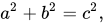
When the early cave dwellers realized that setting little rocks or marking notches on pieces of wood or bone, to make first use of numbers, the square root of 2 already existed, or that the diameter of any circle was and will always be its circumference divided by an odd looking number that begins as 3.1416 .... that is never ending nor exhibit a pattern. That number was already established as a universal scientific truth even from the time the first stars were created. Pythagoras merely discovered the theorem named after him but all three sides of right triangles did and will  always go by this relationship: a^{2}+b^{2}=c^{2}, .

Then we have the unlikely forces of nature - Shapes. Yes indeed, engineers and scientists do consider shapes, geometric patterns and the mathematics that define them as forces of nature. Shapes, long before we even started to understand them, designed them, created versions of them, were there already for nature to use right from the very beginning of creation. We may wonder whether our physical world are what they are because they were shaped that way, or are shapes the way they are as nature forced them to become.

Bees have for hundreds of thousands of years been building their honeycomb beehives in geometric patterns of the hexagon. Unlike birds nests that come in all kinds of configurations and material, all species of bees use only beeswax in the one and only geometric pattern - that of the hexagon. Let's examine the hexagon for a minute, just to satisfy our curiosity as to why bees chose it. Whether as a flat pattern or in the shape of a tube (as in the beehive), it is the most efficient shape to cover an area or contain the optimum amount of volume with the least amount of material. Bees know to conserve energy and material and no other shape will suffice except for the hexagon. Six equilateral triangles put together will make a hexagon, each side of that triangle has the length equal to the radius of the circle that circumscribe the hexagon, with all the six corners of it resting along the circumference of the circle in six equal spaces. Got that? If that seemed somewhat complicated to you, guess how you feel now when it is all second nature to the bee. But it is not just bees that make hexagons. Even an inanimate phenomenon, like the weather, create hexagons in the form of snowflakes and make them so no two snowflakes are the same. They  make finger prints look ordinarily bland. Volcanic eruptions that are as predictably violent as they are chaotic produce lava formations as columnar basalt - as perfect hexagonal columns as if they were fashioned for an architectural project.

Back to my special fascination with the egg.  If proven true beyond any reasonable doubt - more likely than not as research seems to lead that way - that modern day birds descended from dinosaurs (whose fossilized eggs are common specimens) then the egg represents over 200 million years of a perfectly designed feature of adaptation. The platypus, a mammal, seems to think so as well, that even today when all its furry cousins have gone to one reproductive method of live birthing, this odd holdout still lays eggs.

Egg shapes vary according to the needs of the particular egg layer. Long distance flying birds have elongated eggs because their physiology demands a more streamlined body that influences the shape of their Fallopian tubes to be narrower while flightless birds like the ostrich or emu that are not constrained by a streamlined physique have spheroidal-shaped eggs, closer to a baseball than to a football (American football, that is). Birds metabolism is so high that their elevated body temperature is detrimental to the development of the embryo. The solution is the egg. Away from the inside of the bird's "womb", the egg's temperature is then regulated in the nest. Other birds are so highly adaptable as to regulate the rate of incubation of their eggs. A small species of bird in Europe regulate the incubation period of their eggs in such a way that they'd all hatch at a very narrow window of a week to ten days every spring in time for when a species of caterpillar develop in the area which, not surprisingly, occurs  and ends within 7-10 days. Birds are smarter than we give them credit for, surely undeserved of the reputation of having a "bird brain".

Speaking of brain, this is where we come in. It is where we excel. It is our insatiable desire to know that starts with wondering first, then we ponder what, why, and how that lead us to answers that lead to increase in knowledge that brought us to where we are today. We've done well. Very well indeed.

Unfortunately, technology has brought us to today. With its one singular side effect. It is making us lose the one gift that the Creator endowed us with. The gift to wonder. Once we lose that completely then we lose our humanity. Technology may be smart but it lacks the one thing that only we have. The ability to ponder the things around us; the ability to perceive those closest to us and to be mindful of them because outside of those for whom we care and those who care in return, we will have become as inanimate as a computer chip. If you think that is spoken in jest, try and observe young people today. They could be physically congregated as a group of three or a dozen but yet so invariably segregated, hunched over, lost to the world of a palm-size screen, oblivious to what goes on around them.

If we believe that we are creation's highest point then we must admit that the only thing that differentiates us from all other creatures is our ability to wonder and to ponder because those two are the precursors to why we search, which leads to knowledge that leads to understanding. Even if all of our pondering and wondering comes to nothing of significance, the ability to do them is still the greatest gift of all that no other living thing is able to do. So, cherish that thought and hope and pray for the day when everyone looks up and look around to rediscover the person sitting nearby and one to another.

P.S.


My fascination with the hexagon continues and here to prove a minor point. These photos are from an ongoing project that once finished will be detailed in  my woodworking blog. While I will take credit for this, my most recent elaborate project, I will be humbled by the bees because they do not have the benefit of advanced  geometry, nor the engineer's drawing instruments or the woodworking power tools. I planned this a lot; the bees just do it barely within an hour after their brief juvenile period and unerringly build a perfect beehive.

This is how six equilateral triangles make a hexagon, shown partially glued up

These will become hexagon plant/pot holders that will be attached to a rotatable hexagonal column planter.

The upper part of this planter will rotate on a Lazy Susan carousel (with ball bearings) so that plants around the column will have equal shot at the sun's rays by the window if regularly rotated from day to day.

Why I showed this is merely to serve as an example that when we wonder, then when we ponder, we sometimes find a way that leads to  that one "aha" moment.


Monday, April 8, 2019

The Moral of the Story is ...

Another episodes in America


1. Bernie is not a very good neighbor.  Actually, he is a bad one. And he lives in two different neighborhoods, where he is  equally bad at both places. He lives in one home that he alone owns. He is also a part time owner  of another home in the other neighborhood. His ex-wife lives there but because he pays half the mortgage and home maintenance, including half the household expenses, his ex tolerates the whole arrangement. And as you shall see, Bernie has good reasons to straddle two homes.

Bernie has this habit of borrowing tools and other items from his neighbors and conveniently forgets to return them. Both subdivisions are plagued equally by this man who a long time ago declared himself free of any qualms or even a  teeny-tiny bit of conscience.  If the neighbors don't ask for the items back after three months or so, he considers those his.


Bernie also has the resourcefulness of the top natural scavenger. On a scale of 1-10 he is right there at 7.5, where the Andean condor and Griffon vulture are at 10. You see, he has in his calendar the one day a month when residents in upscale neighborhoods  put on the curb for pick up any discarded items that are not classified trash or garbage, from old furniture to golf clubs and and sports equipment, luggage, etc. He has those days on his schedule where he goes around starting at mid morning till mid afternoon on those specified days. He would pick up stuff that he'd judged to be either in good shape (though old or dated) or still serviceable or reparable. Upscale neighborhoods have plenty of those. Bernie is not doing anything illegal and when he picks the items up nobody really mind or even care. He had become a frequent visitor to these neighborhoods that often the residents there would rate the items they were about to throw away according to what this unknown man would consider worthy. They'd joke among themselves on the likelihood (scale 1-10) the items they put up would be picked up by Bernie. That is the "disposable society" that America is sometimes known for.


Also on Bernie's calendar are the two special days a year. Twice a year at each subdivision he holds a garage sale. That would be four times total (at six months interval, twice at his own subdivision and twice at his ex-wife's). There the scavenged items would be laid out on the front yard like obedient  subjects held in court by Bernie whose aim is  to dispatch them  one by one to bargain hunters. Bernie would also include items he borrowed from neighbors as part of the merchandise.  There is one particular detail that Bernie is extremely careful with - he makes sure that the "borrowed" items from one neighborhood are sold only at the other and vice-versa. He keeps a good log to avoid that one  mishap - a neighbor spotting his tool or what-not on sale at Bernie's garage extravaganza.

Three months ago a new neighbor moved in to a home just four houses down from Bernie's. He went over to introduce himself and offered to help  the new resident unload. Bernie has one motive that is farthest away from altruism. He merely wants to see what he can catalog as potentially borrow-able from this new neighbor. The new neighbor introduced himself as Cornelius and seemed to prefer to be called that way. Three weeks after that Bernie was calling him Cory and Cornelius didn't seem to mind. By the fourth week Bernie had borrowed a couple of items, one of which was a unique looking ice pick.  It caught Bernie's eyes because not only was it something he had never seen before but the handle was intricately ornate with the Tiffany look  on it. Bernie is not shy about borrowing and although he'd been rebuffed many times in the past by wiser neighbors, which carried little effect on him, he was clearly surprised at how Cory so willingly let him borrow the ice pick.

Bernie had no intention of using the borrowed item. It went straight to one of the cabinet drawers in the kitchen.

That was three months ago and today he is holding his bi-annual garage sale at his ex-wife's front yard. He always makes sure he does it on a pleasant day for a guaranteed traffic. People would come from all over and among them are "professional" bargain hunters. Then there are those who just drops in on a whim. One such couple was Alice and Joe. It was Alice's idea to stop. This was Joe's day off and they were actually on their way to lunch. Joe initially wanted to stay in the car and wait until Alice was through rummaging  but in the last second he reluctantly got out and passed the time looking at what he believes are other people's junk.

One thing caught Joe's eyes almost immediately at the first table. It was Cory's ice pick. He picked it up, look at it closely, at which time Bernie came over and did his sales pitch. "That had been my favorite for years since I bought it but I thought someone, like you, will get to enjoy it as well. For twenty bucks, that's really a good deal". Bernie was flawless. Joe said he'd like to call his buddy and took out his cell phone from his pocket. At which time Bernie retreated to give Joe some space. He's thinking a good sale coming up. Joe held on to the ice pick and continued to look around.  Bernie was thinking this was a sure sale.

Twenty minutes later an unmarked police car parked a few yards away. Two detectives got out, shook hands with Joe and all three stepped towards Bernie. Joe, like the other two cops, was a homicide detective. Joe called them because he was off-duty and he needed them to make sure all three of them were there to listen to what Bernie had to say.

Joe said, "Sir, you do know this could be a stolen item?  Are you sure you own this from way back when, as you said".

Bernie always had a quick wit, "Yeah, but surely hundreds of this were sold over time.  Why pick on mine?"

"You are sure you've had this for years?"

"Absolutely! Why would I lie about one lousy ice pick".

"So you don't mind if we have this checked out?"

"Not at all, but you'll have to give me twenty bucks as deposit." Bernie was quick again.

One of the detectives took out a twenty from his wallet. The other produced an evidence plastic envelope. Sealed it and let Bernie sign on the flap.

One week later Bernie was arrested for the murder of a wealthy stock broker six months ago.  An ice pick was used when the victim apparently resisted during a robbery at his home. The stock broker owned a very rare ice pick that was among his collectibles that was missing. The intricate design was well documented in photographs of his private catalog. The ice pick from Bernie's yard sale may have been washed but not so thoroughly, apparently, because some almost microscopic specks of dried blood were trapped in the folds of the crevices of the ornate handle. The blood had the DNA of the victim.

Bernie quickly changed his story and switched the blame on Cornelius, his new neighbor. Cornelius was nowhere to be found. He abandoned his new home and an APB (All points bulletin) was issued for his arrest and a manhunt begun.

Bernie who spent days in jail was ultimately cleared. Cornelius, a career robber, as it turned out, remained at large. The idea that he's still out there made Bernie a virtual recluse, imprisoned in his own home, double locking his doors on days and barricading it at night, sleeping as little as possible.

The Moral of the story: (1) Return what you borrow; (2) Never sell to others what you borrow from your neighbors. (3) Karma - according to adherents of the philosophy - can be cumulative. (4) Do not denigrate garage sales or flea markets - sometimes there are hidden treasures there.

Speaking of flea markets I had personally found quality hand tools there that were not only rewarding to restore, they are still very much in use in my wood working shop. These things, inanimate objects that they are, have stories to tell. Filling those blanks, or to imagine stories around them may for some open a different view of America.

Speaking of stories, there is another one. 

2. Chris came back after a three year stint during the Iraq war a broken man. Almost each passing day was a slow downward spiral into an abyss he  was now hopelessly unable to reverse. One day he resolved to get out of it the only way he knew how. He was going to do it that evening. His life had been reduced to two months behind in rent for an empty unkempt apartment where the only thing of value left are his old 101st Airborne uniform and a 9 mm cal. pistol similar to the side arm he had during the war. And a handful of ammo. He was going to use just one of them later that evening.

He got out of bed at the usual late morning of between ten and eleven and often with very little ambition to do anything, when the days would go by aimlessly. But today he had a purpose. He will go  out, walk around the neighborhood, have one final look. Not that there was much to look at. He will come by the shelter where he'll get lunch and say goodbye to the folks who every day dutifully served him and others like him. They are his last remaining contact in a world that had forgotten him. Abandoned him, in his mind.

He was surprised that he had accomplished what he planned for and was now walking back slowly, block by block, to his apartment. He might take a nap, wake up by sunset, and it shall be the end. He played that in his mind, over and over, making note of the sunset and the metaphor it represented in the coming night.

Just two blocks away from his apartment at an intersection by the curb was a white dog standing motionless. Its white coat caked with mud, its right ear was scarred and there was a frayed dog collar around its neck . They locked eyes. Chris looking down at the dog that  was looking up at him. When he stooped down to pat the dog it remained motionless then licked his hand. Chris then walked away in the direction of his apartment. The dog followed him. He looked back and for some reason he felt compelled to encourage the dog to follow him.

The dog had to be hungry. When he got to the apartment he knocked at his downstairs neighbor's apartment whom he knew has a dog. He was going to see if she can spare some dog food. The lady knew him and she was happy to give the dog some in a dish and  water in another. While the dog was eating their conversation led to what he was going to do with the stray. The lady suggested that he take it to the animal shelter that was actually a short walking distance from the apartment. It's possible the dog's owner may have registered the dog in the lost section. She gave him a spare leash for the dog and off the two went when the dog finished.

When Chris got there a young staffer told him there was nothing filed for this particular dog. She can take the dog but in a few days if there is no claimant the dog will be euthanized. The staffer now introduced herself . Her name is Claire. Claire said, "I think the dog likes you.  Why don't you keep him? You know he has a name on its collar. Tracer."

Claire, before Chris could respond, asked, "If you have to go to work, you can leave him here and pick him up after work." When Chris answered that he didn't have a job, Claire asked him if he wanted to work at the shelter. He seemed to be good with dogs. "There are a lot of them to take care of here and the shelter does have a need for another person". Claire added.

That was ten years ago. Chris just had his ten-year anniversary with the shelter. He had been a model employee. Claire is now the Director of the shelter, married to a policeman, and they now have two kids, and Chris had since been a regular  Thanksgiving dinner guest at Claire's growing family that has now two dogs of their own. Tracer passed away three years ago but Chris has another rescue dog that is with him while at work at the shelter and goes home with him each night to a better apartment. Chris also volunteers his weekends serving meals at the very same place that used to serve him.

Chris did get off the downward spiral road but through an entirely unexpected but altogether beatific way.

The Moral of the story: Everything and everybody has a story - the dog, the downstairs neighbor, Claire and most of all - Chris. We should all be mindful of these stories. They're all around us.


These stories I did imagine. The real ones out there could be more profoundly real.


Thursday, April 4, 2019

So That's What It Really Is?!

A couple of European readers actually thought that the origin of popular phrases in the previous blog  as portrayed by the stories I wove around them were real. They were merely made up by me.  As it turned out, for the most part, only American English speakers saw the humor in them. Or, as the British natives would say, "humour". None native English speakers therefore beware! Now, it must be realized, however, that the stories that accompany them are slight reflections or social commentaries on American life (if you can see them), which stand on their own. But the phrases and idiomatic expressions are real. The puns are ...well ... you be the judge 😎

1. Amy and Joan, long time friends, wanted so much to get to this very popular restaurant that always has a long line and a reservation waiting list that goes back weeks. They think they found a clever way to beat the system.

One day, at ten in the morning the two friends went to the restaurant as the breakfast crowd was thinning. Breakfast does not require reservations so they had no problem getting seated. By 11:15 the breakfast crowd is gone except for the two friends.  They nursed their now lukewarm  coffee as slowly as they can - sip by intermittent sip. By this time the waiter approached them with the check who then told them that they needed to leave as soon as possible because the staff had to change all the table cloths for the lunch diners that are now lining up outside.

Amy said they're having lunch as well as a continuation and they're happy to keep the table with or without the new table cloth. But the waiter said they can't do that. Joan demanded that the waiter call the manager. The manager came and Joan explained that since they are here and still have their table they have every right to it and are now willing to order their next meal as a continuation.

The manager, now rather peeved and quickly losing his patience, explained as sternly as he could that for 23 years he'd been working in this restaurant throughout all that time he was sure , 

"There is no such thing as a pre-lunch" .

2. Greg's wife Peggy is known to be such a picky person when it comes to certain things. One day their electric door bell - Peggy's favorite because of the particular chime it played when people come at the front door - ceased to work. It needed to be replaced. Peggy dragged Greg to go shopping for a new door bell. Just what Greg dreaded, they'd been to several stores, by car and by foot, but Peggy didn't find anything that suited her taste or fancy. Then there was this small store that Peggy said is the last one for the day. It was getting late and if she couldn't find any there, the hunt continues the following day. They went in even though Greg held little hope. The owner came to greet them and showed Peggy a few that might interest her.  Meanwhile Greg, not wanting to be anywhere near when Peggy dashes any hope of ever finding her "door bell", decided to browse at the opposite corner and as far away from where Peggy and the store owner were doing their little back and forth. 

Hardly twenty minutes passed and there was Peggy with a paper bag at the cashier's station waiting in line to pay. Greg grabbed the store owner to ask him what his secret was. The store owner said, "I can tell as soon as you came in from the looks on your faces that you've been to at least five or so stores already". Greg said, "Six and you are the seventh. So tell me!"

The store owner was happy to explain. "I have these three most popular door bells and they excel in performance. But they're rated at good, better and best. So what I did, which is what I usually do, was let your wife listen to the good one first, then the better one, and  the best one last. At that point, she made her decision". The store owner had known this for a very long time now that with a little patience and clever timing he just knew that, 


"The third chime is always a charm."

3. Bob was telling his best friend Josh about this new woman he'd been dating for sometime now that Josh has yet to meet. Josh asked Bob how is it so far. Bob said, "Ruth is kind of special except for a few things. She's beautiful and smart and almost unreal, even too good to be true". SO what's the problem, asked Josh.

Bob told him Ruth orders dessert first before the main meal. Not as a dietary thing but just because she'd rather eat the best part of the dining experience first. There are other idiosyncrasies that makes her a little bit off compared to most everyone he knows in the real world. She's an astronomer too so she's out most nights and comes home at dawn. "But when do you guys get to go out together then?" asked Josh. 

Bob replied, "We go out when Ruth is not working which is mainly during full moon or when the weather is bad. When the moon is full the night sky is not conducive to viewing distant parts of the heavens and when the weather is bad, well, that is obvious. There are no astronomical observations to be made during inclement weather".

Bob then asked Josh what he thinks before he introduces Ruth to him. Josh as only a good friend can do said that given what Bob had told him so far, 

"Ruth is stranger than fiction".

4. Al and Will had been best friends since kindergarten. They were inseparable. They played football together in high school and their team won the state championships twice. That cemented their popularity.  The local town knew them as the Al and Will team. 

After graduation though things went rather differently for each. Al went to work the farm that his family gave him to develop, a parcel of land that was part of the family's large acreage that had been theirs for generations. Will went to find his fortune in the city thirty miles or so away.  He didn't do too well and in no time resorted to petty crimes.

Meanwhile, Al worked hard. He just finished digging a well as a water source for the few livestock and poultry he had recently added to the land and well on his way to developing an orchard.

Meanwhile, Will was increasingly getting into hard core crime. Then one afternoon he decided to rob a bank. It didn't go well. Police were alerted but Will had sped away in his getaway car. He drove away from the city in the direction of his old town towards Al's farm. Will found Al by the well where Al was unloading bricks. Apparently the bricks were to provide a wall around the open well. They were talking animatedly when police cars, trailed by swirling dust, were heading towards the farm. Al pleaded with Will to give himself up. Will will have none of that.  As the first police car turned in after the gate, Will made a few steps back pulling a hand gun from his waist band. Not realizing that he was close to the open well he kept stepping back. Then he fell into the well.

While waiting for the firemen to arrive to rescue Will the Sheriff held a news conference. Though a little dismayed and disappointed by what happened in this small town, the Sheriff was saddened by the turn of events and as he looked down the big hole, he said, "From what we can see here, it is:


Al's well that ends Will!"

5. Nick lives in Queens, NY. It's a tough neighborhood where he makes a living. Even tougher for him because the small store that he runs is as much a legitimate fruit stand as a front for a numbers game and illegal sports betting. He takes in bets from professional gamblers and the local folks who are also his customers. He knows all his customers which also include some of the poorest ones who had no business parlaying what little money they had in the hope of hitting it big in numbers or sports betting. Often some of these folks would incur gambling debts they have a hard time paying back.

Nick appears tough though because he had to maintain that exterior so no one runs up debts beyond what he'd allow. Nobody does for the most part.  Every now and then some tough looking men would hang out at the store. They have the swagger of mean-looking enforcers from the "organization". It is enough to provide the right "image" though Nick never used them.

Nick does not go straight home every evening. No one really knows where he goes for an hour except his wife. He volunteers each night at a homeless center serving meals. Then he goes home to have a later dinner with his wife. The two children would eat earlier and attend to their school work.

As most evenings go, Nick's wife asked him how his day went. "There was a lot of people at the homeless center tonight and I really felt bad for those folks", Nick replied. "I will probably work there a bit longer this Sunday. By the way, Salvatore came to the store today. He still couldn't pay the $200 he owes me. I told him I'll forgive it if he volunteers his whole Sunday at the center. Don't worry he won't see me because I'll work in the kitchen. He will be assigned to clean the tables and push wheel chairs and other chores." 

His wife gave him a warm kiss on the forehead and said, "You're a good man Nick."

This proves once again that, "You can't judge a bookie by his cover."


The real expressions are (just for the benefit of those unfamiliar or who didn't get what the stories were all about):

1. "There is no such thing as a free lunch."  This has a really interesting origin. In old English taverns  some owners offered  free lunch to customers who ordered a drink. The cook would actually put extra salt on the food. The salty meals made the customers thirsty so they ordered more drinks; more than they had originally intended.  Hence, in life we somehow pay in some way or another  for most of what we thought we got for free.

2. "The third time is a charm."
3. "Truth is stranger than fiction".
4. "All's well that ends well."  --- By no other than Will Shakespeare
5. "Don't judge a book by its cover."