Thursday, November 30, 2023

The Moral Currency Exchange

Many years ago, at the multi level parking lot, adjacent to the offices where I worked next to other commercial businesses nearby, my heart  momentarily stopped as I approached my truck.  The left rear fender had a huge dent. Crumpled, paint-scraped metal where it used to be a curvy unblemished and smooth fender.

A business card was tucked beneath the left windshield wiper.  It had the name and phone number of the manager of the Chick-Fil-A Restaurant, at the adjacent mall. It had a note.  The writer asked me to call his number, admitting responsibility and apologizing for what happened.  He had already called his insurance company.  

His insurance even paid for a loaner car while my truck was in the shop.  Twice, during the week, he called me to make sure everything was being taken care of, and that he had been following up with the insurance company on my behalf.  

Now, that was one moral currency that never devalues, nor is it affected by the passage of time.

Fast forward to over twenty years later, just two weeks ago. Pulling into a parking space outside the fitness center,  I misjudged how close my truck's nose was to the small car's left side that was parked at the adjacent space.  I dented the left fender, with little damage to mine.

Without hesitation, not even for a second,  I scribbled my name and phone number on a piece of paper and tucked it under the car's wiper and took some photos.  I went to do  my swim and when I got back the other car was still there.  After waiting for a bit, I called my insurance company to report the accident, provided them the details of how it happened and photos of the car's license plate and the damage.

I asked the claims person about what if the driver does not call me, what should I do.  She said not to worry.  They will run the license plate and they will contact the car's insurance company on record.  I have not yet heard from the other driver but I feel better that I did the right and proper thing. 

The title of this musing alludes to something that people had already recognized as one of humanity's ideal principles dating back from as early as humans had written about the story of life, for centuries.

"There is a concept in Judaism called in Hebrew midah k'neged midah, which is often translated as "measure for measure".

As we all know, this philosophy not only has had many iterations in the Biblical texts but  other writings and practices from different faiths preach the same theme.  

The principle of treating others as one one would want to be treated by them - ethics of reciprocity - is, of course, more popularly known as The Golden Rule.

What we should keep in mind, however, is that this  really refers to how one would treat another who would do the same even before any actual actions ever took place.  There is that one difference that separates it from the phrase "tit-for-tat", or even that of "measure for measure", because the latter two call for  reciprocity of actual deeds or exchange of goods.  

The so called "ethicization" of human behavior had long been explained philosophically as well as spiritually or religiously, for that matter, although it is oftentimes misunderstood or misapplied.  We are more familiar with the word karma.  It is mainly known to have origins in the Hindu faith (the word itself) but it is premised in Buddhism and other ancient religions as well.

Karma from its original meaning was never just about bad things happening to those who did bad things.  It was rather about consequences, good or bad, based on the individual's actions.  In fact, there were specific words to describe just that. Dharma is good karma that leads to meritorious rewards; adharma leads to both spiritual and real demerit and sin.

To just say that for every action there is consequence for the doer is, of course, much too simple as to not have the proper ethical premise. It is more profound than just accounting for pure cause and effect.  Now we get into intent and purpose (reference to my previous musing, "For All Intents ..") that have to be weighed in over actions and consequences.

Now we must grapple with unintended outcome where the doer did not mean for what happened to another when there was no intent of the kind to cause harm or damage.  Often someone may mean well when the result of his or her action proved harmful.  That is what was meant about the "ethicization" of this particular philosophical theory.

In other words, one's intent, attitude, and desire must be evaluated.  

That is well and good from the views and perspectives of the human experience.  In other words, where people are actually made aware of the causes and consequences, even provided with ample evidence of intent, and witnessing or even promoting the application of consequences, hence the premise is evaluated.  In human terms, of course.

The question we ask ourselves is this:  How is the accounting done when no one else is looking? {Reminds us of a quirky funny question often asked in jest: If a tree falls in a forest and there's no one around, does it still make a sound?}. For lack of a better way to concisely define it, I came up with the, "Moral Currency Exchange", or MCE, as some kind of cosmic balance sheet.  This is an effort to include the non-believers who do not rely on any kind of spiritual belief system for the proper accounting of deeds and/or misdeeds.

You, the reader, and I can look at our real personal experiences to evaluate the validity of MCE, if at all.  Go ahead and think of just a few instances where you are convinced that fortuitous events happened to you and the many ways by which you can ascribe a few little things you did to or for others out of unselfish motives on your part.

Now, I can't know your own personal experiences and since I do know mine, but without trying to scale the morality ladder, just to be seen or hailed for it, I simply must say that  how or why MCE works is a personal matter. I believe too that it increases in value almost exponentially from what little act it was based on initially.  But we will find that there is ample evidence of it in our own personal experiences.

Let me digress for just a bit.  It will be about lost wallets. Not including wallets lost to pick pockets or simple thievery, many studies were done about lost wallets.  Some of the studies involved controlled conditions but mostly about collecting statistical data.  Wallets containing no money were less likely returned.  The most surprising part was that wallets with the most cash were returned at higher rates than those with less.  

There was no common thread among those who returned them.  Young, old, even children, people of authority, ordinary lower income people, etc. It would seem that more people return lost wallets with the most cash in them because they felt that people who lost the most would be hurt more.  Not a very scientific conclusion except perhaps for the universal wishful thoughts that indeed most people have a way of interpreting the Golden Rule in their own independent ways without really thinking about it.

Is there a ledger somewhere in this universe of ours that records even the littlest things we do?  Good or bad?  Does someone who took the trouble to go back to a large grocery store to pay for a $2.00 item that was missed by the cashier at checkout get some ethereal merit of some sort?  Little things we do that cost so little, do they mean much in this ledger? Giving the delivery person a bottle of water on a hot summer day, tipping the workers generously for work they do in the backyard or in the attic; going out of one's way to help a stranger; helping a neighbor in need of compassion, just little things offered to help or alleviate grieving hearts, etc.

Is it really true that over time the things we do - how little or how huge - accumulate for some later accounting? 

I will end with the opening verses in a  poem written by Alice Cary ( Born April 26, 1820 - died Feb. 12, 1871), "Nobility" :

True worth is in being, not seeming, -

In doing, each day that goes by,

Some little good - not on dreaming

Of great things to do by and by,

For whatever men say in their blindness,

And spite of the fancies of youth

There's nothing so kingly as kindness,

And nothing so royal as truth.


A related musing, "For Kindness Begins Where Necessity Ends" is worth a quick read at:

https://abreloth.blogspot.com/2022/02/for-kindness-begins-where-necessity-ends.html


Friday, November 24, 2023

Existential ..

Webster defines existential as, "grounded in existence or the experience of existence"; "relating to or affirming existence".

Another overused adjective, often paired with the noun, "threat", that is also almost always misused and abused.  As a result we no longer pay attention, especially after hearing so many things we're told that this or that is an existential threat.

The threat to existence is no trivial matter based on that definition.


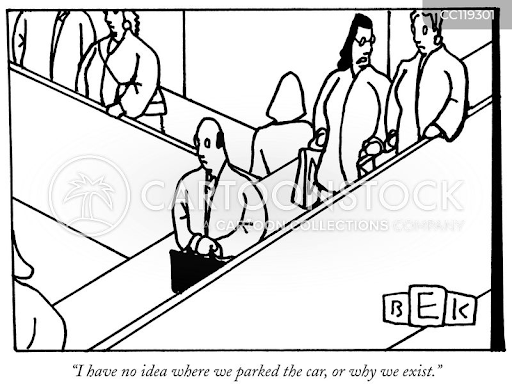
"I have no idea where we parked the car, or why we exist."


Let's first look at the bigger picture of our place in this huge universe of ours to get a starting reference at what it would take to be existentially threatened before we cast ourselves with the extraordinary ability to do it on our own.  

Let's begin with our sun - the source of heat and light and the gravitational hold that keeps our little world in its place.  If we were to scale it down to the size of a golf ball, our puny earth is smaller than a grain of sand about eight meters away.  Yet, season after season, that sun, so far away, 93 million miles in real scale, rules what climate prevailed on earth for millions of years.  Our ancestors and those of other organisms had to adapt to the tantrums of a fusion thermonuclear device (yes, believe it) by which the sun produces its energy.

Now, there are other suns all throughout the universe.  So farther apart from each other that the nearest neighbor, the Alpha Centauri double star system, is indiscernible to our bare eyes.  Using the same golf ball analogy, with our sun as a golf ball on top of the Washington Monument, the nearest star would be just another golf ball farther north beyond Quebec, Canada, and you'd have to go another two hundred miles past that city to find it.  

These vast distances have a way of emphasizing  that our earth is puny, all its inhabitants even punier, yet it has a way of making it possible for life to develop and flourish in the only place we know it exists.  In fact, scientists fondly put our place at the Goldilocks Zone.  Not too hot, not too cold. Farther away we get a cold, lifeless planet that is Mars; too close and we'd have a hot summer day at 880 deg F (471 C), surface temperature, in our sister planet, Venus.

For life to exist in the only place we know and, more significantly, where we happen to be, along with a gazillion other organisms, the threat to our existence is not to be taken lightly.  Yet, it appears that the phrase, "existential threat" gets thrown about with careless abandon.

In fact, it is the same phrase directed at real and imagined threats over centuries of human conflict.  We will not flip back to so many pages of our past but, perhaps, look back to just the last half century after the Great War.

We - every nation with the capacity to do it - built up an awesome cache of arsenal against one another over decades of unrelenting arms race. The reason: the opposing side poses an "existential threat" to the other's way of life.


"This stuff is virtually useless against nukes."


For example, the hot wars of the Korean and Vietnam Wars were caused by threats, fueled by nothing more than the ideological differences between the perceived notions that capitalism was an existential threat to communism and vice-versa.  It turned out that such wars were not only avoidable, they were both unnecessary, if fervent ideological zeal and unreasonable fears were kept at bay.  

From all the capitalist nations' perspectives, we now know communism doesn't work.  The only place where it is still practiced in its pure form is Cuba - a fine example of the way not to run an economy.  Just ninety miles away, while also being surrounded by other more relatively successful Caribbean nations, is a capitalist nation that is the haven for countless Cuban immigrants who have called it home for decades, also a beacon of hope for individualism, as opposed to blind reliance and dependence on the power of the commune.

On the other hand, the Vietnam War could also have been avoided if not for the perversely imagined threat of the ideological "domino effect" that communism was going to engulf the entire Asian continent.  It turned out that had the west let the vines of communism spread on its own, it would have wilted or withered without establishing deep roots.  We now know that even China of over a billion people is a successful economic power by running its economy as capitalists would, albeit running its executive government as a sort of hybrid communism.  A united Vietnam today, where the North won, abandoned pure communist idealism and is embracing capitalism to dictate its economy.

I will say this quickly as in removing a band aid.  Climate change is not an existential threat.  We are throwing money at it like drunken sailors - no offense to sailors who when they wake up the next morning will sober up and re-take their senses far better than the unelected government bureaucrats who will spend taxpayers' money like there is no tomorrow.

Today, we know that people - the governed - will discern quickly what works and what doesn't.  The mistake was that governments were guided too much by ideology and had always maintained that throwing money and resources are what would assuage the fear, however unreasonably overblown and imagined, against perceived threats, existential or otherwise.

Climate change has been a phenomenon  since the creation of our solar system.  It was our ability, as it was true for every surviving organism today, to adapt to the changes in climate.  Supported by geological evidence, there had been five ice ages before the last one.  Keep in mind that every ice age was always followed by a warming of the climate.

Earth today is undergoing  a  warming up cycle from the last one.  A few things to consider here:  (a) climate changes occurred in the past and will continue to occur into the far future without our actions; (b) climate changes made us who we are today.  If not for the warming of climate, we would still be covered in fur; diversity of skin and eye color are all a result of climate changes; if not for climate change, there will be no Sports Illustrated, Swimsuit edition; (c) Climate change created the Great Lakes and all kinds of bodies of water worldwide; island nations and nation-archipelagos were created as ice melted at the poles to raise sea level as the earth warmed up.

Plate tectonics, driven by the molten nature of the earth's mantle, have more power to reshape the global landscape than all the nuclear bombs combine. Look no further than its handiwork in the Grand Canyon, the African Rift valley, the shapes of continents and the separation of the Americas from Africa, etc. What used to be one great landmass, called Pangea, are now the various continents.

All of the above, including the constant volcanic activities and earthquakes that caused all kinds of changes in the landscape - were catastrophic events at the time that they occurred.  We and all current living organisms survived because of adaptation - a distinct ability every survivor is equipped with. 

"All I'm saying is now is the time to develop the technology to deflect an asteroid."


And don't forget, extraterrestrial threats like a wayward comet,  asteroids, massive radiation from the sun's hiccup or tantrum, a supernova explosion nearby (in galactic proximity, of course).  One asteroid that hit earth 67 million years ago killed off the dinosaurs but it ushered the age of mammals (including us) and for the diversity of birds soaring through our skies or running through desert sands, that were the successful species to adapt from dinosaurian lineage.

So, why is climate change being forced on us as an existential threat more than a nuclear war, famine and diseases?  

Permit me one analogy.  A dropped pebble on a still pond will create a ripple.  Try as we may, we cannot stop the ripple, wave after wave projecting from the center of the impact. There is just no way.  The dropped stone is the changing climate, composed of many elements but the least of which is the use of fossil fuel.  The foolish one who is trying to stop it is the promoter of the ideology to control the narrative, overturn the people's way of life over a flimsy argument, and the messaging of a political agenda.  

What are we to do but ride over each wave, float over the ripple.  Yes, indeed we can cut emissions through efficiency in combustion, lighter vehicle bodyweight, use electric cars where warranted, more efficient housing materials, create more carbon sinks with a massive tree-planting program, etc. As had been in the past, climate change occurred over millennia of very complex processes that allowed time for adaptation to help species survive.  Warmer climate allowed for longer growing seasons and better yielding food crops. 

We know there is something wrong when political personas predict rising waters, end of civilization with dates like 2012, at one time, then re-adjusted to 2030, and on and on. Predicting dates like that, just   to make it relevant for people living today and create a dire scenario of a pressing nature, is pure folly. Don't forget too that these narratives almost always follow the same political magnetic lines against another.  It is no longer about, "what can we do together to make this a cohesive and reasonably well thought out plan agreed upon by both sides", instead of instinctively demagoguing the messages to conform with a single political persuasion.   

Ending the fossil fuels, extinguish the coal industry, doing away with internal combustion engines, outlawing gas stoves, refrain from eating meat, plus many more inanities, are only ideas that are dictated by a single voice, but clearly not through wide public acclamation. 

Here's a not-so-farfetched thought experiment.  Can we conceive of an all electric powered fire trucks, emergency rescue vehicles, earth moving equipment, cargo ships, 18 wheeled transport trucks, air transport, even cruise ships?  Now, if we make an exception to refine hydrocarbons just for these example vehicles, does anyone realize how expensive fuel production would be just for these vehicles and equipment?  Can we defend this or any other country with electric tanks, warships and stealth aircraft?  Can we launch into space even just one lightweight weather satellite? 

As in the TV game show, "Jeopardy", all of the above in the last two paragraphs, and many other examples, will fall under the category of, "Stupid Answers".

One final thought. One popular mantra of saving the environment is recycling.  Well, well, nature has been recycling everything over eons. Carbon and hydrogen based vegetation, decayed and piling up layer over each layer for millions of years, compacted under immense pressure and heat, became what is known as hydrocarbon.  This was the gift from the earth that propelled civilization into the industrial age, modern travel and productive agriculture from better hydrocarbon-based fertilizer.

Just imagine this.  Hydrocarbon splits up into carbon and hydrogen after releasing the stored energy within their bonds during and after combustion.  Vegetation will recapture the carbon, hydrogen will combine with oxygen to make water or water vapor.  Should we not be dedicating resources to make that recycling process one of the permanent solutions instead of demagoguing carbon as a pernicious villain?  After all, we are all carbon-based organisms by definition. We consume carbohydrates for energy, and amino acids that are the main components of protein are bonds of hydrogen, a little bit of nitrogen and, yes, carbon! 

Let's think about this very carefully before we condemn hydrocarbons, also known as fossil fuel, into the Most Unwanted List. 

We will soon  begin another cycle around the sun, let us not forget that what we see around us are, almost without exception, recycled material, not the least of which are hydrogen and carbon in the form of hydrocarbons, which by the way includes the base component for asphalt - which literally paved and continues to pave the world's highways around the world, connecting places and people who would have been so remotely far removed from better healthcare facilities, otherwise. 


The last oxygen atoms you inhaled within the last seconds just now had been around since a few billion years ago; the carbon dioxide you just exhaled was the same molecule that came from simple life forms and dinosaurs, Neanderthals, Nile crocodiles, etc. over eons of breathing in and breathing out many million, trillion times over and over.  This makes the nice sounding catchphrase, "Net Zero Carbon Emissions Initiative" sound like a pipe dream with too many holes to hold anything.  


Let's re-think every existential threat we hear or read about.  Better still, let's expunge that phrase with a permanent restraining order.


Tuesday, November 14, 2023

For All Intents and ..

First, I like to rehash what I wrote about years ago, a short one I read from somewhere.  A funny story – it was funny then, to me, anyway – that I keep recalling it every now and then, went like this:

There was a campground for boy scouts by the beach close to the sea where dolphins also come by each morning.  The camp director actually fed the dolphins at about the same time the boy scouts had their breakfast.  Each morning the camp director would announce breakfast to the boys and call out to the dolphins with, “For All in Tents and porpoises…“, to come and get it.  

Corny now, perhaps, but it was a clever pun I can’t shake off, that it was the title of my musing then.   

"The phrase for 'all intents and purposes' originated in 1546, in an Act of British Parliament that gave King Henry VIII the power to interpret laws in any way he wished".

When I read the above, a factoid of little significance now, pales against everything else we  know about Henry VIII.  It was also about "Absolute power corrupts absolutely".  So many stories about that too but this musing will not be about that.  It will not be about politics.  Neither about dolphins or porpoises.

However, the phrase "intents and purposes" held so much staying power and latent energy that it has not lost its relevance even in today's language and vocabulary - legalese or otherwise.  Today, we may use "virtually" or "in effect" to mean the same thing; but often we still hear or read "for all intents and purposes".

I chose this to be about life in general, personal ponderings for everyone.  It is one characteristic of language that two words taken together render both innocuous; separately, each has a far deeper meaning.

Intent, as a stand alone word is powerful. Purpose can easily be just as powerful, if not more so.  Yet, neither one is of any value unless propelled into action.  In physics, both will be defined purely as potential energy.  No different from a wagon load of coal, a barrel of oil or a giant boulder at the mountain top. Unless converted into heat and/or kinetic energy to perform work or exert power to move some other object, intent and purpose are both simply as useful as an ax or saw inside a locked tool shed.

However, when John says to Jane, "I intend to marry you", is that more powerful than when he tells a friend, "I love Jane.  Very much"?  The first sentence could be more powerful to Jane, more so to her mom - the eager future mother-in-law. Actually, John telling a friend he loves Jane is a lot more powerful than just saying to Jane, "I intend to marry you".  Think about that for a minute.

To all retirees like me, when we wake up each morning we intend to get up. When indeed we do, it's another day to be grateful for. We intend to do something. If we didn't act on that intention to do it, we find that the time to the next sunset will seem like taking forever to elapse. That might seem like a good way to lengthen the remainder of our time on earth but in reality it could be the shortest and awful way.  Let me pause and speak for those in nursing homes or living by themselves who are much too unable to act on their intentions.  We must never forget nor should we not care or wish them well in our prayers.  This musing will not speak to them.  It is for those, the reader like you, who is blessed with the ability to still act on mere intention everyday, greeting every sunrise with a purpose.  I am reminded of the last few verses from Rudyard Kipling's  poem, "IF":

If you can fill the unforgiving minute

With sixty seconds' worth of distance run,

Yours is the Earth and everything that's in it.

Sadly, the subject-phrase is also used in the following quote:

"He was forty, out of baseball, and, for all intents and purposes, out of life".

Intentions reside in our head, denizens of our thoughts. Some, if not many, are fleeting visitors, others linger, a few are plucked and we act on them.  Others over stay, can be annoying, others become kibitzers - not in any good way - congealing into  harmful obsessions.  Still merely intentions.  But they have the power to sometimes become agents of over analysis. Analysis after analysis that leads to mental paralysis. 

Intent, the criminal kind, is not prosecutable in the court of law; fortunate for anyone not acting on impulse or intent to commit a crime.  Anyone who purchased a gun for the purpose of committing a crime is held blameless until the act of robbing an establishment.  

Two faces of intent and purpose we'd rather not intrude into our lives, either as a doer or the object of someone's deed.  Intent and purpose, both powerful in each own individual potentiality but let's focus on their good sides.

Intent is where everything humanly doable begins.  It was intended by our parents that we do well when we grow up.  Their good parenting was primed by the same intent.  It was our intent to do well in school because the purpose of a good education is to serve us well later in life.   

Intent and purpose should not wane post everything we have accomplished so far.  Intent and purpose do not and should not end at the water's edge of retirement.

Acting on one's intention to be of service to others through volunteer work is as rewarding or even of greater value over another's exotic hobby of collecting rare objects of art.  But no matter how noble or exciting an intention can be if left unfulfilled is of negative value against one simple undertaking that is acted on and finished.

The origin of the following proverb is not known but it first appeared in print in 1828:

 "The road to hell is paved with good intentions" 

This is the darker side  of intention though no less powerful when used to motivate others to do evil deeds.  We will not get into it any more than what we see in newspaper headlines, almost on a daily basis.  We will not look back in the history books for so many roads humanity had paved with good intentions, only for many of them to lead to places of unimaginable horror - man's inhumanity to another man.

We will leave it at that.  Let's go to another analogy. A more pleasant and practical one;  some readers may even find this useful.

A few weeks ago my wife and I decided we needed a round breakfast table in the kitchen area, replacing the rectangular one that is there currently. There is a purpose for why, which I will get into later. I suggested we'll just buy the table top only and I intended to build the base. Awesome, if not a bit ambitious intention (at my age). I found a company in Austin TX.  They will custom-make the top to my specification: 48 inch dia. round table, 1-1/2 inch thick, from solid red oak ( I intended to use 1 inch thick red oak stair tread at the home center to make 2-inch thick workpieces after gluing them up for the base) .  The manufacturer will make it a point to send me a diagram of the intended table, with all the specifications, once I place the order. It was going to take 2-4 weeks to finish. All of these were all intentions at that point until I gave them my 16 digit card number plus my signing on to the design they sent me.  I thought a lot about all those intentions, not the least of which was the cost (not cheap for just the top) and the hours and hours of building the base. 

I had time before the table arrived.  I have wood working experience though not necessarily about making the table base, let alone a plan or drawing of my intended idea of it.

First photo below is what the company sent me to see first and approve. It will be sanded and ready for staining and finishing of my choice.


Alas, the tabletop arrived (below) before I was done with the intended base!

It took two of the delivery guys to carry it into the house where I had them lay on the work table I had set up earlier. It was exactly as they promised, except I wasn't quite prepared for how heavy it was.  But for all intents and purposes, I am now well past committed. I intend to get this done.


Meanwhile, I was dry-fitting the cut parts (below).  At this point of construction it was already about forty pounds.  I intended for this to be a knock-down assembly construction. I was going to stain and finish the parts individually for later assembly inside.  It was going to be quite unwieldy to carry from the workshop, through the garage to the inside of the house.

Dis-assembled parts (below) stained and finished in the garage for better air circulation against the fumes.


Now, (below) I have it attached to the table's underside.  The challenge is how to flip it over, right side up, and ease it down to the floor without breaking my back or crushing my toes.  The work table surface is 30 inches off the floor and this table is now about 120-130 pounds.  


So many intentions cascading through my thoughts. I intend to do it this way or that, and what else will intrude before I get to do it.  And I will still need to move it to the intended nook, after moving the old table. I guess y'all will have to wait when I have this fully accounted for in my woodworking blog. And I can't have my wife watch me do it to spare her the anguish of my attempt.  We'll see.  It will not be but for a while. I will be waiting for a part.  A part of me who will want to do it.

Now, for the purpose of a round table.  As most of you know, my wife has Parkinson's.  Mentally, she is definitely very capable so  she still handles the detailed home accounting and all our financial records and she still likes the occasional card game.  The round table is a lot more suitable when  our two couple-friends come to play. The grandkids visiting us this Christmas also love the same card game we play.

However, I do intend to finish this by Thanksgiving.


Monday, November 6, 2023

Are We Living in an Algorithmic Universe?


Today, we hear constantly about news and discussions on AI, and references to algorithm for  this, algorithm for that. Let's take a  dive, not too deeply I might add, into a world  defined by this seemingly mysterious, but almost ubiquitous word. We'll look at it from a different set of colored lenses.

Merriam Webster definition: 

al·​go·​rithm ˈal-gə-ˌri-t͟həm 

: a procedure for solving a mathematical problem (as of finding the greatest common divisor) in a finite number of steps that frequently involves repetition of an operation

broadly : a step-by-step procedure for solving a problem or accomplishing some end

For most folks algorithm will seem intimidating but we can ignore the mathematical trimmings  associated with it.  Let's pick the last phrase in the broader definition - a process for "accomplishing some end" as focus for this musing.

Whether one believes in a universe with or without a Creator, one must deal with how we got to this point of our existence. From the development of our civilization, and the time that it took to get us here - 13.7 billion years from the first spark of creation to about 200-800 million years ago for when complex lifeforms may have begun - took a succession of events, a very long process, if you will, to get us to the present moment.  All these numbers are, at best, a bunch of estimates based on what scientists can squeeze out of the best science available up to the present moment.  Be that as it may, despite our inability to know everything - ever - there is one certainty we can establish: it took innumerable succession of steps in a particular order to arrive at some end (where we are today), or millions upon millions of algorithmic steps to make you out of that primordial cell 4 billion years ago.  

That primordial cell was hypothesized as the last universal common ancestor or LUCA.

Now, whether there was just that one LUCA or multiple versions of it in our history, one undeniable fact is that there were simple life forms millions and millions of years ago. From those origins arose all complex living things that are in existence today, although presently only a mere 1% of all living things that ever existed are still around as a result of at least five known extinction eras (from fossil records) over time. 

At the instant moment of creation ("Let there be light" .. Genesis 1:3) from that primordial spark of pure energy to some of it condensing into the first elementary particles of matter, to the first electron, to the first hydrogen atoms, to molecules, polymers (combination of molecules) and to the first reproducing cells that took millions upon millions of succeeding steps - some were dead ends, others continued on - until the pairing of cells for sustained reproduction, then onto more cell divisions, and voila, here you are.  You are in fact at the tip of countless cell divisions, uninterrupted algorithmic steps to make you.  Keep in mind that if there was one break along the way, you will not be here.

In fact, you are you and uniquely you because  of the combination of genetic characteristics from your mom and dad. In those genes, all contained in an embryonic cell no bigger than a pinhead, were a complex code of steps that regulated what parts will be formed first and strictly in the order that they were to take place so that nine months later you became an individual being. You'd have to admit that it took perfectly executed algorithmic steps during those nine months; otherwise, you will not have been what you became after nine months, at the very least, or worse, there will not even be a you. 

So, you were a product of a series of perfectly written algorithmic codes.  And the question then becomes - if there was a code, there had to have been a coder.  There lies the argument against a universe without a creator.  Some will say that is a huge leap to make.  Is it?

Well, yes, but the alternative is for  everything to have happened randomly, in no particular order, no repeatable algorithm to regulate the continued propagation of species.  You see, without a code writer, it will be as if we gave a monkey, or, generously, have a million of them tap on a million typewriters and expect one or a combination of them will have produced a Shakespearean tragedy or comedy. Of course, you are far more complex, by a billion fold, at least, than one Shakespeare's complete play. 

Okay, so we got that out of the way.

Let's make one more leap.  You are a product of an algorithmic universe. If so, you are faced with this: At this particular moment in time, when you  look back and then forward, was it fate that made you become you to the exclusion of your own free will?  Fate versus free will. Is that a fair question? Or, is it neither here nor there?

The avenue of fate leads to a dead end repository of total blamelessness.  One can't be responsible.  It was fate. And there lies the rub into a pointless existence.  And we know that is not true. So, what is the next option?

There is a case for a hybrid of fate and free will. It can be said that fate is only the starting point.  One is born in a house of wealth or abject poverty, a bad neighborhood, etc. An advantageous circumstance of birth, or an uphill struggle from poor beginnings had many times been proven to be not the absolute determinant of a future life.  There are just too many stories about spectacular reversal of fortunes that can only be explained by the individual's will or the absence of it.

That would be one micro-view at the individual level. Does algorithm work at the macro level?  Say, at the collective level of a kingdom, an empire, a nation, does algorithmic sequencing of events and circumstances determine the path of the collective?  

I more than hinted at the possibility that indeed algorithms had a way of determining the rise and fall of empires in an earlier musing, "2050: The Ebb of the Tragic Trajectory of a Once Powerful Nation".  Did God preordained for empires to rise and fall every 250 years?  

We cannot question the mind of the Creator, can we?  At one time I used the analogy of the characters in a comic strip who obviously live in a two-dimensional world of flat panels of a comic book.  Their creator, illustrator and story teller, lives in a three-dimensional world of a room, drawing board, pens and chair, etc.  The characters have no way of seeing anything beyond the flat panel and so they can't know what the illustrator is doing and or what it is he or she intends for the story to go.

We are like those characters in, this time, a three dimensional comic strip.  The three dimensions we exist in, make that four if we include time, allow us to live our lives under a framework of algorithmic codes, and some leeway, facilitated by our ability to exercise some free will towards some end.  We have advanced this far into our development, physically and mentally; humanity had accumulated a compounding wealth of information and knowledge but for as long as we are confined to this four-dimensional world, we have no access to dimensions beyond this.

Back to the illustrator/creator two paragraphs above and let's assume he or she decides to give the characters free will to go about making decisions for themselves.  Farfetched, isn't it? Imagine the steep learning curve, missteps and miscalculations will abound.  Permit me another analogy I've used before.  Imagine a fish wondering whatever happened to its friend who seconds ago took a wiggly worm and it's gone! It left the watery world, the only one they knew, never to know or understand where the other fish went. There's an airy world above, the dangling fish at the end of a fishing pole, that they could not understand or even survive in.

We are the creatures today that took eons to develop.  Our ancestors, limited in their understanding in the beginning, went on to inhabit a civilized world (for the most part) even though brain anatomy did not change much at all. It seems then that there was an algorithmic code in our being that allowed us to progress from the world of Neanderthals and Cro-Magnons and other earlier sub-species to a society of law  and order, the Magna Carta, Geneva Convention, etc. 

Is human nature part of the algorithmic code?  Is the "selfish gene" as proposed by Richard Dawkins the beginning and the end that bookends our humanity?  We would like to think not.

There must be more to the algorithmic universe.  If we've gone this far, it is a good bet that we can go much farther.  Somehow it must also be built in to our algorithmic brain that brought about  in various iterations  our hopes and dreams expressed by  philosophers, spiritual leaders and ordinary people in our history - the longing for this Enlightenment, the Nirvana that, the Eternal Bliss, Heaven, Salvation and all the higher meanings that transcend physical life.  

We would like to think that. 


Tuesday, September 26, 2023

Is There a Case for Benevolent Dictatorships?

Ordinarily, benevolence and dictatorship next to each other do not belong in the same sentence. However, early in the 20th century, historians have used the phrase "benevolent dictatorship" to describe several notable governments that were run as such.  The concept was not without controversy nor was it free from criticism. 

First, let's consider the following perspectives: (a) Good parenting in any household is, and should be, a benevolent dictatorship; (b) Businesses, any business from a handful of employees to mega corporations can only be run successfully through dictatorship; (c) In the military, along the entirety of the chain of command, dictatorship is both the language and the operating system. So, parents of young children, CEOs and military commanders share those attributes?

 "I believe in benevolent dictatorship provided I am the dictator".

                                                        --- Richard Branson

Richard Nicolas Branson, mega entrepreneur, business visionary.. may have been semi-facetious when he said that so let's have another quote to kind of add another facet of governance before we get into governments - the leaders and the governed .

"To my knowledge there are no good records that have been built by institutions run by committee. In almost all cases the great records are the product of individuals, perhaps working together ..  In reality outstanding records are made by dictators, hopefully benevolent, but nonetheless dictators".

                                                                                                — Peter Cundill


Now, this takes us to the business of running a country.

"The best government is a benevolent tyranny tempered by an occasional assassination".

                                                        ---- Voltaire

Votaire was the pen name of François-Marie Arouet, an 18th century writer and philosopher who advocated for free speech, freedom of religion and the separation of church and state.  

This may sound surprising but a democracy, or democratically run nations, is  relatively new as practiced  but the concept had been around  early on in  the long history of humanity.  Plato wrote "The Republic" in or about 375 BCE but it is still today  a college source of reference materials in philosophy and political science.  Commonly used summary for The Republic is that, in three words,  it is about justice, virtue and happiness that should define good governance.  Plato spoke of a philosopher-king - capable of leading an empire/nation with equal justice for all, a virtuous man who must aim for the attainment of happiness for the people. 

The Roman Empire picked it up after the collapse of the Greek Empire but the rule of and by the people did not take hold once the Caesars took over the reign of governing, despite the existence of the Roman Senate, where Julius Caesar was unceremoniously assassinated by several senators right on the senate floor.

It was less than three centuries ago when the idea of democracy was resurrected  and dubbed an experiment by historians upon the birth of a new nation in the New World.

After 1776, the new concept was emulated around the world that had several monarchies toppled over like dominoes.  Where monarchies remained, they merely stayed on as some sort of national symbols while the real government function rested in parliaments or other formats of democracy that allow for the people to choose their leaders.  

Democracy - what a perfect way to run a government. But, is it?

Fast forward to today and we find that, generally speaking, governments are run either as a democracy or dictatorship. The thing though about modern dictatorship is that it can rise from a democratic system that can perversely devolve into an autocratic rule.

We can come to agree that both ideologies have had their successes and, inarguably, their failures.  I think I've covered this in more detail in another blog earlier.

Now, which were those "notable governments that were run as such" referred to in the first paragraph above? 

Obviously, we cannot cover all of them but it is worth mentioning here that there are at least a dozen books by different authors written with the exact same titles, "Benevolent Dictator/s".  

Please refer to the two portraits (below) of two leaders in the modern era:


Left: Viktor Fyodorovich Yanukovich; we will use his initials as VFY
Right: Lee Kuan Yew, who journalists would also write about as LKY           


VFY currently in exile and living in Russia is a former president of Ukraine who was driven out of office in February, 2014 by parliamentary vote, later charged in absentia for corruption and deaths of many protesters and political enemies during his tenure as president.  He was found guilty and sentenced to 13 years in prison.  Fitting the definition of a kleptocrat for enriching himself while in office, resulted in a collective label attributable to corrupt public officials in Ukraine the word "Yanukism".  Indeed, upon his abrupt and unceremonious departure Ukraine was in deep economic trouble while his lavish lifestyle was exposed by the amount of luxury cars, homes and financial records and traces of foreign bank accounts that revealed the extent of the fortunes he amassed while in office. He is not the only one who took refuge in exile. 

From 1946 to 2012, almost 200 former dictators and monarchs either left their respective countries in exile or were assassinated in a process that is now defined under the general category of regime changes.


LKY, if he were alive today, will have been 100 years old a few days ago on September 23.  Worth mentioning because it means that LKY lived through WWII, regionally as the War in the Pacific, and the Japanese occupation of the Malay Peninsula.  
 
LKY, widely acclaimed as "the father of Singapore" and deservedly so, is also known to have taken Singapore from a third world country after the end of the war up to the time that it separated from the Malaysian Federation to first world status in less than three decades after his country's independence in 1965.  For one leader to have done it well within one lifetime at the helm of unopposed leadership for forty years was an extraordinary feat unmatched in the modern era.  

"With overwhelming parliamentary control at every general election, Lee oversaw Singapore's transformation into a developed country with a high-income economy within his premiership. In the process, he forged a highly effective, anti-corrupt government and civil service".

He advocated for civic nationalism backed by meritocracy and integrating instead of dividing the multiracial residents of the island by making English, Malay, Chinese and Tamil as official languages but, to take advantage  of the efficiency of English in international commerce and trade, English became the lingua franca.  LKY grew up in an English speaking family and learned Chinese later in life. During the war he learned to speak Japanese and worked as an interpreter at one time.  He spoke Malay fluently which helped when he negotiated Singapore's entry into the Malaysian Federation, and the subsequent separation from it two years later to gain independence.

LKY had his detractors on issues of press freedom, political protests but not with regards to corruption or enriching himself while in power. To achieve and maintain an honest government LKY believed that ministers were well paid.  Later, he proposed that top civil servants, including judges should be paid at par with professionals in the private sector.  He recognized that teachers should be well paid if the future of the country hinges on the education of the youth.  

LKY was a pragmatist and his tenure could best be described as "semi-authoritarian"  and as a "hybrid regime" came the phrase, "guided democracy". 

VFY and LKY give us two contrasting portraits.  However, is this what wins the case for a benevolent dictatorship?  Let's read the quote below:
 
"The longing for a leader who knows what is in her people's best interests, who rules with care and guides the nation on a wise path, was Plato's idea of a philosopher-king. It's a tempting picture, but it's asking the wrong question. In political history, philosophers moved from a preference for such benevolent dictators to the ugly realities of democracy when they switched the question from "who could best rule?" to "what system prevents the worst rule?"

                                                 -- Rachel Kleinfeld

(Kleinfeld is a senior fellow in Carnegie’s Democracy, Conflict, and Governance Program)


This musing has not adequately answered the question to every reader's satisfaction but I'm afraid we will be asking it again and again. 


Sunday, September 3, 2023

What If Your Train Doesn't Stop Here or There?

An atheist was drinking in a bar alone. Quietly at first but by 1:30 a.m. he asked the bartender, "Do you believe in God?"  

"Yes", the bartender replied, "and I need to call you a cab".

"Why?", the atheist was irritated.

"We're closing at 2. Driving at this hour, in the condition you're in right now, you just might end up killing yourself".

"Well, that would be it, right? I die and that's it. Light's out, curtains down, show's over. My train stops here or out there.  I've had a good run and when the whistle stops, end of story because I don't believe in the after life". 

"Are you a betting man, sir", asked the bartender.

"Yeah, I go to the casinos occasionally. I buy lottery tickets. Why do you ask?"

"Ah, well, believing as you do, a two dollar bet to win a million dollars would be one awesome return, right?"

"Yeah, sure!"

"And you believe, when the lights are out, curtains down, your train stops, your life is gone, you'd be a complete zero, not worth anything."

"Yep, flat out nothing, zero, zilch."

"Not even worth two dollars, right?"

"Not even that".

"So, betting a zero, zilch as you put it, would be a good bet  if there is an afterlife and it would be one awesome return, wouldn't it?  Zero for infinity, eternity, life after death, albeit a different life, perhaps?"

"If", the atheist interrupted.

"Indeed and to that I say", the bartender replied, "What 'if' your train doesn't stop here or there"?

"Well, tell me, if there is eternity, is the God you believe in eternal"?

"Let me tell you something. Several months ago a man sitting right about where you are sitting now, had much to drink and he fell asleep.  Right at about closing time he suddenly woke up, as if jolted by something.  I asked him what was wrong.  He said he had a strange dream. He said he had a conversation with God, which went like this: 'God, I know a million years to us is just like a second to you, right?  And a million dollars to us is like a penny to you, right? So, will you give me a penny - a God penny?  God responded, 'sure, just wait and I'll give it to you in a second'.

The atheist, after a minute of pondering, though not focusing on the punch line of the joke, said, "I got it, will you please get me a cab.  Here is my car key. I'll come back tomorrow afternoon".

"You mean this afternoon.  This is already the morning of what you think is tomorrow". 

"Right you are again". He stood up.  "I'll walk outside, get some air while waiting for the cab, all right"?

The bar owner who happened to be nearby checking the receipts by the register who was listening to the conversation  said to the bartender when the atheist walked out, "You've been telling that story to drunks all the time, but to an atheist"? 

"I got him to take the cab, didn't I"?

Later that day, just before 6:00 P.M. The bartender was back for his usual second shift that begins at six.  The day shift bartender said, "The guy who left his car is here. He's got a table since five and all he's been drinking is club soda".  

"Didn't you give him his car key?"  

"I did but he said he'll wait for you. There's a young lady with him".

As the bartender approached their table the atheist stood up, extended his hand for a handshake and pointed to the young lady sitting down. "This is my daughter, Gracey. She drove me over and insisted she'd like to meet you".

Gracey spoke, "First, thank you for talking with him and getting him to take a cab. My sister and an older brother appreciate it. Would you please sit down for just a bit. Your conversation didn't really change him.   You made him go back to the man he used to be.  He was a believer, not extremely devout, but he always took us to church every Sunday when we were little.  My mom passed away last year from cervical cancer".

The man, the dad, chimed in, "She was a wonderful woman whom I adored, a good wife and mother to my children and a great grandmother to our grandkids.  Why did she go the way she did? She suffered and it was painful to bear that she will not see our younger daughter get married.  Since then, I've stopped believing".

Gracey interrupted, "But it is all good now. He spoke to my sister and brother earlier today". Looking at her dad, Gracey said, "And dad, stop apologizing to us.  We are so happy, so blessed, you are back with us".  Turning to the bartender, she said, "Thank you for getting our dad back to us. You just don't know how wonderful this is going to be for us and our children.  So, thank you."

A couple more minutes later they all stood up, the man, the dad, extended his hand again and said, "Thank you for walking me back to my family again. Someone up there must have been listening again and spoke through you".

"God was listening all along and didn't stop speaking to you. This time you went back to listening again". 

As the bartender was putting his apron on, the day shift bartender asked him, "What was that all about?"

"Apparently, in the wee hours of the morning when I finished serving the last drinks, I somehow served a different kind of drink that thankfully quenched someone's thirst in some miraculous fashion.  I hope that in all the years that you will be bartending - I don't know how long you will be doing this - that you will get to experience something like today.  You will understand it then but not for now".


Stories like this happen all the time.  Often in the unlikely places among the most unlikely people in the most unlikely circumstances.  And across all social strata. We  are told we may seldom see it because in this modern age of social media, self absorption, everyone hunched over that tiny screen, people may not notice it unfolding in everyday life.  But they do a million fold more often than those extraordinary events we read in the news or social media. Whatever the reader's belief system or philosophical inclination, it is hard to ever find any definitive answers to some of the questions we encounter that defy logical or scientific explanations. Yet we do hear of life-changing single events or series of happenings that seem to defy the natural progression beyond or apart from what is expected.

The bartender, not saddled with self righteousness, nor a model for sainthood, became no doubt just a messenger.  Whether one ascribes any kind of spiritual motivation on his part or he was just simply doing what bartenders do - listening to other people's honest take on life once uninhibited by alcohol - he, without realizing it then, became an instrument by which another human being was offered a message.

Perhaps it is true that our individual life's trajectory is not one fixed track but one that requires we make  course corrections along the way that come either as minute shifts or life changing transitions.  It must help then to listen and observe along the way if our train doesn't stop here or there but one which goes on forever. 


--


Sunday, August 27, 2023

Leap of Faith Into the Less Traveled Road

One morning, nine year-old Claire asked her dad this question, "Dad, if there is only one God, why are there so many religions?

It was a simple question from a young girl that  adults would have been hard pressed to answer.  Whatever answer Claire got from her dad at that point of her  life may not have mattered much to a young girl . She was likely to have forgotten the answer anyway and soon she would have outgrown that moment of curiosity and go on to other things.

What if she didn't? And if she keeps on asking, will she find better answers? Perhaps she took her dad's answer to heart, whatever it was  at that moment, but she may have kept thinking about it into her later life - pondering and re-thinking the different iterations of the question and the answers she got from other people and from reading. What would Claire have found if indeed she kept asking?

Claire went about the second half of her childhood as most of her friends did. Her family was Presbyterian, her mom sang at the church choir, her dad a deacon. By her senior year in high school Claire decided she wanted to major in history in college, to the slight disappointment of her parents but they didn't show it. Claire had applied to and was accepted by several colleges.

That summer she spent a good amount of time at the local library to read when she was not at her summer job. The question she asked her dad when she was nine kept intruding into her thoughts so she concentrated on researching middle eastern history - part of her preparation for college and to further her young childhood curiosity. 

First, she quickly found that around the world, across different nationalities and cultures,  there were quite a number of religions, cults and sub-cults and indigenous belief systems and superstitions. There were written texts, structured practices around each of the major religions and invariably established places of worship. Long before monotheism, belief in just one God, paganism that worshiped many gods and different deities was the prevailing belief system of empires for thousands of years of human civilization up to the time of the Pharaohs in Egypt.

Claire took the less traveled road back in time, where she found that it was 6000 BCE when the Nile valley was first inhabited. In 4000 BCE, the earliest depiction of gods were on the walls of tombs. The Egyptian empire did not begin until about 3000 BCE.  The pyramids were built between the 2600 to 2500 BCE.

 From the World History Encyclopedia, she read: 

"2000-1700 B.C.E.: Abraham, spiritual founder of Judaism, Christianity, and Islam, is born in southern Mesopotamia.

According to tradition, Abraham (the Bible refers to him as Abram and later Abraham; the Koran refers to him as Ibrahim) is chosen by God to spread the message of monotheism. Abraham's wife, Sarah, unable to have a child, tells him to conceive a child with their Egyptian servant Hagar, and Ishmael is born. Sarah, however, later has a son, Isaac, with her husband. Jews, Christians, and Muslims all consider themselves Abraham's spiritual descendants. Muslims claim descent from the firstborn son, Ishmael; Jews track their descent through the line of Isaac and his son Jacob".

Claire surmised that all three major religions must have been rooted from one main trunk, as if they were all branches from the same tree. And like everything, as in language and cultural evolutions, faith and belief systems went through many tributaries from and along the same river of time.

Jesus of Nazareth was born approximately 2000 years from the time of Abraham's estimated birth. It had been another 2000 years or so to today since that moment in time in Bethlehem. In that period, world empires changed hands many times. Nazareth then was part of Judea that was part of the vast territory of the then pagan Roman Empire.  

Followers of Jesus and his disciples all through the succeeding generations became the first Christians; but because of their beliefs they were persecuted which forced them to go underground.

That all changed when Constantine (for whom Constantinople in what is now in Turkey was named after) became Roman emperor. He stopped the persecution of Christians and by 313 AD he endorsed the Edict of Milan allowing for Christians to worship freely. Constantine's mother was a Greek Christian who may have had some influence later on the emperor's "conversion".  There was no evidence of that nor was there proof of the story that the emperor saw an image of the cross in the sky before a crucial battle.

What is true is that from Constantine's reign emerged The Holy Roman Empire. 

Claire had Catholic friends and on a few occasions she had a chance to attend their church services during Christmas holidays.  She on one occasion asked one of her friends why there were statues or sculptures of several Saints inside the church that were treated with reverence inside and during street processions. She asked, "Doesn't the Second Commandment prohibit that?" She quoted:

"You shall not make for yourself any graven idol, or any likeness of anything that is in heaven above, or that is in the earth beneath, or that is in the water below the earth. You shall not bow down to them or serve them; for I, the Lord your God, am a jealous God .."  

                                       -- Exodus 20:1-17  (MEV, Modern English Version)

Her friends did not have an answer, except to say that it was the tradition they grew up with. Claire went on to read up on it. She found a plausible explanation. The conversion of the Roman empire after Constantine was slow in chronological time but it was a rapid change in the ideological sense. The old Roman temples, like their Greek equivalent of an earlier era of the Greek empire, had many gods attending to the people's needs. National Geographic dedicated one issue on the subject:

"The Roman Empire was primarily a polytheistic civilization, which meant that people recognized and worshiped multiple gods and goddesses.. They believed that these deities served a role in founding the Roman civilization and that they helped shape the events of people’s lives on a daily basis".

It's plausible, Claire read the explanation of some scholars, that an accommodation was made during the conversion to not subject the people to an abrupt, perhaps even traumatic, and complex change from temple worship to the new idea that was Christianity. Methodically, the statues of the gods were slowly changed to or renamed after Christian saints and martyrs to adapt to the new concept of monotheism and, henceforth, to preaching Christianity.  Being what they were to the worshippers, the images and sculptures, steeped in tradition, remained in the traditional places of worship, patrons to different needs of the people. Plausible but perhaps not conclusively established.  Claire kept that to herself and not make it a judgment wedge between her and her Catholic friends, although the vexing question of the Second Commandment in Exodus 20: 1-17 remains.

The Roman Empire was vast. It was all of Europe and the Middle East and parts of Asia. Like the Greek empire before it, the Roman Empire was influential in how culture and the sciences and religion were spread and developed. Roman Catholic doctrine  spread throughout the empire. Italy today was where the seats of power used to be at the time of the Caesars (notably, twelve of them in succession) from the last century before the birth of Jesus Christ to the end of the first century after his death.  Rome and where the Vatican is today was the seat of Roman Catholicism. The empire's influence was such that much of the languages in Europe evolved from Latin, which was the language used during the Catholic Mass until the Vatican Council decreed  the end of its use in 1963-64; by 1969 churches worldwide stopped using it to conduct the mass completely. 

Fast forward to 16th century Germany.  In 1517, one hitherto unknown priest named Martin Luther caused  what started as a minor stir by challenging a Dominican friar's preaching, "that the purchase of a letter of indulgence entailed the forgiveness of sins".  Luther's concern was that it could lead to a slippery slope where rich people  could conceivably buy their way out of sins, i.e., a large donation or an outright offering of a tract of land to build a church could buy salvation. That little disagreement led to more and what followed was known as The Great Reformation.

Martin Luther pushed and succeeded in having the Bible translated from Latin to the German vernacular to allow the common people to read and understand the "written Word of God" and interpret them in ways not dictated only by the religious leaders. On June 13, 1525, already out of the priesthood and actively involved in the movement of Reformation, Luther married Katharina von Bora, herself an ex-nun when she and several other nuns escaped from a monastery to join the  movement. Luther hence decried the practice of celibacy because it was not a Biblical requirement  for anyone who professes to preach and spread the Gospel. 

To make a long story short, the movement to reform the church led to peasant protests. That started to split among specific area and jurisdictional churches into several splinter groups of protesters, henceforth labeled Protestants.

Claire soon found a very long list of different denominations of churches under the main umbrella of Christianity, so many to list here.  Claire was intrigued by the Amish. Where did they come from? In America, the general public recognizes  them for their traditional attire, horse drawn black carriages, coexisting as an anachronism in a modern society, who speak German at home but speak English to conduct their trade and engage in commerce.

Claire was actually led to the Amish when she first read about Anabaptists. They were one of the splinter groups who called for re-baptism, because the protesters were all baptized at infancy but learned from Biblical passages that Jesus was baptized as an adult by John ..

"Mark 1:9–11, 9 In those days Jesus came from Nazareth of Galilee and was baptized by John in the Jordan river. 10 And when he came up out of the water, immediately he saw the heavens being torn open and the Spirit descending on him like a dove. 11 And a voice came from heaven, “You are my beloved Son;1 with you I am well pleased.” 

The Anabaptists, therefore, merely followed the scriptures once they started reading the Bible.  Baptism hence was done as a total immersion in water on adults only because infants were not only deemed innocent they were unable to speak to confession, and whose faith were yet to be determined. "The Amish, Hutterites, and Mennonites are direct descendants of the early Anabaptist movement". 

Anabaptists were persecuted in Germany. Many escaped to other parts of Europe.  Generations of them later made it to the newly created nation called America where they were and are free to worship freely.

Claire read:

"Because the Amish do not have church buildings, they hold church services in their homes. Every other Sunday, the members of the local district meet in the home of one of their members. Services rotate among the homes throughout the year, coming to each household about once a year depending on the number of households in the district".

There are no altars, stained glass windows, not even hymnals because they sing from memory (in German), etc.

Claire could not find any reference in the New Testament that Jesus referred to worshiping in a physical church.  Instead, she saw Jesus as a reformer who did not call for people to be in a specific man-made structure in order to worship God. In fact, she read, from Matthew 6:6 ESV, Jesus proclaimed,

“Beware of practicing your righteousness before other people in order to be seen by them, for then you will have no reward from your Father who is  in heaven".  Jesus also spoke in parables.

"6 But when you pray, go into your room, close the door and pray to your Father, who is unseen. Then your Father, who sees what is done in secret, will reward you."

Claire was  overwhelmed by the number of Christian denominations - from the various Catholic  and Protestant denominations all over the world worshipping in small and mega churches and cathedrals. By that time Claire was not so much confused as she was exhausted after she read from Matthew 24, 

"And as he sat upon the mount of Olives, the disciples came unto him privately, saying, Tell us, when shall these things be? and what shall be the sign of thy coming, and of the end of the world? And Jesus answered and said unto them, Take heed that no man deceive you. For many shall come in my name, saying, I am Christ; and shall deceive many..

Claire then believed that the last portion of the Biblical quote above led to the question she had asked as a child that could be interpreted to predict the spread of so many who will call themselves Christians but not least of all are the other prevailing belief systems - Islam, Judaism, Buddhism, Hinduism, each with several subsets. 

In the end it was not so much that Claire found her answer but that it gave her a more profound resolve to read the Bible for spiritual guidance and leave history where it belongs - in the past. 

Before the summer ended she decided that she will change her major from history to chemistry or biology, to the delight of her parents who knew of Claire's affinity to and proficiency in math and the sciences, graduating valedictorian. Her Dad asked, "Why the change of heart?"

Claire replied, "I believe I have sufficiently enough of history that I need. I'd like to focus on the future.  I hope to do well and go on to medical school but  I promise, you will only pay for my undergrad and I will be on my own towards a post graduate degree".  Her Dad assured her he has enough saved for that already and not to worry.

We can only wish Claire the best as she finds herself at a crossroad in a world where uncertainty dominates her future despite the seeming abundance of answers.


.