Wednesday, June 18, 2025

Widening The Road to Megiddo?

Should we be alarmed by what is happening in the Middle East? As a follow through to what I wrote last year in April, "MAD-deningly Unthinkable Road to Megiddo", I ask if  the fuse has been lit to the powder keg sitting in that region of the world like never before?  To be consistent with what I had written previously, the fuse may have only been laid out but not quite lit.  Not yet.

There is a basic premise in the background that the reader will either accept or reject. But, shouldn't we accept the idea that, "The history of mankind is a history of war"?  We do not need to go too far back in the past to support that statement. In1914 WWI started and ended in 1918 but  only a generation passed when in 1939  WWII began. It didn't take long after 1945 when WWII ended when the Korean War started in 1950, thru 1953.  The Vietnam War begun within a year after that (1954) and went on until 1975.

Is the entire world bracing for another major war? Is it going to be that one  final war when humanity has at last learned its final lesson?  Either that or because there is no one left to wage another war against another after the much feared Armageddon. 


HAR-MAGEDON (meaning "Mount of Megiddo)
Or Armageddon which, outside of its Biblical context, is often associated with catastrophic events or end of the world scenarios. From the map above, encircled in the middle, Megiddo is an actual place in present-day Israel.  Also:

"Historically, the significance of Armageddon has evolved, with its origins tracing back to ancient texts and prophecies. The name itself is derived from the Hebrew word “Har Megiddo,” referring to a hill in modern-day Israel where numerous battles took place. This geographical location has been symbolically linked to the ultimate confrontation between divine forces and evil."

Biblically, in the New Testament, it is mentioned only once in Rev. 16:16.  Below are sort of three different takes, based on how the Bible was translated.

a.) From the King James version: "And he gathered them together into a place called in the Hebrew tongue Armageddon".
b.) Christian Standard Bible: "So they assembled the kings at the place called in Hebrew, Armageddon".
c.) New Living Translation: And the demonic spirits gathered all the rulers and their armies to a place with the Hebrew name Armageddon.

Again, if we look at history, there were many times that human conflict had approached catastrophic levels of destruction and death as to be ascribed to Armageddon.  WWI and WWII were described as such.  Before then, people who were alive to witness the carnage of many wars in Europe, including the time the Mongols came from the East (going as far westward as Hungary), the conflicts could easily have been described as catastrophic.  Historically, if we look back for just a few centuries, Europe was the geographic stage of many wars.

Centuries B.C., however, were times of numerous conflicts, empire turnovers, enslavements, subjugation, uprooting of population and many instances of exiles that happened in the area now described as the Middle East. Powerful empires came and went in the same geographic area.  The Assyrians preceded the Persian Empire  which was defeated by Alexander the Great who led the Greek Empire. The Holy Roman Empire after that followed which covered a much wider swath of territory that included a westward thrust into Europe, that included conquest of the British Isles. The Ottoman Empire when it ended was the last notable one in modern history. All of those historical markers occurred in the same region that we are witnessing today.

There was little attention to that region in the modern era, in terms of major conflict, until the Iran/Iraq War from 1980-88, followed by the Gulf War (1990-91).  Other than the USA, there was a coalition of 41 other countries involved but that did not meet the description as the gathering of, "all the rulers and their armies to a place with the Hebrew name Armageddon". 

Today, the world watches the aerial conflict (planes and ballistic missile warfare) between Israel and Iran. This has prompted a predictable reaction from watchers of history and eschatology that perhaps this is indeed when and where it will all begin - Armageddon over the horizon.

Perhaps, the widening of the road to Megiddo is indeed in the making but I stand by what I said in,  "MAD-deningly Unthinkable Road to Megiddo" when I wrote:

"You will hear of wars and rumors of wars, but see to it that you are not alarmed. Such things must happen, but the end is still to come" (Matthew 24:6). From today it will still take a long time before Armageddon.

"It will perhaps take a decade or more (2067, perhaps?) before Megiddo becomes the central point of conflict.  That is how long it will take for the conditions to happen  before the final war.  Meanwhile, regional conflicts and rumors of conflicts will continue.  Anti Semitism will continue to escalate here and abroad (particularly, Europe)".

One thing to remember is that even though Megiddo was  part of the geography of the Middle East all the way from ancient history, it was not until 1948 when it became part of the newly created nation of Israel.

For more context,  the reader may want to re-read, "Maddeningly Unthinkable Road to Megiddo" and "The Serpent's Trail of Dan".


Friday, June 6, 2025

Defying The Wisdom of The Crowd?

I mused about "The Wisdom of Crowds" in March, 2018. Today,  can we still rely on the wisdom of the crowd?

The "crowd" is supposed to be at the core of  how democracy works; or, why it should work. So, defying the wisdom of the "crowd" would seem the antithesis to the will or intention of the many.  Yet, why does modern democracy struggle in dealing with the concept?

I wrote then, "Not known as a special scientific principle but widely recognized, even accepted, is the idea that a "collective" in a large group of people is smarter than a single individual". 

As an example, I cited the TV game show, "Who Wants to be a Millionaire?".  Of the three lifelines the contestant was allowed to go for help, the audience was often more correct by a huge percentage than the experts or when the contestant had to pick from a 50-50 choice.  In other experiments where the "crowd" is asked  to guess solely with their "gut instincts", such as guessing the weight of an ox in a state fair or the number of jelly beans in a jar, say, at the shopping mall, the average of the guesses from the crowd is closest to within 1% of the actual answer .

This takes us to the social, cultural and political issues of today here in the U.S. and every nation where democracy is practiced. We will exclude dictatorships, including those where regularly held "elections" are a sham.  Venezuela definitely comes to mind while most political experts put huge question marks on China's "electoral" system and most recently, in nearly two decades now, on how Russia's election allowed for alternately switching positions of president and prime minister  between just two individuals who'd been running it since 2008. The wisdom of the "crowd" still exists but only in silence and quiet desperation.

Barely six months ago, here in the U.S.,  the "crowd" made its pick. Political pundits, talk show hosts, media mongers and opinion makers at barber shops and  beauty salons, TV and radio shows, and from every corner of society where opinions are traded freely and openly - proverbial watermarks of democracy - have much to say as to why the election turned the way it did.

Was it about the messages that either party stood for?  Was it how the messaging was done? Was it about the incumbent state of the nation that made the "crowd" choose a change in direction?  Was it about simple and easy to understand words versus vague or complicated references in slogans?

What is it then that gets the "crowd" to go one way or the other? Is the wisdom of the "voting crowd" a real phenomenon? 

We are familiar with the bell curve used by educators for performance distribution. It is also a good indicator of "normal distribution" when applied, in this case, to the "crowd" population in a country that is  now split down the middle of the political divide.  

Unlike in parliamentary systems, such as those in Europe, where there are more than two parties contesting the elections, where coalition between two or more parties determine their version of the "wisdom of the crowd", the U.S. is  split right down the middle between just two parties. Indeed, the U.S. has its own unique version of the "wisdom of the crowd". Let me explain. We can look at the curve as a picture of the left and the right of the political spectrum.

Near both side-ends of the curve are the extremist factions of the two party system - the far left and the far right. The bulge at the center is populated by moderates from both sides, liberals and conservatives, the left and the right who  make up the wisdom of the "voting crowd". 

The center is where the majority of the "crowd" from both parties belongs: the middle class,  the blue collar and skilled workers and non-college graduates, housewives and middle white collar workers.  

To the extreme left we have the intellectual elite, academia's highly over-educated, the upper-class of society and Hollywood glitterati.  To the extreme right, we may have a similar make up of the left except perhaps that they have a view of the isolationist   attitude of superiority from the point of view of their own perceived unspoiled world.  The far left and far right who are on the fringe of the "crowd" will never meet halfway towards each other for any meaningful coalition to counter-match those in the middle.

The "wisdom of the crowd" resides where views and opinions are modulated by common sense and normal valuation of fairness - from both sides of the political spectrum. In almost all past elections the middle went one way or the other but it had always adhered to the same aggregation of common sense and fairness. So, what happened last year?

In last year's election the middle,  by an overwhelming 70%, believed in controlling the border and curbing illegal immigration,  and they believed without equivocation the natural designation of just two sexes, that biological males should not compete in  girls and  women sports or that pronouns are not to be tampered with as to create unnecessary social turmoil, confusion and identity politics on top of worries on inflation and state of the economy. 

The losing party failed to recognize that by leaning to the loud voices of the far left,  the party's agenda ran deeper into  identity politics and cancel-culture. The losing party somehow believed that siding with the far left or the extreme ideology of Diversity, Equity and Inclusion and everything on the opposite side of those enumerated in the previous paragraph were a winning combination.  Their candidate actually believed that the government has an obligation to pay for sex change therapy and surgery of those incarcerated in prison including undocumented migrants.  There is no point to enumerate every issue involved to drive home the point.

The "wisdom of the crowd" prevailed because not taxing tips, overtime and social security made sense and an open border was glaringly misguided as a matter of policy. The election result made it clear and in no uncertain terms that extreme positions of either side are not allowed to dictate the middle  of the bell curve.  Is the shift a real phenomenon?  Can the other side recover?

One undeniable indicator of the shift is in  TV viewership where the "crowd" has apparently switched away from the legacy media to the one conservative network, in recent ratings data, after the latest revelation in the cover up to hide the mental and physical decline of the previous president.

After all that, the losing party will try to recover and win over the "crowd" which, as in previous election cycles during the last two centuries,  is a real possibility given a certain amount of time.  The question is always about how long it would take.

It is likely not anytime soon if the losing party decides to double down instead of retrenching from its leftmost wing of the party. Spending $20 million  on thirty different focus groups to find out how to reach young male voters is not it.  It will take a while after letting the extreme left dictate the conversation predicated by labels of "toxic masculinity" on one hand while on the other it is okay for biological men to compete against women athletes and share the same locker rooms.  It will take a while to completely get away, if at all, from multiple gender  and freewheeling pronouns nonsense.  They need to accept that an open border policy is not acceptable to the "crowd". The biggest stumbling block is getting rid of their old guard (the octogenarian lawmakers) with new leadership.  Unfortunately, for now, the young Turks in the party are from the most vocal dyed-in-the-wool fringe characters from the extreme left end of the party. 

The losing party will spend a good amount of time in the wilderness for a while.

The bottom line for the country is to have a well balanced representation from both parties to populate the center bulge of the normal distribution curve with moderates from each side.

Thank goodness for the "wisdom of the crowd" we may yet hold on to our individual freedom. Common sense may yet re-emerge to predominance and may the "wisdom of the crowd" restore order over the chaos of extreme political correctness. May common sense triumph over ideology.

(Below is the link to "Wisdom of Crowds") 

https://abreloth.blogspot.com/2018/03/the-wisdom-of-crowds.html


Wednesday, May 28, 2025

"Are You That Low on The Totem Pole?"


That was a question from a personal experience etched in my memory from way back when, during my career at the "corporatory".  I made up that term and Google can redline it all day long but I will not let it auto-correct that word. The question in the title, though asked in jest, has a special place in my memory and I recall the anecdote related to it with fondness and reflection.

It was in the late eighties, I can't recall exactly when but it was in that decade.  My boss and I traveled to New York to discuss  details on leasing a large fuel oil storage tank in the Caribbean at a terminal owned and operated by Amerada Hess. Our appointment was with one of the VPs and his staff of three high level managers.   Visitors were directed to  the middle floor where a male receptionist in a blue blazer checked us in. He asked us to wait in the seating area in the hallway.

A couple of minutes later, the main door opened.  Expecting a secretary to come out, we were shockingly surprised to see an elderly gentleman who called out and addressed us in our first names, while waving us in.  It was no other than Leon Hess himself,  CEO of Amerada Hess.  We did not expect, first of all, that Leon Hess would be in the meeting, and least of all for him to come out and greet us himself.

After  the pleasantries he led us to a room next to his office through a huge padded door, likely soundproof from the outer office area. It was his private dining room.  Again, although we did expect to have lunch with them, we didn't realize we were dining in. The table was already set. As if by choreography, as Leon Hess was directing us to our seats, the VP and three managers came in to join us.  There were more choreographic instances later. 

Two tuxedoed waiters came in.  One to take our drink orders while the other filled tall glasses with iced water.  The menu was set, which started with soup. Then, as if by choreography again, the waiter came in to collect the bowls, followed by salad in small platters and warm bread strategically placed within easy reach of each diner.  Each time, after each chore the waiters disappeared, shutting the door behind them.  I was curious how the waiters knew when to come in. Then I found out by observing Mr. Hess.

Before the waiters came in to collect the salad plates, I noticed Mr. Hess pressing a button just below at the table's edge on his right.  He observed when everybody was done with each dish and pressed the button to summon the waiters outside.  But that was not all.

After dessert and as we were having coffee, Mr. Hess excused himself.  As he stood up, the door opened and his son, John Hess, came in and sat at the chair just vacated by Mr. Hess. Conversation went on but as soon as Mr. Hess came back in, after a few minutes, John Hess stood up, literally in mid sentence to make his exit.  Mr. Leon Hess reclaimed his seat.  I realized then that, apparently, there should always be a Hess present in conversations like the one we were having.

After lunch we exited the dining area and we proceeded via another door to a conference room.  There the managers did a "show and tell" on their Caribbean storage facilities with slides and other "fun facts".

At the conclusion of our meeting, my boss said that although in principle we agreed to take the lease, the agreement will be signed by our superior in Houston because leases longer than three months were above my boss's "paygrade".

Mr. Leon Hess then asked, smiling, "Are you two that low on the totem pole?"  He said it was fine - he was just teasing us.  Was he?

Well, my boss and I represented a major oil company but our small group was just a  part of the entire supply and distribution department.  In fact, fuel oil and asphalt which we handled, aside from being the bottom of the barrel in the oil refining business, had less importance and popularity when compared to gasoline, diesel, aviation and other "cleaner and lighter" products in the overall scheme of what oil companies were noted for.

Mr. Hess started his business in the heating oil business and turned it into what became a  Leading Independent Energy Company by acquiring Amerada Petroleum, involved in refining and exploration.  He was succeeded by his son, John.

Apparently, Mr. Hess had a special affinity with our company because in the sixties when he started, he distributed heating oil products that were produced by our company that had its headquarters based in New York before moving "lock stock and barrel" to Houston, Texas in 1971.  Today, Amerada Hess too has a huge storage facility in Houston.

Yes, indeed, as big corporatories go (that word again), my boss and I,  particularly me at that time then, were way low on the totem pole.

But then, as totem poles go, those at the top depend on those from below. The bottom and the middle are what support those at the top.  We notice the top of the pyramid, the pinnacle of that massive structure, but we must realize that  if not for its base and middle structure, there will be no top.

Empires have come and gone throughout history. Each one that crumbled almost always began from when society disintegrated first at near the bottom, for myriad reasons, but once the very foundation is weakened, the top is easily toppled over.

Totem poles can only stand erect but only for so long and for as long as there is the structure beneath it to support it.

Yes, my boss and I were indeed low on the totem pole and the product line we managed was hardly what people associated with big oil, known for gasoline and lighter products like propane and butane and all the chemicals that a host of other products depend on.

Later in my corporatory life I was involved in trading the very same bottom of the barrel. It was still hardly paid attention to by those who traded in the lighter and cleaner products and neither did it have the glamor that made others  dream or aspire for such a job.  But, little is known that if I failed to move the bottom of the barrel -  black oil and asphalt - the whole refining process could very well get "constipated" (pardon the word), once storage is clogged with unmoved inventory.  The refining process is constantly a stream in motion.  If there is no place for black oil to go to, the whole process would stop. What's lowest at the totem pole of refining - the bottom of the barrel, so to speak -  must keep moving for the process to keep flowing.

Now, I hope the reader has a different perspective on what keeps totem poles to remain upright and tall.

Note: I made up the word, "corporatory", as a portmanteau of, you guessed it, corporation and purgatory. That is the place where everyone who toils in it will spend his or her time until one is directed to go one way or the other.


Saturday, May 17, 2025

The Baker's Son

I was about to park in front of the local grocery store I regularly go to when I noticed a new place of business two doors down to its left that must have opened only recently because that was my first time to see the sign that says, "The Baker's Son".  I hesitated to even look in because what need did I have from a baker's supply store as I imagined it to be such a place. But I went in anyhow.

As I opened the door I was greeted with a distinctly unmistakable aroma of freshly baked bread and the sweet smell of pastries and muffins wafting through the room. It was just a room indeed. For a place of business it looked that way because it was just a small section of what used to be a bigger place  called "Tuesday Morning", which was a national chain that had since closed.  The rest of the building had been sectioned off to other businesses, one of which was the grocery store I originally wanted to go to.

Well, I wasn't able to resist the freshly baked bread and two kinds of pastries. As I was paying I asked the cashier, in a joking manner, "So, where's the baker's son?"  She pointed at a young man in a baker's hat talking to a customer.  I approached as he turned around. He could not have been twenty five years old who had a light mustache and some indiscernible tattoo on his left forearm. I said, "If you don't mind, I'd like shake the hand of the baker's son".  He offered his hand and politely thanked me for coming in. He was very polite with his words and a willing smile on his face as he spoke.

This brought me back to just a few days ago. I was chatting with the electrician whom I hired to do some rewiring and to install additional outlets around the house. Conversation led to his sons (three) and about the kind of future young people faced these days. His eldest is in college for a future in accounting. He wondered about his son's prospect at accounting. He worried that such a career, like similar others these days, will succumb to AI or AI aided jobs.

He lamented that the  business owner he works for is having a hard time  hiring qualified, let alone experienced, electricians. He remembered years ago when he applied to this company about "rounding off' his then eight years of experience to ten because he would not have gotten the job.  Today the company owner hires people with just a year of experience.  Otherwise, he will not be able to hire anyone due to the scarcity of experienced people and the competition in hiring. This electrician told me about how often he had to re-work certain jobs done by  inexperienced co-workers who inevitably, and often, quit the grueling work, especially when it involved going to the attic or tight crawl spaces.

He added, "Don't get me wrong. We earn good money. I pay for my son's college, after all". He sighed and went on about his job as I excused myself.

Many decades ago, as a freshman in engineering school, I had a classmate who struggled with academics early on who made it through the first semester with minimum passing grades. By the second semester and towards the end he was failing in math and physics. He told me that switching majors the following year was one option he was considering. The following year I didn't see him anywhere at the university.

It was by my fourth year when I saw him again.  It was at the bike shop I brought my bike for some repairs. And there he was. He told me what happened. He decided not to re-enroll and told his dad that he wanted to work at the bike repair shop his dad owned.  His dad was at first disappointed but relented. 

He started making one-wheeled sidecars attached to 2-wheeled motorcycles as that new passenger conveyance was taking over the foot-pedaled tricycles; the latter actually replaced the horse drawn "carretillas" that were slowly fading away as a relic of pre-1940's era. He made the shop a more successful and lucrative business.  There was no question, he was making money while my classmates and I were still in school, trying to complete a five-year course in engineering.

That was not an argument for or against a college education.  It was an eye opener for the argument that a college education is not for everyone.  In fact, it is an argument for those with visions to veer away from something dictated mainly by convention that a college degree is the only pathway to success.  Michael Dell, Zuckerberg and Steve Jobs never finished college when they ventured into going into business.  {Zuckerberg did get his degree but only after twelve years since he dropped out}.

Before the industrial revolution in England, last names like Smith, Miller, Mason, and yes, Baker, were plentiful and to this day, of course. In fact, Smith was merely a generalized name to dedicated ones like Goldsmith, Blacksmith, etc. just as Mason was short for stone mason. We can surmise that villages would have identified craftsmen as John, the grain miller, or Tom the blacksmith, and so on and on. Later, their families merely took up their parent's "title" as their last names.

The bottom line is that young people are not to be pressured into a college degree if it is not for them.  There is always the issue of aptitude for academics, whereas a good academic foundation is something that often is predicated by the young person's interest early on in life, a supportive family, friends and the school system.  Today, particularly in the developed countries, there is a shortage of young people in the craft and service industry.  Plumbers and electricians,  mechanics, construction workers and those in farming and animal husbandry are in short supply even as wages have gone up considerably.

More importantly, these are jobs unlikely to be taken over by automation, AI or by robots.

Here is one other thing.  Apparently, it is notable that protesters at universities and public venues are for the most part made up of young people - students from the humanities departments - history and art majors, etc.  who apparently have in their agenda political and social causes that propel them to protest and engage in disruptions that sometimes lead to destruction of property.  These students pay high tuition money to enroll in these prestigious universities only to waste them in extracurricular activities that will not be worth much in their resumes in the future.  As a  matter of fact, they can be more detrimental than beneficial if future employers are made aware of those activities.

This is not an indictment against art, history and poli sci majors.  Graduates from these majors do have a place in society but the value of protests and demonstrations that lead to destruction of property is zero when all is said and done.  The value of a college education is likely wasted once these protesters who have in their record these kinds of activities come to the attention of future employers.

This brings me back to the baker's son.  I do not have information about his story but his place of business and the career he picked cannot be underestimated.  It is young men like him who early on decided to make something of their lives outside of academics but through a direct path outside of the corporate culture - that of the individual craft direct to the consumer.  That is because when we come to think about it, it is always about consumption by those willing to pay for goods and services provided by others.

We can look at it another way.  Everyone is a consumer of goods and services. Anyone reading this is a consumer of information brought on by a series of steps such as those from the producers of electricity, maintainers of the web network, etc.  The baker is a consumer of energy, raw materials, and business infrastructure but he has a short gap to cover between what he produces and the consumer of the product.  The plumber, the electrician and craftspeople have the shortest path between the services they provide to those willing to pay for those services.  It is not a trivial concept to consider.

Once we've considered all of these, we realize that a college education, the price we pay in advance for it in the hope of a career that is not cast in stone, must be weighed carefully by one and by all.

The Baker's Son is one of the multitude of people who everyday finds  a way to shorten the distance between the producer and the consumer.   


Wednesday, May 7, 2025

Bewitched, Bothered and Bewildered

It has come to this. The division in this country can no longer be cloaked nor denied.  The last November election results broke the last semblance of political  unity, although all the signs of cracking had been there since the last thirteen years or so.

It is a bewildering time at a place touted as the birthplace of modern democracy which the Greeks and the Romans tried but failed.  Here we are befuddled by what is going on. 

Is it true that The American College of Psychiatrists - an American association, based in Chicago, Illinois - is in the process of adding to its roll of modern mental ailments a new phenomenon first observed after November 5th, last year?  While they're considering it, the board outrightly rejected the one proposed earlier by one party group who wanted it to be "Trump derangement syndrome", or TDS for short. The likelihood is that the public will  get a general definition which will be EDS instead - for a more inclusive, "election derangement syndrome". 

Those proposing, even insisting, that TDS it should be, claim that the other side does indeed exhibit the quintessential confluence  of the  B's, that of being Bewitched, Bothered and Bewildered, a Bedraggling case of Befuddlement. 

It would be tragic if we cannot make light of this phenomenon; inject some humor perhaps, because otherwise, we are in for a bleak four years of  Bedraggled politics.  So, let's see.

But first we need to go back to 1940. Rogers and Hart created the song "Bewitched", in a musical called, "Pal Joey". It quickly became part of the Great American Songbook, first introduced to American audiences by singer and Broadway actress, Vivienne Segal, on December 25, 1940 while WWII was still going on in Europe. It became a hit in 1950 and in the Broadway revival of it in 1952, as the world was starting to settle down from the calamity of the war.  Below are just the three lines out of a lengthy song that one side of the political divide cherry picked to describe the other.

"And wouldn't sleep

Until I could sleep where I shouldn't sleep.

Bewitched, bothered and bewildered am I!"

Let's face it. In a politically divided country that this nation had become, must we take everything so seriously?  As in most contests of any kind, there can only be one victor. One at a time, that is. The pendulum swung one way, and it is meant to swing the other direction, the losing side may say, and perhaps for a moment we are able to learn something from history.  We hope so because we have been poor learners of it.  If not, we are doomed to see it repeat all over.

One party felt bewildered by last year's election that certain sectors of the population they believed were on their side all along went the other way.  And Vanity Fair was so bothered that they just published an article, “Why Are Americans So Obsessed With Protein? Blame MAGA” by author Keziah Weir. Was it perhaps because after last year's campaign the MAGA crowd grew tired of word salad? 

One party accuses the other of being bewitched by wokeness. The latter accuses the other of worshipping the modern leader of the Third Reich. Then the other responds that if it is so, they should all be withdrawing their money from their banks and convert them to gold or move it outside of the country.  You see, they claim that during the old Fuhrer's time, the deutsche mark was so devalued as to have sunk in a hyperinflationary rate of 30,000 per cent by 1923.  Let's take a history glance at what happened.  

"In January 1923, a dollar cost 17,000 marks. Just three months later, in April, that figure reached 24,000. The numbers skyrocketed each month, reaching 353,000 in July, 4.6 million in August, 98.9 million in September, 25.3 billion in October and 2.2 trillion in November. The sorry climax arrived in December, when the exchange rate topped out at 4.2 trillion marks to the dollar".

That was what precipitated the rise of the Nazi Party. The rest is history.

The other option is to leave the country.  But it seems that this sentiment only affects those from Hollywood.  Matt Damon did move his family to New Zealand post the 2016 election but it didn't last.  He's back in the good old USA.  Apparently, the only one who seems to have a much stronger resolve is Rosie O' Donnell who recently moved to Ireland (for good, or so hopes one party).  There were many others who did talk about leaving but opted to say, "psych!" in the end - a weak attempt at face saving, the other party claimed.

It was Henry Higgins from "My Fair Lady" who proclaimed, "The French don't care what they do actually, for as long as they pronounce it properly". So, one party claimed that the other party doesn't care what it actually does for as long as they pronoun it properly.  And bewitched as to believe that biological men can play in women's sports and not be bothered that women's records are being broken literally in leaps and bounds. A bewildering shift but even the National Organization for Women (NOW) cannot be bothered to even show one iota of sympathy for young women in high school and college sports, one party says.

Instead one party is bewitched by taking up the case of a "Maryland dad" who was deported to El Salvador. One party accuses the other of hyper sympathy when a few of them (a senator and three congress persons) made a spectacle of a trip to the South American country, a bewildering case while ignoring visitations to Jewish American citizens held by Hamas, the other party said.  But it was a case of due process and Constitutional rights, one party says.  To which the other responded that the man in question actually chose to ignore due process when entering the country illegally - not once but twice, and supposedly engaged in helping several others in one case of alleged human trafficking, one party said.

Added to all that irritates the other party is the current President thinking of so many ways to bewitch and bother them.  The President must spend a good amount of his time at breakfast each morning thinking of one thing or another to bewitch and bother the opposing party.  One day it was buying Greenland, another to make Canada the 51st state, and the latest is to reopen Alcatraz.  All of these perhaps to get the opposing party to be in a constant state of bewilderment?

In the end, is the other party being played by the President into a constant state of befuddlement as to get them so riled up as to lose their temper and their ability to think of an original idea to best serve their party in 2028?

What, we're talking about 2028 now!  To quote John McEnroe, "You cannot be serious!"

Well, we shouldn't be Bewitched, Bothered and Bewildered by all of these. Politics has a way of taking us all into a bedraggled state if we take it seriously. Instead, we should strive to understand, vote our conscience, and ask, as John F Kennedy urged the American people in his inaugural speech, "Ask not what your country can do for you, ask what you can do for your country." As everyone of our political leaders should do. 


Sunday, May 4, 2025

Sense of Value

Hassanal Bolkiah, Sultan of Brunei since 1967, is considered one of the wealthiest men and longest reigning Asian monarch.  Although by today's standard of wealth compared to that of Jeff Bezos, Bill Gates, or Elon Musk, the Sultan would rank at the lower rung of the ladder.  However, there is one huge and obvious difference. The three other men worked hard  during much of their adult life to amass their wealth, while Hassanal Bolkiah was simply born into it. He was the eldest son of the then reigning sultan - his father - who abdicated the  throne in 1966.

We can only list a few of where the sultan's abundant wealth is spent on but it is enough to give us a sense of value that is excessively over the top. While one Ferrari may indicate wealth he has 450 of them. A Rolls Royce is ritzy enough but what about a $400 million golden one. A Boeing 747 that is so opulently appointed inside with gold and Lalique crystals, dubbed a "Flying Palace", is his mode of transport for three hour trips or longer . A wealthy dad may indulge his daughter with a brand new car but what is appropriate if you're the sultan?  On his daughter's birthday he gifted her a personal Airbus A340 (the go-to-jet by the world's airlines - with less than 400 of them in commercial service). If you think that is too much, what about a $20,000 haircut? Every month.  The sultan's barber lives in London. When it's time to get a trim, his barber is flown in on a round trip first class flight from London to Brunei.  He also gets paid in cash and tip to cover his "lost business" while away from his shop at Dorchester Hotel in London Mayfair. 

That is all it would take to put our sense of perspective in a discombobulated state, if it is not utterly stupefying.

What the sultan spends for his monthly haircut will pay the annual salary of a senior executive in the  city of Kuala Lumpur - capital of the neighboring country of Malaysia. And where does the earning power of a sidewalk vendor in the streets of Manila, or Rio de Janeiro, or of the factory worker in Bangladesh or Cambodia compare?  

If we just compare the earning power of those living in middle class Paris, Geneva or San Francisco with  the wretched poor in third world countries  it will only further aggravate our natural sense of values.

Over the course  of human history 99.999 % of men who amassed 99.999 % of the wealth in the entire world ever accumulated, not generated, were born into it. What?! You may ask. First, keep in mind that wealth generated by folks like Ford, Rockefeller, Carnegie, Sam Walton, etc. are all modern phenomena.  Gates, Dell, Bezos, Musk, Zuckerberg, etc. worked for the wealth they generated.  Whereas for centuries before them, kings, despots, emperors, conquerors, accumulated wealth by and through all means which generations who followed (survivors, inheritors all) were born into.   Put another way, every royal dynasty we see today goes back innumerable generations ago. Every crown, every throne, that is worn or sat on today is inherited for as many generations it took from the original "royal blood". Every ruler who followed was born into it.

The sultanate of Brunei started in 1402. That is six centuries of generations of inheritors. I only pick Brunei because it is  much easier to follow its history. Let us not forget monarchies and royal institutions that to this day still exist - from the English throne, the house of Saud, royal houses in many parts of Europe, Japan's Emperors, etc.  

Lest we forget, the Chinese dynasties were already around before the B.C. era,


Years                       Dynasty (eras And Sub-eras)
c. 2100–1600 BC     Xia Dynasty
c.1600–1046 BC      Shang Dynasty
c. 1046–256 BC       Zhou Dynasty
c. 1046–771 BC       Western Zhou


More dynasties followed through the A.D. era until the last two - Ming from 1368 to 1644 and the Qin (1644-1912), that ended after the pivotal Boxer Rebellion.

Lest we forget also is the universal rule of, "You can't take it with you"; futile efforts of the Egyptian pharaohs, notwithstanding. Every  ruler  handed down wealth and power through the rule of inheritance to circumvent the inherent and deleterious effect of limited lifespans. Alexander the Great was rumored to have wept when there were no more empires to conquer but ironically died at the age of thirty.

Let us not forget that all the wealth ever created, lost or squandered were and still are only circulated here on this green earth, because until such time when humans can invest in equities or real estates on Mars or the moon, all the wealth remains here - distributed, divided, scattered, forcibly taken away, or passed on to generations of inheritors.

For most of our past history fortunes of royalty changed hands by force from one ruler to the next or when the majority of the ruled revolted against the rulers.

Fast forward to today and we see the shifting of fortunes through entrepreneurship. While it is looked upon as a better alternative to the rule of absolute rulership by monarchy, it is not without its faults.

"In 2022, it was estimated that the CEO-to-worker compensation ratio was 344.3 in the United States. This indicates that, on average, CEOs received more than 344 times the annual average salary of production and nonsupervisory workers in the key industry of their firm".

Two years ago I wrote, "The Other Side of Wealth" on Jan 15, 2023: 

Briefly, it was late in the 17th century when wealth started to transfer to ordinary people with extraordinary skills at running businesses and industries. That was right about after the Black Death that ravaged much of Europe. Monarchies began paying competitive wages to people to work the lands as workers/slaves were decimated by the deathly effects of the plague; soon followed by fiefdoms and royalties giving up much of their land for ordinary people to manage and develop.  Shortly after that the industrial revolution followed.

"The French Revolution was a period of major social upheaval that began in 1787 and ended in 1799. It sought to completely change the relationship between the rulers and those they governed and to redefine the nature of political power"
 
The Bolsheviks revolted against the tsarist regime in Russia that ended  the Romanov dynasty in 1917.

Some historians claim  it was the American Revolution that inspired  both the French and Russian revolutions.

Here we are today.  Are we in the midst of another disturbance in how we assess  sense of values as it applies to the predicament we find ourselves in? 

It is obviously a more complicated  task for any of us to arrive at an answer.  But why must we, in fact, try to find an answer? Our sense of value is best served by  asking this, "Is wealth the only source of happiness?"  If happiness is the ultimate goal, then we must first define what it is. And there lies the greatest quest but we find that in the end, wealth is not the answer.  

Our sense of happiness is in fact the beginning of our sense of value.  Children are happiest of all age groups because they do not yet know to want as much as what adults seek. 

I will close with what I wrote ten years ago, "Happiness Is.."

This much we know.  In any culture, from any region on earth, from the poorest to the wealthiest, from the most powerful to the ones barely able to defend their borders, the happiest from every population are the children.  Yoda had it right when he said, albeit in Yoda speak, “Truly wonderful the mind of a child is.” You see if laughter is the side effect of happiness, children seem to have an unlimited amount of it.  Not only that, children have the sincerest, most genuine form of laughter. I used to not pay attention until our grandchildren came to brighten our lives.  Reader’s Digest was right all along with their monthly, “Laughter is the best Medicine”.  If so, then children are the best portable carriers of it and they must be allowed to infect us all.


Sunday, April 27, 2025

A Look at "Made In China"

 A while back a  dear friend  was so adamant about not buying anything "Made in China".  He said he was always willing to pay top dollar for anything made in the U.S. or Germany and, alternatively, would rather have them made in Japan or Taiwan.  For him it was also his natural order of preference.  What we never did discuss was that his iPhone which was always the latest updated model whenever one comes out, was "Made in China" while my always inferior brand (only by perception, of course, but not by performance) was made in S. Korea.

Like most everyone then who paid attention to quality, China was at the bottom of the list. Of course, by the same assessment, many decades earlier, Japanese toys and other merchandise after the war were viewed the same way. It took some while but later Sony television, the Walkman and Lexus, etc., erased all earlier preconceived notions.  We can say, however, that perhaps there is no equivalence.  Well, there is definitely no comparison.  Japan's major cities and ports were reduced to rubble after 1945 but in less than two decades, with critical help, of course, from the U.S. on Japan's economy, Hondas and Toyotas were born. The Japanese labor force and technology had quite a head start compared to the Chinese general population in the 1950s.

Let me digress for just a bit. While I was in engineering school in the 60s the sought after slide rule was made by Keuffel & Esser (K&E), a U.S. brand.  Only rich students, or rather those with rich parents, can afford it. Most of us settled on Hemmi slide rules. They were exact copies of the K&E, except that instead of the U.S. hardwood for the base inner bar, the Japanese maker used bamboo. As it turned out, the bamboo based Hemmi fared better in the tropical climate.  My classmates with the K&Es resorted to using talcum powder between the slides as wood would expand and contract with changes in temperature and humidity.  That was my first encounter with the ever improving Japanese innovation that completely erased my perception of cheap Japanese toys growing up.  As an aside, had I held on to my Hemmi, or had my contemporaries held onto their K&Es, we could get top dollar for them today as collector's want them (nobody uses slide rules anymore; but lest we forget, scientists and engineers used them during the Apollo program that took the first men to the moon and back).


Now, back to Made in China.

Many years ago I came across these scissors online.  They were imported by a Canadian company. It was under ten dollars for all four so I took a chance. They came packaged in brown paper and looked like they were indeed made in some backyard shop by a local craftsman. Rough hammer marks on the handles were prominently evident. The center rivets were handmade and hammered in.  But they worked!  Rather well, actually, that  I still use them to this day at my shop. They easily cut plastic, rubber, etc. effortlessly.


From the above, mere examples that they are, we ought to acknowledge the Chinese factory workers' persevering craftsmanship as we do of the Japanese, the Germans, the Swiss, etc. Way back when, axes from Sweden (I still have the small one-handed version) were the best of well made axes.  Many of them were handcrafted by countless craftsmen who forged them in their backyard furnaces.

Now, it must be acknowledged that every nation that ever came to be began the same way in the production of goods, tools and crafts.  They all started with baby steps. In the early days of the history of America, England and every nation in Europe, the quality of production started the same way. Competition, discerning consumers, regulations and the natural trajectory of controlled mass production determined the survival of every producer of goods.

Civilizations developed from contributions of workers and the innovations that resulted from their individual and collaborative efforts. The Chinese gave us paper making, fine silk and gunpowder and fireworks. American workers gave us first some of the greatest advances in farming equipment that made agribusinesses and food production the backbone that propelled it to an economic power status, then followed by mass production of cars, earthmoving equipment, airplanes and shipbuilding, etc. in such a short period of time that after WWII, it became unquestionably an unrivaled economic and military  superpower 

Where and how did the reputation of poor quality and shoddy workmanship of Chinese made goods come about?  Some were even reputed to be unsafe and harmful to the environment. Again, China too began with baby steps.  However, because mass production in the quantity that it was done against a backdrop of already well made goods from developed nations, the comparison was way too glaringly obvious. 

Fast forward  to today and the picture has changed to the benefit of worldwide consumers.  Then,   far more quality goods are being produced now than poorly made ones today in China.  Competition, like everywhere else all over the world, ruled the business of manufacturing coupled with a global marketplace where delivering the goods on time is as critical as the quality of the material.  Online ordering and the ease by which consumers have access to reviews by existing consumers have become part of the market filtering world. 

A few years ago one Chinese online merchandiser was so reviled by customer reviews where one said, "The brown paper wrapper was far  superior in quality than the tool I ordered .." 

Not anymore.  The same supplier continued on and today is delivering good quality material.  This is not to say that shoddy products no longer exist because they still do but  the discriminating consumer is now a lot more discerning of how and where to shop online.  Several things did occur.

(1) Chinese made "knock-offs" or copies of primarily U.S., Japanese and European designed products have improved (hopefully, they are paying royalties for the copies); (2) Foreign companies that set up shop there have kept the quality of workmanship at the highest level (example, Apple products, tennis shoes and rackets, apparel, etc.); (3) Sophisticated factory equipment and highly trained workers; ( 4) Low labor costs maintained (although questions about poor labor conditions are still being asked by those from the outside).

I can only speak to woodworking tools because that is where I have a little bit more knowledge than the average non-woodworking folks.  For years I stayed away from Chinese made power tools and sharp edge implements. I remain adamant about power tools but recently I ventured into a few things and I was pleasantly surprised.

But first this one little anecdote.  A while back I ordered this marking gauge - an exact copy of a U.S. brand. It came as two parts requiring assembly with two Allen screws.  Unfortunately, the two parts didn't fit. After several email exchanges, the seller finally acquiesced to issue a refund.  They did not want the item back. I guess they simply did not want to spend the additional cost for mailing.  I didn't want to throw it away. One day I did a little bit of sanding along the mating surfaces bit by bit - not overdoing it - until both parts mated snugly. Voila, the two parts fit.  It was just a quality control issue, I guess, so that perhaps the rest of the production line was just fine. Anyhow, I'm using it now as it was designed to be used.  Accurately and usefully indeed.

Below are two jigs for cutting splines on box corners.  The one on the right is almost an exact copy of the U.S. made one (left).  The Chinese version has one improvement - a hold down arm to secure the workpiece. Note the U.S. version shows a hand holding the workpiece down. And the Chinese version is a third the price of the U.S. made one. It is of course easier to improve on an already existing tool, specially if one had no prior expense developing it.  No different from what Hemmi did on the K&E slide rule.


Below is a spokeshave that came with a nice presentation box for under $60. Spokeshaves had been in use for over 200 years. The name indicates that it was used mainly to shave off wood that were used as spokes for wagon wheels.


It was very sharp straight from the box with very accurate adjustment knobs.


Until I started writing this blog I didn't realize I had accumulated the number of hand tools that were made in China over the last few years. Notable among the three items below is a router plane.  This is one design in use since the beginning of woodworking in Europe, before the power router was invented. This one was designed in the U.S. but manufactured in China, sold here at half the price of a U.S. version. It has excellent depth of cut adjustment knob and overall a well made product.

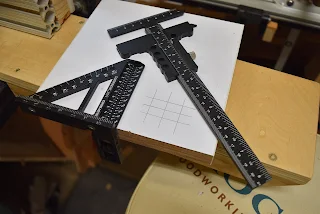


Below, a latest addition to my measuring tools is a T-square mainly for woodworking. The manufacturer in its earlier foray into the online market was not well received due to sub-par or poor workmanship.  It is now producing some very innovative product lines at low prices. Again, this is one where they had improved the design by adding a sliding mechanism where one may insert a pencil or pen to draw lines parallel to the T by moving the T-square along the straight edge of the workpiece at precise increments.  It comes with different  inserts for different pencil or pen diameters.  Quite an innovation that makes scribing precise and effortless, for $20, it is indeed a bargain.


What is the bottom line? 

First, let's separate everything from the prism of geopolitics.

Earlier in my woodworking, as a hobbyist of course, I would scour the flea market for used hand tools made in USA or Europe. With patience, I was able to collect a few really good tools at flea market price.  It required a bit of work looking for and reconditioning them, but that was what made it fun and rewarding.

For the average hobbyist, I recommend the flea market  but the supply of good used tools seems to be running low.  Now, for the flea market price, made in China and Taiwan tools are worth looking into.  Japanese wooden hand planes are still a bargain (even those directly imported from Japan).

And don't skimp on time doing diligent work researching. If you find delight and interest in it, it is worth a bit of fun.  Now, "Made in China" is not a quick and easy answer as you might think.  Fortunately, there is ample material to do your research online and on YouTube. And remember to not be remiss in acknowledging the tireless energy of the ordinary factory worker or backyard crafts people wherever they are who make a living making stuff for other people.

Now, for the geopolitical side of "Made in China".  I will not rehash my views expressed in my earlier blog, "Tariff - Who Will Blink First".  Something is going to give and our best hope is for something to be settled fairly and realistically.  There is the issue of protecting intellectual property which is a subject often broached by those in the West.  Like I said earlier, I hope patent owners are getting compensated, and they should be.  Fair tariffs or some other fair trade mechanism must be a goal for all  sides to address for the sake of the factory workers and businesses from all sides.  Of course, a simplified view like this is not the whole answer; however, the status quo or not addressing fair trade is likely far worse in the end.