Thursday, September 3, 2020

Sometimes There Doesn't Have to be a Reason

There doesn't have to be a reason to bestow kindness to a total stranger. We do not demand it of ourselves nor of our loved ones toward a neighbor, a friend, least or none at all from within our families.

A couple with two young children stopped by a diner at a rest stop. The young waitress who was serving them was noticeably just a few months before giving birth to a child.  She smiled  as she was making her rounds at the few tables she was assigned to but clearly she did not have an easy time doing it, let alone carrying out her chore.  The couple, specially the wife, cannot help but notice.

When the family finished with their meal and about ready to go, the wife and husband looked at each other not saying a word but their eyes said a lot which only the two of them understood.  The husband looked at the check, took out some cash and put them on top of the bill and stood to go to the restroom, and said that they will all meet up at the restaurant's lobby.

The waitress barely saw the backs of the family as they exited the main door.  On top of the check was cash twice the amount of the bill and a folded paper napkin that held more extra cash and a note written by the wife  that said, "Bless you and the baby, take care".  There was no stopping the tears as time seemed to have stood still as she looked out to see which of several cars the family was in that were lining out to get back to the freeway.  Their paths will never cross again; that intersection may be forever erased but it was enough to cause an unimaginable cascade of many other happenstance to occur somewhere else, even in other parts of the world. 

The waitress was home that evening resting her aching feet when there was a knock at the apartment door. Outside was a couple with two paper bags.  The waitress hesitated after staring at the peep hole. She slowly opened the door.  No words were spoken before tears from all three started flowing in unison.  The first words spoken were those from the older woman, her lips quivering, "We brought some groceries and there are more stuff in the car for the baby, and a crib, in case you still  don't want to come home with us".

The waitress now crying and sobbing uncontrollably replied, "Oh mom, I want to come home!"

The other couple earlier at the restaurant and their two daughters are now almost at their destination but still on the freeway.  The two children in the back were very much asleep.  The couple had been quiet the last several miles.  They seemed to be reminiscing about the same thing.

Ten years earlier, the husband was laid off from work. He took a temporary menial job while his wife started working as a waitress, to help out with the family's financial needs, although she was four months expecting their first child. Driving home one day, from his job, the husband saw ahead a stopped car while a gentleman stood next to it fumbling with his cell phone.  The husband asked to see if he could help.  The gentleman said something about a bad back and unable to change a flat tire but he is not getting any signal at all.  The husband offered to do it which the gentleman accepted.  They were talking as the husband was changing the tire.  The husband mentioned that he was a construction foreman months earlier before the mass layoff.  It so happened the older gentleman was looking for a construction supervisor, located at the next big town.

Now, the husband is half owner of the now expanded construction company which he and the older gentleman both co-owned.  The older gentleman did not have children of his own. He considered the couple's two daughters like his own grand children. And he made one promise. When he retires the husband may buy the gentleman's half at the original value when they started the company. He said, "Don't ask because I don't have a reason.  There doesn't have to be a reason."

That episode is of course just half of the world we live in. It would seem these days that there is kindness to go around but also an equal dose of people doing unkind acts to others.  Unselfish kindness matched by extreme cruelty occur as if only to  exact an unexplainable equilibrium on the balance scale. 

Here is something to think about.  The metaphor here will be quick and the reader does not have to spend much time to understand it except to consider the point that will be made from it.  The much accepted scientific explanation of the origin of the universe, but not meant  to cause any prejudice on the reader's own spiritual inclination, is the now famous big bang event.  Right at the moment of creation - the big bang, so to speak, or the rapid expansion of pure energy - particles and anti-particles were generated simultaneously.  When particles and anti-particles collide, or matter and anti-matter, as it were, they totally annihilate each other. But there was one significant quirk. For every one million anti-particles, there were one million and one regular particles.  Had there been an equal number of anti-particles and particles then they will all only have cancelled each other out into nothingness. It just happened that one particle per million survived and taken together all the surviving particles are what we see today as the universe we know.  Like I said, it is the current acceptable theory borne out by complicated equations and lab experiments on particle and anti-particle collisions.  There is more to this, of course, but we leave them to the academics to pursue or debate over.

Meanwhile, we come to where the metaphor leads us.

It would appear, or at least we would like to believe, that the balance scale is tilted just a wee bit, so that for every million unkind things man had learned to do to others there are a million and a few more, much more  acts of kindness in the world. It has to be so because to believe otherwise, would only mean that civilization would not have continued to develop and flourish; or, it would have ended a long time ago.

The world is what it is; however, we do not have a monopoly to kindness.  You Tube videos and National Geographic and the science channels have conclusively shown us a semblance of kindness among animals.  A lioness was shown protecting a calf wildebeest from other lionesses; a herd of hippos saved a zebra from crocodiles; a chimpanzee treating a kitten like its pet; well documented incidents of dolphins saving distressed humans at sea; extraordinary parenting by many species, and so on and on in the animal kingdom.  This is not an attempt at romanticizing animal behavior but rather expounding on the natural occurrences of kindness in so many species and cross-species interactions as to define such behaviors as natural.  

The huge difference is that in the animal world there is total absence of malice.  Left alone their eco-system is managed without prejudice and, I must repeat, without malice.

We cannot be too hard on ourselves when all is said and debated over because the one attribute that no other living things have is that we have the capability to yearn and often act on those yearnings.  We yearn to do good to others and above all to do it in many instances with great sacrifice.  That alone proves to go against the natural instincts of survival and mere self preservation.  

Acts of kindness had overwhelmingly come to be the universally preferred trait over unkind behavior.  Courage and valor had triumphed over cruelty and bad behavior.  Proof?  History is our witness and record keeper. Name one despot, dictator, ideological subjugators and conquerors that lasted even for just a few generations.  Of course, pages of history are filled with chronicles of man's inhumanity but there are just more than enough pages of kindness  to get us to the present, to see civilization's  continued progress toward the universal yearning to be kind to one another.  Our continued existence depends on that.

There doesn't have to be a reason to exercise that trait.  The milk of human kindness is what had sustained us so far.  The biggest surprise is that more often than not, it does not cost much at all. That extra tip to the waiter or waitress, helping others whom you have never met before or will ever see again, a Christmas gift to the mailman, a little bonus to the person who cuts your grass, etc. are such a small price to pay for a gallon of kindness. Those among us who do the extraordinary, or whose acts of kindness were achieved at great sacrifice, or those who paid the ultimate price for others are those among us who prove that the yearning to do such goodness must be enough to show the existence of the human soul.

We are told that we can't know that for sure but why do we have to bet against it. And there doesn't have to be a reason to bestow any form of kindness in this life without regard to whether there is or isn't an afterlife.



Thursday, August 20, 2020

The Long Game ...The Ultimate Perspective

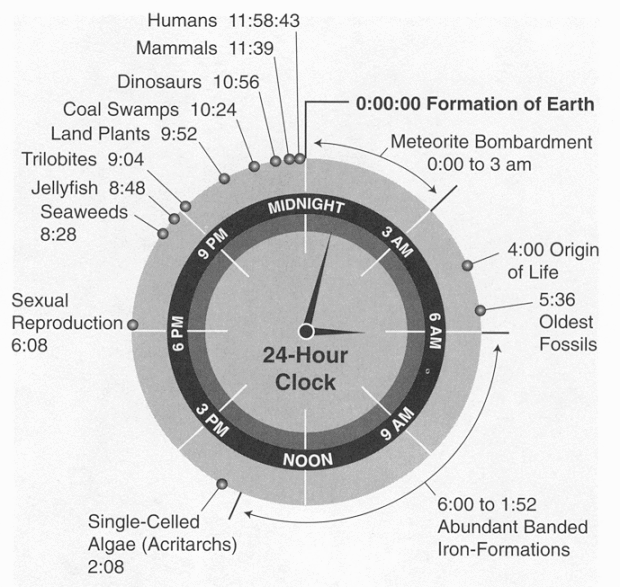
The ultimate perspective for humanity is best portrayed below.  Just so we know our place and time in history, and before we even attempt to revise our most recent past, take a look at the chart.  Just looking at earth's history alone, not the history of the universe, and compressing it into a 24 hour period - a manageable scale for us to grasp - our species did not show up until close to midnight. In fact, it was in just the last minute and seventeen seconds of the total 24 hours when our direct ancestors first emerged, just barely past the age of Neanderthals. Our life time so far is a minuscule sliver, a thin slice of the tip of a finger nail, narrower than a strand of hair, if the entire chart were the human body.


know


Then someone or several folks put together a more ambitious scale - the history of the universe compressed into one calendar year of 365 days.  Let's just visit December 31st.


"What happened on December 31 in 24 hours?

December 31, 12 a.m.: 40 million years ago: Dawn of the primates


Whatever we have heard about the history of mankind on Earth happened on December 31st of the cosmic calendar. This truly shows us the insignificance of our time spent here on Earth. The dinosaurs had roamed the Earth for 5 days, and we were still living in trees on the dawn of that final day. Humanity is quite literally a blip on this calendar, as everything that follows happened on the final day of the year. For more specificity, the time has been shown instead of the date.


14:24 hrs – Primitive Humans were born.

22:24 hrs – Stone tools were used by humans and fire was domesticated.
23:59 hrs and 48 seconds – The Pyramids were built by the Egyptians.
23:59 hrs and 54 seconds – Buddha was born and the Roman Empire was formed.
23:59 hrs and 55 seconds – Christ was born, which marked the beginning of the Roman calendar (0 AD).
23:59 hrs and 58 seconds – Christopher Columbus discovered America
23:59 hrs and 59 seconds – The world as we know it… "

That was the last second.

Today, we are talking about our time since the last Presidential election as having occurred only in the last 0.04 second.


There is a point here somewhere in a bit.

Simon Sinek, renowned motivational speaker is popular with both corporate and military organizations for his powerful presentation on business strategy and analyses of short and long term goals from the perspective of "Game Theory".  He often talks about the finite and infinite games that are the two main components in game theory.

Rules in sports compel finite endings like after nine innings in baseball, or when one team scores more that the other after one or more complete extra innings for each.  Competition in sports must end after a finite period.


However, in life, in business, in military conflicts, make note of the difference when rules are played one way or another.

Sinek talked about most recent events, relatively speaking. He often talked about why the U.S. finally got out of Vietnam, and the French before that, or why the Soviets suffered the same fate in Afghanistan that now the U.S. is finding itself in a deadly and costly conflict in over a decade and a half.  The Soviets played the finite games of winning one battle after the next for control while the Afghans were fighting for their lives, fighting for their survival.  Project that to all the conflicts in the last century and that has always been the disparity in the rules of the game.

Here are a few of my own take on the finite and the infinite rules.


The Nazi Party thought they played the long game with their goal for the Third Reich as lasting for a thousand years. They thought that the so called final solution was a permanent one but the Jewish population was fighting for their lives and their existence. A finite ambition losing to an infinite nature that is the survival of a people. Today, Israel is one tiny country surrounded by most other countries that want to extinguish it. The law of the will to survive and the sympathy of its allies that believe similarly is what is keeping it in place.

Alexander the Great cried when he ran out of kingdoms to conquer at age 33 or so.  He had a short term ambition, like all conquerors before him and all dictators who followed, of winning a finite goal framed within just their individual lifetimes,  while the people they subjugated or aimed to control  were playing the long game of surviving for all the generations to follow.

Let's look at our never ending battle with termites, ants, roaches and mosquitoes, etc.  Our aim individually is to win the finite goal of getting rid of them within the confines of and around our homes while these creatures play the infinite game of outlasting us.  These species will still be around even if we successfully mismanage everything else and somehow cause our environments to be un-inhabitable because we play the finite game while they play the infinite game of survival.  Termites, ants and roaches, even scorpions were here from the time of the dinosaurs and likely to inherit what is leftover if we mess it all up.


I assume all the readers have heard of Block Buster Video.  At one time, for a few years, they were the only game in town on video rentals. They thought, even believed perhaps, that they were playing the long game, with a customer base that will remain infinitely loyal.  Block Buster played the short game of making money on late returns, including charging for un-rewound tapes and for believing that they will have an infinite hold on the market.  Until Netflix came around with their flat monthly rate, zero late fees, unlimited movies, based on a simple 2-DVD-at-a-time turn around.  The rest is history. However, Netflix is playing a much longer game by using new technologies, such as when streaming came along.  They also went into producing their own  video content so as not to rely solely on Hollywood and third party producers and film makers.  Their constant innovations and market reach are based on the infinite game of competing indefinitely.

If Amazon had not kept up by constantly innovating and improving their services they will have been outpaced by Walmart, Target and others who are  not only fighting back, they are capitalizing on their brick and mortar facilities for quicker delivery.  Competition is well played only when one aims for the long game, best if planned and executed for the infinite, always exploiting every opportunity. Failed shopping malls due mainly to online, free return, free shipping competition, are being looked at by Amazon - irony of all irony - for acquisition as fulfillment centers, making Amazon's equivalent of a local presence as ubiquitous as Walmart. And the competition continues.


Dictators, throughout history, have all failed because they played the short game  of a mere lifetime - just their own.  The Roman Empire lasted for a while because it planned for succession with a series of Caesars, and the practice of an earlier version of democracy.  But like all empires it lasted for about ten generations.

Socialism, with many versions of it in the course of history, failed and will always fail because redistributing wealth is playing the finite game of satisfying the people for the short run as socialists try to win their support for the short-term gain for power.  But a far larger failure is when people fail to see the glaring and inherent defect of socialism, but keep subscribing to it anyway.

Succession is what keeps the free market system going and the key that is always ignored is that succession goes to those willing to work harder than the next person or competitor and innovating to keep the lead. 

It seems then that whether we like it or not, we are always presented with the finite or the infinite, when it comes to what rules we want to go by.

When someone finds out after checkout that the cashier failed to ring up one item but ignores to go back and pay for it is playing the short game. If that someone only sees the insignificance of the item as not hurting the grocery store, practically victimless, is playing the short game against the infinite landscape of morality, however seemingly trivial it is.  Cheating on a test, shoplifting a piece of candy, one little infraction - if an individual allows one little thing and another and another to continue throughout one's life - the "victimless" offense in reality victimizes that individual in the end.  One finite game, or so it seems, but then how is it being accounted for in the scheme of the human experience?

We can scour the entire landscape of morality through religion and philosophy and we may find answers as varied as every principle there is available.  We can take a pick.  Hinduism has dealt with it one way.  The principle of  karma is complicated but I found one simple explanation  for the reader, with a quote below:

"A common theme to theories of karma is its principle of causality. One of the earliest association of karma to causality occurs in the Brihadaranyaka Upanishad of Hinduism. For example, it states:


Now as a man is like this or like that,

according as he acts and according as he behaves, so will he be;
a man of good acts will become good, a man of bad acts, bad;
he becomes pure by pure deeds, bad by bad deeds;


And here they say that a person consists of desires,
and as is his desire, so is his will;
and as is his will, so is his deed;
and whatever deed he does, that he will reap."

— Brihadaranyaka Upanishad, 7th Century 


That is one view but note that in general every religion preaches in that manner.  The reader chooses or elect not to choose (which is a choice in itself) but it is widely believed by all that choice has consequences. 

So, where do the finite and the infinite  rules apply in a human lifetime?  A murderer executed after trial was punished within the confines of a finite time and that is the end of it.

Now, here is where Hinduism found its answer. Karma becomes the infinite enforcer in a world where re-birth, or just simply the idea of re-incarnation is applied. The reach of consequences goes beyond one's lifetime all the way to the next one and to the next, until one reaches Nirvana.  In much of western religion, the consequence is enforced upon the afterlife immediately - destination: eternal hell or heaven based on a single lifetime.  When we get down to it both preaches the same except that in one  the individual gets one chance to get it right or wrong; the other allows the individual several, or perhaps an infinite period of re-births until he or she gets it right. The re-birth system for adherents to Hinduism allows, for example, for young children, even new born, another chance at a full life if they passed away early in their childhood.  It only seems "fair" to the children who were never given a chance to live to be good or bad and be judged for the consequences of their choices throughout a fuller lifetime.


We, of course, do not know, we cannot know, and only by faith can we profess what we believe but where there is agreement is that doing what is good, allowing for righteousness to prevail in our lives are consistent with living for the infinite life versus the finite, far shorter existence. This is all to the reader to decide.


Monday, August 17, 2020

It Just So Happens...

Do we live in a world of "it just so happens...?" 

Let me share with the reader the following true episodes.

In 1971 I joined a multi-national corporation.  This was in the Philippines so we were just one of many of its worldwide semi-independently run companies in the region.  In that year, as a new marketing employee, I was assigned a task, just for the week, to host one of the potentially up and coming leaders in the Asian region who was one of many attending a week-long conference in Manila. He was with the Vietnam division based in Saigon. I took him around for a quick tour of my assigned territory of responsibility- a section of Manila - and to meet some of our local dealers.  I will use only his first name - Dai An. An means gracious in Vietnamese, I was told.

We bid our goodbyes when I saw him again after their week's conference was over before he left for the airport.  Later that year I was getting married.  A week or so before that date I received a package delivered to me by one of the flight attendants of Air Vietnam. It was from Dai An.  He remembered my coming wedding and that was his wedding gift.

Fast forward to four years later.  We all saw on TV on April 30 as Saigon was overran by the North Vietnamese Army in 1975.   Needless to say, the Vietnam division of the multinational corporation, like all other companies in Vietnam, was gone. It was tragic to witness it all as the whole country unraveled and turned into an information black hole. Over the next few years that followed I kept wondering what happened to Dai An.  

Fast forward to five years or so later.  My family and I immigrated to the U.S. I was fortunate to have been accepted to work in the U.S. company that was and still is part of that group  of multinational corporations. My second year assignment in 1981 was coordinating our asphalt shipments to various plants in the Midwest. One day I visited our plant at Pekin, Illinois.  I met with the plant manager and after we had lunch, on an after thought before leaving, I went to look one more time at the dock where our barges would come in to unload the asphalt.  It so happened that the tank foreman who oversaw the tank farm was there as well.  During our conversation he revealed that he used to work in Saigon for the same multinational corporation I worked for in the Philippines.   He was Vietnamese and it so happened that his boss there, way several rungs above him, was Dai An, who had since leaped-frog into the Managing Director of aviation supply and distribution after the Manila conference.  And the most pleasant surprise of all was what the foreman revealed. Dai An is not only in the U.S., he works for the same company we both worked for. Dai An was in marketing.

The first thing I did back in Houston was to find Dai An - one of, at that time, 35,000 employees spread out over the U.S. and its territories (only), excluding the worldwide companies that make up the total multinational group that was perhaps five times or more that number.  We talked over the phone and caught up with some of each other's life.  Then a few weeks later on another "it so happened" turn of events he was transferred to Houston on a new assignment. We had more time to catch up over many lunches since we worked in the same building (different floors).  

What Dai An went through is worth re-telling here.

Just before Saigon fell when a U.S. retreat was imminently near, Dai An was asked to remain until the last minute of evacuation to insure that U.S. planes were fueled. Meanwhile, the U.S. consulate flew Dai An's wife and daughter ahead to the U.S. and for Dai An to follow later as soon as all the planes had been fueled.  Unfortunately, as evacuation came to its chaotic end Dai An did not make it out.  He and some members of his family hid and moved from place to place for months and months, using what money and valuables they saved. 

One day just when much of their resources were about gone he and some of his family were able to secure passage on a ship. They were smuggled out like so many boat people we kept hearing on the news and TV. After so many harrowing days at sea, including the rape of his sister by fellow passengers, and near abject starvation,  the ship was intercepted by the U.S. Navy.  Like all so called "boat people" they became refugees, some of whom were brought to the U.S.  

Meanwhile, his wife, like so many separated family members, kept calling the State Dept. to search for Dai An. As we can all imagine there were thousands of displaced individuals for the State Dept. to attend to.  Meanwhile, she also kept calling the U.S. corporate office to help with the search.  The company actually did have HR staff and the services of outside personnel engaged to comb through every refugee camp to search for war-displaced Vietnamese employees of the Vietnam division.  Then one day, they found Dai An. He was at an Arkansas refugee camp. 

After reuniting with his family the company had him go to graduate school at company's expense to earn an MBA degree with a promise of employment after that. He joined the marketing department later and that was where I reconnected with him.

Dai An was a changed man since I last saw him in Manila a decade earlier for reasons that hardly need explaining.  You see, Dai An had all the upper class upbringing, a Paris education and fluency in French like a first language,  He was destined to the upper echelon in the organization and his position even then gave him enough clout to have a Vietnamese Air flight attendant personally deliver his wedding gift to us.  It so happened that the turn of events made him come down from the perch of the upper crust privilege to becoming one of the boat people. We cannot imagine what that was like. His sister never recovered from the physical and psychological trauma that shortly after arriving in the U.S. she committed suicide. Dai An was not a broken man but the struggle to survive took its toll. The effortless smile that I remember was now a struggle between suppressing a pleasant emotion against bitterness and helpless incomprehension of the fate he was dealt.

In early 2000, the exact year I could not recall, he took a Mideast assignment.  We lost track of each other again as I too moved to various assignments within the company.  I retired in 2007.

Fast forward to thirteen years later in 2020, just a month ago.  The gym where I used to swim has never re-opened to this date.  As Covid-19 lock down restrictions eased up a bit the Homeowner's Association Aquatic Center opened the 50 meter pool to the resident-members.  I started swimming there. The lanes were reconfigured to  25 yard lengths cross-wise to accommodate more swimmers and better social distancing for a total of 25 lanes versus just 8, lengthwise.

One afternoon after a few laps I took a break and struck up a conversation with the gentleman at the next adjacent lane who was also taking a break.  It so happened that he was also a retiree from the same company I worked for except that he worked at our Houston refinery.  He too was a Vietnamese refugee who worked for the same multinational corporation while he was in Vietnam.  He was fortunate to have come just a bit sooner than 1975.  And he knew Dai An!  

The sad news, he told me, was that Dai An passed away in 2012. Sadness gripped me once more.

I never had a chance to reconnect just one more time.

In case you haven't noticed there were a series of "it just so happened" episodes.  I visited our Pekin, IL. plant only once - just that one time - and had moved on to other assignments later. It just happened I went to look at the dock one more time before leaving.  Had I not done that I would not have met the tank foreman.  The 50-meter pool's reconfigured 25 lanes, shown in photo, is a large area but it so happened that I took that lane adjacent to that particular one where the gentleman was already swimming.  By the way,  so far in over a month I did not see the gentleman again.


I took this photo during a distant thunder alert when everyone had to get out of the water to wait until the warning was lifted. Note the size of the pool area is not trivial, by any means. Though the odds were not too overwhelmingly minuscule the  "it just so happens" event when taken together with the other previous ones was quite something to behold.


The law of causality didn't seem to be at work here.  The causality principle is meant for one happenstance to cause another to happen and after a long chain of causal events we have history. Here, "it just so happened" had linked certain events to come together, albeit over expanse of years in between. Let me back up for a bit.

Dai An and I even if we had lived in the same country our paths would not have crossed. I came from a very poor family. He came from the upper crust, more at home among the elite national and international luminaries and bureaucrats. Our social circles, our communities, our friends, would have been too far distant from each other for any hope of intersecting.  Even if we, say, worked for the same multinational corporation in the same country, our paths would still not have  crossed had I not been picked to give him that  tour.  In our company at that time, I never crossed path socially or even casually with the senior executives - vice presidents and up. 

I would like to go back to the first sentence above.  Is the universe made up of "it just so happened" events.

Our world - a tiny speck that is a particle of dust in a swirling sea of a hundred billion stars that is part of billions, if not a trillion, galaxies - is home to all who've ever lived and it will be the home for every generation of living things to follow. We limit that to the kind of life we know because to speculate on anything else outside of our planet will  make it an overwhelmingly impossible task to contemplate, let alone  understand.

It just so happens that our sun is a medium size one because any larger and the energy and radiation it puts out might not allow the life we know to develop.  Any smaller and there might not be the kind of energy to sustain life (again, the kind of life we know). It so happens that it is a second or third generation star because as such it was born from a supernovae explosion.  Only a supernova explosion from which other stars are born will produce the heavy elements, like potassium, iron, even oxygen, etc. that are necessary for life to emerge. Only a supernova could have produced silver and gold, etc. for no other event will produce the extreme heat and pressure to make all the heavy elements beyond carbon.

It just so happens that there was a third planet to orbit that medium-size star that was formed 4.5 billion years ago, that is in a zone that is neither too hot nor too cold.  A second planet, Venus, is much too hot for a habitable atmosphere, the fourth planet, Mars, is way too cold for water to naturally exist as a liquid.  It just so happens that earth was the place for the recipe for life to work.  But even when life was fully developed for over many millions of years, it just so happened that a Mount Everest size asteroid hit earth 67 million years ago to cause the extinction of the then super dominant species of dinosaurs so that mammals could emerge to dominate the landscape and bring about the species from which we came. Lest we forget the dinosaurs ruled for about 160 million years.  

It just so happened that it would take that long for a lot of other things to develop so that we are able to live like we do today.  It so happened that there was enough time before we showed up for all the decaying vegetation over millions of years to be buried deep under tremendous pressure for conversion into  hydrocarbon to occur.  Along with that by the way was how diamonds were made.

It so happens that we only have one moon but that it is the right size and distance and orbital speed to cause the gradual rising and ebbing of the tides - its effect on the gravitational pull it exerts but only enough to move the sea level.    So many "it just so happens" that actually boggles anyone's mind.  Did you wonder too that the moon happens to not only be this particular size but to be at a distance between the earth and the sun to make total eclipse possible. But what is really significant is that only a total perfect eclipse, the moon's superposably covering the sun  for Einstein's theory of general relativity to be proven for the first time.  

Just way too many "it just so happened" to get us here today.  As we examine our lives from near or far distant past the number of "it just so happened" events were far too many in a single lifetime. Go ahead, make a list.  The seemingly endless string of "it just so happened" events seem to dictate our overall experience.  Either the universe had been conspiring all along to make it all seem like "it just so happens" or ...

I leave it to anyone with faith of every persuasion to continue thinking and re-thinking this because in so doing you will have realized that it took an endless "it just so happens" to get you here and there will be more to get you to whatever destination awaits you. 


Personal Footnote: When we first arrived in the U.S. I did not immediately apply to work for the same multinational corporation I worked for in the Philippines. It was about three months later that I wrote a letter.  A week after I mailed my application I came across an article in the Oil and Gas Journal at the Brooklyn Business Library (We were in New York and stayed with my wife's sister's family), where I spent some time to read up on business news.  It was pre-internet era. In that article was a featured story on the Gen. Manager for Distribution in that multinational company.  I wrote him a personal letter where I attached the same resume I sent out earlier.  A day after I mailed it, I got the dreaded rejection letter from the company.  It was obviously a response to the application I sent a week earlier.  Had that letter arrived just a day earlier I would not have sent the second one, recognizig the futility of it. But "it so happened" I already mailed the second one but only after I had chanced upon that O&J article, another "it so happened" event.  Two weeks later I received a telegram (again, this was before internet) from the same person at personnel who signed the rejection letter, asking me to call collect for a phone interview and potential trip to Houston. After a month they sent me a plane ticket for an interview.  The rest is history. Clearly, the "it so happened" was quite crucial to how things turned out for me and my family.

Of course, and I say this without any reservation that along with all of those, I also happened to pray a lot, more than I had ever prayed before.

And then ...

My daughter in law with whom my son has two children came to the U.S. with her family on a boat out of Vietnam via the Philippines under similar circumstances that were true for thousands of refugees, many of whom came to the U.S.  Lives unconnected until she and my son met  under "it so happened" circumstances decades after Dai An's and mine intersected in 1971.


Tuesday, August 11, 2020

The Wonders, The Joy of Re-Learning

We, of a certain age, may often hearken to the days of childhood and youth when the unstoppable delight of learning was only matched by the boundless desire to learn more and more at each passing day.  We had the exuberant capacity then and a brain to match the ability of a sponge. We observed, we learned, we remembered, we did and enjoyed all the processes associated with growing up. Of course, farthest from our thoughts then was that  the ticket price for growing up was growing old. And now we, again of a certain age, and you know who you are, are constantly reminded of the adage we used to ignore or deny.  We knew too that, "Old dogs can't learn new tricks" was never an allusion to dogs.  Who ever first coined it, he or she knew what it meant.  More of us today are realizing we could not keep  up with the daily barrage of new technology and the ever changing ways to deal with them.  We sometimes worry but the question is, "Why?" Indeed, why do we and why should we?

If you, again of a certain age, is reading this, has the time for it, comfortably enjoying the rewards and bliss of retirement and the freedom to not have to wake up to the blaring alarm or soothing music or heavy metal wake up call, or whatever gets folks these days to get out of bed at a certain time to go to work each morning, then you are fortunate. What you have, I will tell you, is copious amounts of time to  experience once more the joys of learning.  Actually, it is the joy of re-learning. I will explain.

Covid-19 has opened a door.  Instead of focusing on the glass being half empty we knew we could look at it too  as being half full. Here's one suggested way to do it.

Scrolling through YouTube one day I paused at a topic, "Sine, Cosine, and Tangents Explained", or something like that. The host's presentation, according to him, was going to make his audience understand in simple and easy steps everything they needed to know about the subject in less than half an hour.

Wow! I thought excitedly. Not because the subject matter was new but that for the first time in so many decades I remember it and when I first encountered them. It propelled me back to Engineering freshman year, second semester trigonometry preparatory to differential calculus next semester. Calculus was not taught in high school where I grew up. College was over fifty years ago and since after graduating not once in my entire  career had I ever had to use or apply the practical uses of sine, cosine and tangents, specifically.  I even completely forgot how they worked and what for. I was excited to re-learn the whole thing. It turned out it didn't take longer than a few seconds to bring them all back.  But I was still excited.  Then everything made so much more sense, or I was able to think in terms of how these sine, cosine and tangents have their influences in everyday stuff we take for granted today. 

Re-learning, while not the same as learning, shines a different light.  Sine cosine and tangent have their finger prints all around me, I just realized. How screws and bolts work, propellers and turbines, gradients along curves on highways and race tracks, land surveys that determine your property lines or why your GPS can take you to where you want to go, etc.

It opened doors to re-learn but more importantly the brain is suddenly re-acquainted with long lost chapters in your life, long forgotten challenges and sources of delight. Above is just a mere sliver of an example of things forgotten that are now worth re-visiting.  Every now and then we may want to remember the things that were exciting when we first learned them but more significantly for some of them to mean differently now or that the light they shine presently may reveal perspectives you may never have thought about.

I remember hearing someone talking about the movie, "Groundhog Day".  She was talking about watching it several times over a period of many years at different stages of her life.  She said that each time she watched it, her perspective changed each time. We know what the movie was about, right?  The main character spent his days over and over again in an eternal loop of deja vu. But what she observed was that each time she watched the movie, after having gone through her own life's experiences over time, the movie's message for her changed from the last time she saw it to the time she saw it again.

Indeed, learning and re-learning, even if it is the same subject matter, brings back one different perspective or another.  Answering why is actually the key to understanding ourselves and others in our own circle and beyond.  But that is far too deep, much too cerebral for re-learning to be delightful.

Not ignoring the English majors among my readers, no offense is intended or ascribed, one may find new delight in remembering the differences in poetic style, rhyming mechanisms involved from the simplicity of the children's favorite - acrostics - to the humor of limericks, to the stanzas of sonnets and epic poetry to the 5-7-5 syllable structures of haiku, etc.  Or, why "Don Quixote" may have a different message now from what it had in high school. The music majors of yesteryear or fans of Broadway or opera (two distinct camps that don't often mix) may learn, from re-learning, that "West Side Story" is based on "Romeo and Juliet", "Miss Saigon" from "Madame Butterfly", "Rent" from "La Boheme", "Pygmalion" gave us "My Fair Lady" and on and on.  In fact, some of the stories can be re-examined as to give us pause. For example, one may now frown at the way Henry Higgins treated Eliza Doolittle in "My Fair Lady".  New Perspective, new thoughts that today we could re-examine.

An English major may still cringe at hearing the phrase "different than" when it should really be "different from".  He or she may still be unforgiving because "different than" does not make any sense at all, not ever, because nothing or nobody can be "different than" anything or anybody, except to be "different from". But he or she is re-learning when realizing that common usage makes almost anything universally acceptable.  When "Star Trek" debuted in 1966, hardly anyone noticed, except the English majors of that era, that "to boldly go" was actually improper grammar - splitting an infinitive.  But today, almost everyone is guilty of breaking that rule.  However, re-learning how these things develop over time will open up new doorways for the brain to look into when there is nothing good on TV. Seems corny or insignificant but that is a form of brain stimulation that involves re-examining the once familiar but viewed from a different light today.

Re-learning becomes an undiscovered avenue to actually learn some things for the first time, except that these are stuff one is not only already familiar with but that he or she once had the unbridled enthusiasm for it. I am talking about music lovers who once could tell a Vivaldi composition from Ravel or Strauss (father and son).  The modern enthusiast may brag about distinguishing immediately any John Williams compositions even when he or she only knows the composer from "Superman" or "Raiders of the Lost Ark" and several others.  Ennio Morricone has a cult like following from his famed soundtrack for spaghetti westerns topped by "The Good, The Bad and the Ugly". I mention these because one will be surprised that many of a certain age are re-learning as they hearken to the days of their youthful education.  We must accept the fact that not everyone was enamored with the classics, Greek Mythology, or Shakespeare.  All I'm saying is that re-learning is a way to recapture not just what anything meant to anyone then but how everything has changed or nuanced toward the ever changing views we develop or experience. 

Re-learning is also a way to look back at subjects we may have struggled with but now that there is no longer the sword of a mid-term grade over our heads, we may realize why your high school teacher wanted you to learn algebra or geometry.  Now, you will know the method to the madness except that presently you realize there is a way to distill arguments of today in an orderly fashion as easily as one would assign a value to unknown x, y, etc. in a manner that makes sense.

John Nash "who was awarded the 1994 Nobel Prize for Economics for his landmark work" and whose life was featured in the movie "A Beautiful Mind", was foremost a top notch mathematician who introduced us to "game theory".  I had a glancing encounter with the subject way back in college but lost interest. Re-learning it now is less intimidating but more significantly it comes with the realization of its relevance today when dealing with how or why people take on one view or the other in dealing with social justice, socioeconomic travails and all the political posturing or understanding both sides of the debate that involves society and human behavior.  The thing is we do not need to learn everything about game theory. Perhaps, we only focus on the "prisoner's dilemma" which is one interesting feature of the theory.  Look it up and you'd be surprised at how interesting, even intriguing the simple scenario presented by the "prisoner's dilemma". 

I am just putting all of these out there because in re-learning you may find hidden gems you may have missed back then.  You may be a retired doctor now and you remember how you struggled with chemistry in premed.  Now you can go back and revisit valences or valency of an element that "is a measure of its combining power with other atoms when it forms chemical compounds or molecules".  Biology was more interesting to you then but now here is a chance for re-learning what you dreaded the most but not have to worry about a passing grade.  You could be a retired accountant now and you realize there used to be something about industrial or engineering accounting you did not care for but now you know there was a reason for it.  I can't obviously go into all the possible ways to re-learn anything but it is something to get into when binge watching anything needs a break in this Covid episode of our lives.

Re-learning is like riding a bicycle but now there is a chance to do it with a variety of choices you never once had.  It is like riding a mountain or off road bike and know you may only want to go a few feet or at least make only part of a long ride and that you can get off anytime without anyone to judge you or suffer any consequence from not continuing.  And the good news is that you can do all of these in the comfort of your living room.

You take the good with the bad in social media or consider the good Google and YouTube have to offer. There is a ton of re-learning opportunities from both.  Now, with voice-activated command that comes with almost all new TV, "everything at your fingertips" is now passe.  Just say, "prisoner's dilemma" or "General Relativity for dummies" and suddenly the doors to learning and re-learning are opened up for us, of a certain age, and anyone of a certain inclination to once again re-discover the hidden gems or confront everything that you used to dread in your early education.  

Let x, let y and you know there are a's and b's out there.


Friday, July 17, 2020

Everything To Fear, Including Fear Itself

A year and a half ago I mused about "The Silencing of the Lambs" and four years before that I also wrote about "When Rattlesnakes Don't Rattle Anymore" as a way to record what I thought then about what was happening to the country and to the world so that at some future time I will be able to look back and say, "All my fears were unfounded - our children and their children are after all safe and secure to live in a world far better than what was then.  Their future shall be immune from everything that I've worried about".

Today, I am sad to acknowledge that Franklin D. Roosevelt's inaugural message three quarters of a century ago in 1933 has not converted "retreat into advance".  He said then,

"So, first of all, let me assert my firm belief that the only thing we have to fear is...fear itself — nameless, unreasoning, unjustified terror which paralyzes needed efforts to convert retreat into advance."  ------ FDR, March 4, 1933


Unfortunately, news events today still evoke the very  same concerns FDR worried about. If he were alive today, he would have to lament with the same words when he sees major city streets  plagued with unjustified terror, when a nameless, unreasoning mob paralyzes ordinary citizens. 


Fear itself is inevitable when call to de-fund the police or  abolish it entirely gains momentum and widespread support or that it goes unchallenged. 


Let me share this fable:  A rancher hired sheep dogs to help him manage and protect a thousand heads of sheep in his ten thousand acre land.  Two ranch hands oversaw ten shepherd dogs daily. Using well orchestrated  commands of hand signals and whistles they would direct them to get the herd moving from their corral to grazing land and to the next and back.  The dogs also kept predators away at night and they would find every single sheep that strayed from the herd.  


Everything was fine until one day one of the dogs bit the hind leg of a lamb. The dogs are trained to nip lightly at the heels of sheep that try to separate or stray from the herd.  This time though it was a ghastly wound and in a couple of days the lamb died.  The rancher was furious. He fired the ranch hands and got rid of the dogs.  In their place the rancher's young son and his buddies took over the chore, using their  4-wheel off-road vehicles to manage the herd.  The idea was doomed from the start. By mid-afternoon the young men took lazy breaks, drunk too much, and the sheep went all over the grazing land - mismanaged and out of control.  By the following day what the rancher saw was his land tore up by the 4-wheelers, many sheep missing. Wolves and coyotes were well fed that previous night. All because the rancher was furious with what one dog did.


The country today is torn in half. One half is silenced while the other half is heard loudly and they get louder by the day. The lambs have been silenced.  There is danger too when rattle snakes don't rattle anymore because the eerie silence could be more foreboding.  It was not enough that statues already made to suffer from the daily droppings of pigeons and sparrows, rain and snow and the blazing sun but that they had to be brought down. It was as if by toppling the statues that represented the past which the protesters did not like would make their present better or their future secured. Erasing history is one clear path to repeating it  because ignorance is what they will bequeath to those who follow them.

From a CNN interview: Sen. Tammy Duckworth (D-Ill.) criticized the President's  4th of July speech at Mount Rushmore for focusing on the accomplishments of historical figures. 

“He spent all of his time talking about dead traitors,” Duckworth, a potential Biden vice president pick, told CNN in an interview. 

The senator may not have realized that it was a long list of historical figures  that included George Washington, Abraham Lincoln and Martin Luther King.  The signals of ignorance are glaringly loud and not challenging them vigorously in the press is a clear indicator of the silencing of the lambs.  Rattle snakes no longer rattle as the other half is silenced for fear of unjustified backlash.

"The New York Times is one of the world’s most famous publications – but now an internal battle at the paper is making headlines".

From a British newspaper: "On Wednesday, high-profile opinion editor Bari Weiss stepped down from the organisation with a scathing public resignation letter in which she claimed there was a culture of bullying and self-censorship at the publication.

The 36-year-old, who had been in the job for three years, had frequently courted controversy with her articles – including her questioning of the Me Too movement and her pro-Israel stance – which she said rankled some staff members.

Yesterday, she abruptly ended her stint at the respected publication by posting a lengthy message on her own website which was addressed to the paper’s publisher, Arthur Gregg Sulzberger.

She claimed she had been attacked for her views by co-workers and slammed the Times for catering to the outraged masses on Twitter".

Much of the media promotes and laud diversity, yet it had for years now disabled the diversity of opinions in print and broadcast because social media had become their ultimate editors.  This is akin to permitting only one spectral frequency of light to filter through to their readers and listeners, which is most unhealthy because only the full spectrum of sunlight can provide the necessary disinfectant. Diversity in the population of people and all species of living things is without a doubt the prime mover of the development and improvement of generations over the previous ones that had gone on for centuries. Diverse ideas and debating them among people who are free to express their minds are what gave us the opportunity to experiment. As a result, over many centuries of open debate  in the midst of many human conflict throughout history we have the Hammurabi Code of laws, the Magna Carta, the Geneva Convention, just to name a few. 

Diversity should not be limited to just requiring the proper representation or apparent sprinkling of skin color.  If the diversity of opinion or the free and open expression of what the general population is truly thinking are curtailed in the general media and the workplace then we shall have, if not already, effectively weakened the social and moral fiber of humanity when it is reduced to one monolithic block of thinkers and policy makers.

We should not allow the silencing of the lambs nor should we prevent rattlesnakes from making their noises.  That is the only way we can know they are there. Society is best served - always - when two or more sides are allowed their spot in the full spectrum of sunlight


Friday, June 12, 2020

Of Wealth and Circumstance

If we were to encapsulate the source of anguish or the root of what seems to upset society today as a whole it is the idea of income inequality or the unfair distribution of wealth and everything that is associated with the eternal failure of society to correct what ails itself.

If we were to distill what makes up the landscape over which the battles are fought, figuratively speaking,  it is about wealth and circumstance.

Wealth is that one physical manifestation of one's ability to satisfy a basic need on one hand and all that one aspires to reach and savor the  highest rung, or as high as anyone can attain,  in the hierarchy of human needs.  A $200,000 luxury car and a 10,000 square-foot home are clearly too many rungs above the ground where most ladders begin. Wealth therefore is what separates those with it, or excesses of it, from those only able to satisfy their basic ability to prevail over hunger and  thirst for a day,  under the most basic of shelters.

Circumstance is the condition of where one is, based on events or actions and more primarily where one is situated relative to where others are. In other words being at the right place at the right time is the fundamental function of circumstance.

Put simply, the cattle herder on the plains of Tanzania and the sidewalk vendor deep in the bowels of Tondo, Manila, in north central  Philippines, are hostages to circumstance and clearly their path to wealth is inherently pothole-riddled compared to the smooth pavement  for anyone whose early education began at grade schools preparatory to Eton, or Cambridge or Harvard or Yale.  When it comes to guarantees for success or failure, the odds are determined  by mere circumstance from the start.  But success looks differently when viewed from different prisms.  And defining what success is makes for a more profound introspection.

It may not be so simple.

Jeff Bezos, founder of Amazon, is deemed to become the first ever trillionaire.  I had to italicize it since Microsoft Word has red lined the word, perhaps because  before now such a description of a very wealthy man does not exist.  It used to rest at billionaires when millionaires no longer cut it to the highest firmament of wealth.  Anyway, Jeff Bezos is a very wealthy man. A lot of people had become wealthy in the wake of Amazon's success.  But should we begrudge him and others like him? No.

Since the days of the Rockefeller fortune, Carnegie, Vanderbilt, and later the Walton family and many others in that circle, even as that circle keeps getting bigger, the wealth scale had gotten lopsidedly unbalanced and deemed disruptive to what used to be the "normal "equilibrium between the haves and the have-not. Let's have a look.

First let us consider  viewing it from the rearview mirror of history.  Centuries prior to the Dark Ages, long before the Renaissance Era, the Period of Enlightenment, when kingdoms, fiefdoms and empires where how populations were organized and lorded over by kings and royal courts, wealth distribution was much more severely concentrated and controlled.  The hierarchy of wealth and privilege were so steep that  bloodlines were the only ticket to the top. The ladder was clearly on the shoulders of the masses whose fates were determined by the very few.

Fortunes, however, did change hands time and time again, often through violent upheaval, either from within or without. Kingdoms weakened on their own or were overwhelmed from without through revolt or conquest.  That was very much the history of how wealth were amassed and turned over.  Today's  corporate fortunes and personal wealth go through the same upheaval and turnover, albeit absent the violence and with a lot less malice.  

Fortunes changed hands over many times but every carat of gold, every parcel of land, every droplet of water is still around, earth-bound still, and will remain so until such time when interplanetary investments become feasible.  Yes, until such time real estate investments are available in Mars or on the moon, or  in Alpha Centauri futures. The Jeff Bezos and the Bill Gates and the Waltons of the world and everyone else cannot take it with them anywhere but here.  In other words wealth will remain in circulation and wealth will swirl among individuals and people over generations of changing circumstances.  

The debate has always been about whether high tide lifts all boats or do high tides rise over the heads of the less fortunate and who are without boats? Ideally, the idea of lifting all boats seems simple enough  but what we are forgetting to account for is that no matter where the tide is, it is always about the fact that some folks were just able to build bigger boats.  Should we begrudge those who did?  Today empires, business empires that is, are built not from force or violent conquest, but by working harder, toiling under almost impossible odds, harnessing technology, unfettered determination and stick-to-itiveness (it may not be a word but y'all know what I mean) and always discovering new ways to do things that others did not see before. That is where the bigger boats come from.

One thing to remember though is that bigger boats can only be built where the water is deep.  Elon Musk, had he remained in his country of birth - South Africa - he would not have had the opportunity to create and make a success of Tesla and Space X.  The right circumstances which are the fertile ground for innovation and sufficiency of capital are what the U.S. had become to anyone with a vision and drive and willingness to take risks.

Wealth and circumstance are what powers the wheel of fortune but both cannot escape or ignore the gravitational pull that society demands if civilization were to continue to survive and flourish.  

It is, of course, considered and expected that the human character today has evolved from centuries past so that it is proper to expect that those who have are able to share their good fortunes with those who have less. If it were only that simple.

The needy needs to be helped.  The wealthy can be expected to help.  Even if we all can agree on that simple balancing formula, it will always be contentious when we change the verb and adverbs from "needs to be" to "deserves to be" on the part of the needy and "can be" is changed to "should be" - and every degree of severity in between.  The plea for help becomes a demand for entitlement and since the principle of zero-sum always apply in wealth distribution, friction is always created between the have and the have not.  That is the essence of the debate on income inequality.  

So, do we really have it so bad today?  That cattle herder in Tanzania and the young sidewalk vendor in Manila have today a hundred fold better chance of breaking the mold of their circumstance than the child of a peasant family indentured to eternal servitude, or those enslaved through conquest or purchase during the dark chapters of history.  This is not to make light of today's suffering by the under privilege but I and a host of many others have a personal story of overcoming the circumstance of birth and took advantage of what  chances there were, no matter how  meager the odds,  to better our lives.  For all whose lives had gotten better from hard work and determination, timing in history made all the difference.  Circumstance may have a lot to do for the wealth distribution but that is not all there is.  

If the object of having wealth is ultimately the attainment of happiness, society was wrong all along for looking at the wrong places.  

Forbes recent survey on the happiest countries in the world, the top ten are not economic giants and the U.S. is ranked no. 18.  All of the Top 20, except for Costa Rica, no. 15), are all from developed regions of the world, topped by Finland and Denmark, while the unhappiest countries all come from third world countries, where Afghanistan and South Sudan are the two most unhappy countries.

Happiness is a state of mind, wealth is just a status of some kind.  Happiness is therefore self-measured while wealth is measured by others.  A bank account is a financial measure that can be determined by external audit, while happiness is a personal appraisal no one else can claim to measure nor covet.  While physical assets and titles to property are transferable, often by mere signatures, happiness can neither be assigned or mortgaged, nor can it be devalued by decree or by crisis.  Currency can be confiscated or lost.  On the other hand the capacity and desire to be happy are the two qualities that cannot be determined by wealth and circumstance.  It is possible, in fact, that happiness is independent of wealth and circumstance.

King Arthur and Guinevere from the musical "Camelot" pondered why simple folks seemed happy and content than they were - both who occupied the throne and therefore the top rung in the hierarchy of privilege and wealth.  Guinevere pondered, "What Do The Simple Folks Do?  Two of several stanzas are below: 

Guinevere:

"What else do the simple folk do?
They must have a system or two
They obviously outshine us at turning tears to mirth
And tricks a royal highness is minus from birth
What, then, I wonder, do they
To chase all the goblins away?
They have some tribal sorcery you haven't mentioned yet
Oh, what do simple folk do to forget?"

King Arthur:

"Once, upon the road, I came upon a lad
Singing in a voice three times his size
When I asked him why, he told me he was sad
And singing always made his spirits rise
And that's what simple folk do

I surmise."

There is truth in that wealth and power are not only the wrong answers to happiness, they could be the precursor for sadness if not handled properly.

In fact, it is possible that the mere circumstance of being free from want is all the wealth anyone will need.