Friday, November 8, 2019

Memory

Elaine Paige, playing the role of Grizabella in the Broadway musical "Cats", first sung this now  popular, definitive song about a once glamorous cat - a celebrity in human terms - now a shell of what she used to be, faded and even irrelevant, pining at the time of yesteryears, defined by the second paragraph of the song:

Memory, all alone in the moonlight
I can smile at the old days
I was beautiful then
I remember the time I knew what happiness was
Let the memory live again

Memory. The one that has taken up residence in our heads  is a universal something that even earthworms, jellyfish and clams possess, but is still for the most part a mysterious phenomenon. We all have memories but each is exclusively personal and subjectively so. Only as an individual can anyone know what his or her memory is and no one  else can actually even take a peek or look at what's inside another's mind,  unless the person who harbors the memories says what it is, or more precisely what he or she remembers, or what he or she is willing to share.  "Knowing" one's memory too is tenuous at times. And there lies another mystery. Why, how we remember is one thing. What we remember is another. How accurately one remembers is one more to add to the complexity. 

Memory is essential. It is, above everything else, the very first tool for survival. How  organisms find food, seek shelter, avoid danger are only possible because they remember. Why one mammal will run after prey but flee from predators is that delicate balance between life and death in the natural world. In a nutshell memory is at the very foundation of what defines life. But it is likely the most complex of all the attributes of being alive. And in death that is how we will be remembered by others. But it is their memories of you. All of what you yourself remembers, all the memory you have accumulated will have all gone with you. It is intriguing, so mystifying, it can be frustrating, even.

Is memory some kind of record keeping the brain organizes for you?  Is it a scrapbook it puts together for you to look at from time to time?  Is it the Post-It notes that your brain puts on an imaginary bulletin board for you to refer to every now and then? Are they Post-It notes of mistakes you should avoid in the future, a reference of the right things you've done and ought to do each time the same circumstances are encountered or are they  the checklist of bad ones to be avoided? It is apparently all of those, including the ones when you felt harmed by others.  And they are there to remind you later when you get the opportunity to return the "favor".  Then there are good ones too to remind you to be grateful to others or just to be reminded how fortunate you had been where others were not.  It is all of those, in fact.

Having thought about all of those, memory might seem this perfect complement  to everything that exemplifies us from other creatures. You see we have this ability to not only review and analyze but to critique our memories as well, that no other creature is able to do. And why we do this is because we know or it had been pointed to us on more than one occasion that perhaps our memories are not so perfect after all.  And indeed, we know too well memories are not perfect.  So, our brain then is not infallible? And if it is not, why?  See, here is the thing.  Certain people do have such a prodigious memory, others known to have total recall, though limited along narrow subjects, such as, cards and numbers and calendar dates, etc. But often these folks have deficiencies in other areas of memory management or even normal social behavior. The extreme "savants" are often saddled with other inabilities that most normal people are able to do, like empathy and sorrow that "gifted" individuals can be oblivious to.  So, what gives?

The brain is not made for total recall then? Or, is it  that our mind (there is a difference) is not? It is common knowledge, true or not, that squirrels can recall every nut they bury in the ground and that during lean times they go and find them, even after a very long while. One biologist, perhaps another one of those with time to spare and with grant money to spend, took the time to find out. It was a very scientifically sound method she used and she found that squirrels can only recall 90%, give or take 10%, of every buried nut. That is, of course very critical in the realm of ecosystems. The oak tree, for example, is assured that at least 10% of the acorns it produced will germinate and perchance grow to become another oak tree.  The tree's investment paid off. The squirrels that help to spread the acorns get rewarded by 90% of the nutrients the tree produced, but they would, conveniently or not, forget to find some of them, particularly in places far away from the parent tree. Everyone benefited. Thanks to the fact that perhaps the squirrels brain is not so perfect.

What about our brain? It is true that eyewitnesses to a crime sometimes differ in their recollection, even if their observations were concurrent and even from the same vantage point. Is it because the brain is not designed for total recall? For sure, from the beginning of time, the brain did not anticipate to solve algebraic equations and integral calculus or remember chemical valences, or baseball statistics or which monarch followed whom during the entire reign of the Tudors.  That is why we invented computers, wrote text books and posted on Wikipedia.

Perhaps there really is a better explanation for why the brain does not do total recall so well.  For one thing, it is good at filling gaps, accurately or not, and it can be manipulated to harbor false memories, like people who honestly believed, once enticed into believing, that they saw or even hugged Bugs Bunny when they last visited Disney World years before. That can't be true, of course, because Bugs Bunny is not a Disney character and there was no way it would have survived ten seconds before Disney security and cameras found it loitering in the Magic Kingdom.  But such suggestions of false memory succeeded in infiltrating unsuspecting folks who unwittingly believed their implanted memories.

There is an upside in all of these. Forgetting resolves a lot of clutter in our brain. The brain is good too at erasing bad memories.  Sometimes the brain takes it to extreme and people get amnesia - almost erasing an entire period of their experiences to avoid remembering one horrific trauma. It is like a mental check valve, which is good, gone haywire that turned into a total shut-off valve.  But amnesia is real but thank goodness it can be reversible.  Then sometimes too the brain goes way over active on certain things. Inexplicably, people develop phobias. They don't go on dates on Friday the 13th, athletes go through some weird routine to improve or even try to insure victories with no apparent basis, other than to wear the same pair of socks for every game so as not to break the streak. The brain can also cause a mental loop that  propels obsessive/compulsive behavior. But there are some great things the brain does with its ability.

Memory. It is more than a survival tool. We may yet discover other good tricks the brain can do for us. Meanwhile, there are really great things the brain does to use memory as a coping mechanism.  More than that the brain provides us something much more than just the ability to remember.

Memories become these wonderful companions for many of the older folks who, by no choice of their own, live by themselves or feel alone even when there are people around them in nursing homes or around family  members who choose to ignore them. The memories of these folks are their friends who from time to time call on them from the deep recesses of their now distant past, to comfort them and assuage the loneliness.  Memories, accurate or not, are now flush with vivid colors and countless beautiful moments, that are the video and audio the brain sometimes put together for the person no longer able to experience the world out there. Wheelchair bound or not, the brain takes the elderly to places he or she can no longer go to. Memories, sometimes made fun by others for the repeating loops of the elderly's tales, are actually the brain's gift to us.

Let me repeat the two stanzas from the song, one more time,


I remember the time I knew what happiness was

Let the memory live again


Sunday, November 3, 2019

You

On one of your emotionally down days - everyone has those kind of moments at one time or another -  you may wonder or even second guess what your true value really is in the worldly scheme of things, or whether your life is up to some noble purpose or, at least, of some relevance or pertinence to others. If that has not been apparent to you yet or not quite made clear to you and to others who care about you at this point in your existence, there is something you must first consider.  It took a lot to make you you.  However, when you do want to look at that, you are faced with, "what, who, took a lot to make you, or to create you?" Well, before you get to that depth of thought, you may want to begin this way, first.

A new book just came out. "The Body", subtitled, "A Guide For Occupants", written by Bill Bryson, is one engaging book.  Easy to read and quite a wealth of material that is all about you - physically. Now, since it unmistakably refers to you as "occupant", you will also have to wonder.  Does occupant mean, "occupancy" in the temporary sense, or is it permanent only in one sense? You will not find the answer to that specific question in the book but there is so much there that perhaps can or will lead you to the answer, if you elect to do that. Or, you can just be satisfied in knowing that "it" took a lot to make you you.  But first things first.

The author begun on page 1, "Long ago, when I was a junior  high school student in Iowa, I remember being taught by a biology teacher that all the chemicals that make up a human body could be bought in a hardware store for $5.00 or something like that. I don't recall the actual sum.  It might have been $2.97 or $13.50, but it was certainly very little even in 1960s money, and I remember being astounded at the thought that you could make a slouched and pimply thing such as me for practically nothing."

That was the estimate then and by any measure, including accounting for inflation, you are apparently very cheap to make.  However, now that science has finally caught up with a little clarity on what really makes you, in current dollars, and the discovery that some exotic chemical elements, such as thorium, niobium, etc. are part of you, the average human body can now be made precisely for $151,578.46 worth of materials. Of that total amount, calcium, potassium and phosphorus account for $73,000.  Add labor cost, sales tax and other "incidentals", you, if you are of average build, can be had for just under $300,000.00.

But, from another source, like Nova, the science show, the value that was presented was a lot less. $168 dollars to make you. The difference? The first modern estimate, from Britain's Royal Society of Chemistry, took only the finest carbon, 30 pounds of it, that by the way cost $69,550 and the purest form of oxygen that is 61% of the total body weight, pristine hydrogen and other exotic chemical elements that together make up all 59 of them to make you. Oxygen and hydrogen will only set you back, relatively, a meager $40. But when all is said and done, that's what you get from an estimator that combines British, Royal and Society all in one line.

Anyhow, based on those two numbers, you could be worth an economy version of a Bentley, or a Lamborghini Urus, or  maybe a Mercedes Maybach (taxes and delivery fees already included for each vehicle price). Or, all of the entire you, based on the Nova estimate, is probably worth just two tickets for an early-in-the-season major league baseball game plus two drinks and four hotdogs.  Those are not premium seats either. They're halfway between  the nose-bleed sections and the dugout.

Whichever it is, if you must know, chemically you are a carbon based organism, where oxygen and hydrogen are a compound in a mixture of 2 parts hydrogen and one part oxygen, otherwise known as water, which accounts for a good chunk of your weight, depending on your eating habits, of course.

You are special because among all the living creatures, you are the only one who is self aware and self conscious. You are concerned about how you look - to yourself and to others. And sometimes you could be preoccupied with how others look to you. Another quote from the book,

"Beauty is only skin deep, but ugly goes down to the bone."
                                                                            ---- Dorothy Parker

Dorothy Parker was a satirist (and poet) whose life straddled two centuries. She was born in 1893, died in 1967. It was easy for her to say, she was once young and attractive.

She was right about the depth of beauty though. The outer layer, the epidermis, which is how you look to or recognized by others, is only 0.1 millimeter, or about the thickness of bond paper. The skin is the largest organ, about 20 square feet of area, but its pigments are definitely only onion skin deep, yet that is how you are defined racially.  Underneath, white, black, brown, are skin colors so inconsequential, they are  irrelevant.

Now, here is where it gets you to think a little too deeply. If you are indeed average, your body will consist of about 37 trillion cells, all doing different things to keep you "alive", physically that is. Of all of them, not a single cell actually recognizes you, or even care who you are.  They all kind of do their thing, oblivious to who you really are. Even more astounding is that at the atomic level, there are 7 octillion (billion billion billion) atoms to make you.

Bill Bryson wrote, "No one can say why those 7 billion billion billion have such an urgent desire to be you... Yet somehow for the length of your existence, they will build and maintain all the countless systems and structures necessary to keep you humming, to make you you ..."

And here is where you might think more deeply. Bill Bryson, as exhaustive as his writing was, does not cover this, or even give a hint. You are the occupant of a body that does not recognize you but you are the only one that thinks, or care. So, where do you get that ability. Consider this then. It can be controversial, it may not even make sense, but equally hopeful. You may recognize it or this is entirely new to you. What, if indeed your occupancy is temporary in a body made up of cells and atoms that are there merely as a temporary dwelling.  Absurd perhaps but does it not give you much more to look forward to when you know your consciousness could conceivably transcend the existence of 37 trillion cells?

It took maybe 2-3 billion years before you became you. Your DNA can be traced back to proto organisms, a fist size primate, and that 50% of your DNA are shared with a banana. You are smiling or rolling your eyes but you can find this out with a few keystrokes.  Right  now, while you're on your smart phone or tablet, or in front of your desktop. Any break in the cell divisions along your genealogy or the path taken by your ancestors that led to you and you will not be reading this. It took unbelievable circumstances to get you here at this present moment.  It is something to behold. DNA is one of the most enduring phenomenon in nature. It can last for weeks, months, years, outside your body, or millions of years deep in the crevices of a piece of bone.  The trail it left behind to get you here is 2-3 billion years long.

No more speculation.  Just think. There must be more purpose, there must be a universal reason that you are you. To think that will not only give you hope, you will overcome fear, you can look forward to the idea that your physical body is afterall suited only for temporary occupancy and maybe, maybe this thing about spiritual meaning and transcendental existence is what it is all about.  Your call. It is you that matters.  It is all about what makes you you. 


Wednesday, October 23, 2019

Texas

Image result for texas map flag images


Of the several so called sunbelt states that have become favored locations for companies to relocate into, Texas was in the news lately because of an unlikely move by a French company, Louis Vuitton, to a small town just outside Dallas for its  100,000 square foot "workshop". Keene, TX, population 6,300, will be Louis Vuitton's new site - in a 256 acre former "dude" ranch. French billionaire, third richest man in the world, Bernard Arnault is staking part of his fortune in a small Texas town where Louis Vuitton products will be made and labeled "Made In USA".

Large, medium, small companies have been slowly migrating for quite some time now by moving either their whole companies or portions or branches of them into Texas. Growth in housing development and expansion of infrastructures had been steadily increasing even from decades earlier.  Lately though the pace can only be described as feverish. But this trend had a much earlier beginning.

In 1971, Shell Oil Co., with headquarters in New York city, where  several major oil companies were based, like Exxon, for example, made the very first bold move of a major corporation. The entire move took two years to complete beginning in 1969 at a '70's cost of 35 million dollars, which included one little dramatic highlight of loading several jumbo (747) air transport flights one weekend to move all office files and records in one fell swoop. Since then, the flood gates opened to all kinds of businesses, including Toyota's Tundra pick up truck factory in San Antonio. Austin, TX is now arguably dubbed the Silicon Valley of the southwest.

"Texas is the best state in America to start a new business, according to a new study conducted by WalletHub. The credit website analyzed each state across 26 indicators of startup success to determine its rankings. Texas topped the list with a total score of 61.05, ahead of Utah, Georgia, North Dakota and Oklahoma".

Among several categories which the above and other studies cited, Texas was no. 1 in business environment. Add to that lower corporate taxes, zero state taxes, reasonable sales taxes and more importantly - very low energy costs. We can talk about oil in a bit because Texas too is the palpable antithesis to the  Green New Deal. But later on that.

Meanwhile, for would be employees willing to move with their companies, or adventurous job seekers (who also come in droves), the attraction of low cost of living, absence of punishing regulations and a climate that was  best explained to me by the airport shuttle bus driver when I first set foot  on Texas soil almost four decades ago. He said, "We only have three seasons here: July, August and Summer". That was tongue-in-cheek funny, of course, but not too wildly inaccurate, by Texas standards where, "Everything is big in Texas" is as popular as its nickname, "The Lone Star" state.  But as to be expected from those who live in the northeast and  West Coast USA, they may most certainly make fun of the Texas heat to which Texans reply that not only can they take the heat they also know how to spell humidity. This takes me to a short side note of a personal story that was sealed by the Texas climate.

It was August 1979, when I flew in for a job interview while staying temporarily in New York. It may not have been the right time to emigrate as newly minted Green Card holders when the U.S. jobless rate was between 7-9 % (average '70's numbers). And rate of inflation was at 13%. It was a critical interview for me because there were my wife and two young sons  and me living temporarily with my wife's sister's family in Brooklyn. At that point the stack of rejection letters were already scrap-book-thick and a meager couple of interviews that were over the phone with no follow-ups. Though not quite in panic mode yet, the Texas interview floated much hope when the prospective company sent me a plane ticket and a confirmed reservation at the downtown Hyatt Regency.

Did I already mention it was August?  The morning after my host took me to breakfast, she led me to a series of interviews all morning long. By noon, three of the interviewers and the host took me to lunch. The downtown walk to the restaurant proved pivotal. There we were walking the hot pavement with that day's temperature in the mid nineties and a matching humidity of above 90%. And there I was praising how great the weather was. I must also have mentioned that when my family arrived that April, we left our homeland when it was 95 deg F in Manila. When we landed at JFK international, the frigid blast overwhelmed what would have been a typical culture shock of the expected kind for most immigrants. That day's temperature  of  54 deg F must have been balmy for New Yorkers but it was a 41 degree drop for us. I kept talking about that during lunch at the revolving restaurant at the Hyatt and my host and interviewers took crucial note of it.

A week later, I got a call from the company HR recruiter. He asked if I'd agree to another interview over the phone. It was not an easy interview over the speaker phone (of 1970's technology) simultaneously by two people I couldn't see, who were sitting in a regular office that was obviously not acoustically tuned for telephone job interviews. Furthermore, they represented an entirely different organization from the one I originally interviewed with. To be unprepared was an understatement. 

I got the job, followed by a series of many other assignments but remained in Houston until I retired. It is worth mentioning here that had I not talked so positively, if not glowingly, of the 90 deg day during my first visit, circumstances may have been a bit different. You see, the job I originally interviewed for was at a New Jersey location. When I left that day, the interviewers must have made a note that there was no way I was going to survive the northeastern winter. The company thought wisely to have me work in Houston.  The rest is history.

So, decades later, Texas weather has not cooled down one bit but its economy is sizzling hot. The ports of Houston/Galveston complex that used to share a good chunk of imported oil to be processed by a host of refineries within and outside the city limits, now exports 1.5 million barrels a day to various parts of the petroleum-consuming world.

Below is a quote from CNN Business last August, 2018: 


"Texas is now on track to produce more oil than either Iran or Iraq. That would make Texas No. 3 in the world if it were a country."

"The shale boom already made the United States a net exporter of natural gas in 2017. And the EIA recently predicted that the United States will become a net energy exporter in 2022. That achievement could come as early as 2020 if oil prices are high".

The above prediction was already achieved this year, in early 2019.

Having said all that, such fortune is as easily reversed as in one period of a day if in November 2020, the national election goes one particular way. And if one particular presidential candidate who vowed to end all fracking activities in his/her first day in office wins the election, such misfortune for the state and several others from Oklahoma to Louisiana to North Dakota, can only be described as more than catastrophic. The economic cardiac arrest for those states will be sudden and fatal. For Texas the depression to follow will be one insurmountable sinkhole.  For the country it will be one fatal single blow. One self-inflicted wound to an economy.  One unnecessary death of common sense.

Actually, it is quite miraculous for an industry to survive when much of what it had to deal with is fraught with constantly moving goal posts imposed by its detractors. Imagine an industry that keeps striving like a runner who sees the finish line constantly being moved farther and farther. But it is to be expected in any industry. Except that all industries, every single one, cannot do without energy. Energy that over ninety per cent of it is produced by an industry much maligned and vilified by forces of many faces past that today is fronted by a recent reincarnation with the same theme - to end the "scourge of the oil business" - that is now known as The Green New Deal.

All can be fair and well in a hotly contested issue if not for one side to be so blatantly hypocritical in a manner that is clearly defined by the all too selfish  dictum on the part of politicians and anti-oil proponents which is, "Do as I say, not what I do". Hypocrisy is when political candidates, leaders and luminaries behave counter to what they are preaching about. Certainly not by racking up a million dollars worth of private jet take off and landing on short trips in a 3-month period (for one candidate alone) while campaigning and championing environmental causes, or going to environmental conferences in flight after flight of private jets, met and driven around town by heavily armored limousines that guzzle hydrocarbon fuels by the bucketful every ten miles in heavy traffic self-created by the horde of conference participants from all corners of the earth. Keep in mind this hypocritical behavior is cloaked with what could only be an imagined fear of an existential threat repeated over and over. If true that the world will end in a horrible last gasp for clean air, why the heck then do these folks criss-cross the world with the worst carbon offender of any transport mode - the private jet. This mode introduces carbon directly to the upper atmosphere that is the moral equivalent of an intravenous feed to nature. Let me correct that. It is actually the literal equivalent, indeed.

Hypocrisy is opposing new refineries to be built in the East Coast or California but turning a blind eye to the fact that oil products continue to arrive via pipeline and barges to satisfy their needs while adhering to saying NO! to any new facility in order to fulfil their noble intentions. This is all in plain view when in fact new refineries on site will have saved consumers money by producing refined petroleum products nearby. In one of my earlier assignments I had a huge map of the U.S. in my office (that was pre-cubicle days back then) depicting a spagheti of pipelines criss-crossing underground mostly originating from the Gulf Coast (Texas and Louisiana) where many of those pipelines deliver gasoline, diesel and even natural gas to the East Coast. Those pipelines still do operate today so the vociferous opposition to the Keystone Pipeline between Canada and the U.S. baffles the mind of a lot of people. 

The oil industry responded to leaded gasoline issues by taking it out of the market and a new menu of cleaner gasolines came with adjusted vapor pressures for summer and cooler driving seasons.  More than any other, the petroleum industry has done so much more to improve its product line at huge costs but it must never be lost in people's minds that more than anything it had the greatest impact at making people's lives better than it had harmed. Surely the whales are thankful. Pre-petroleum times meant whale blubber was all we got to lubricate the wheels of progress, both  literally and figuratively.

What will we do with healthcare if there was no plastic in the hospitals - from syringes to medical equipment, to germ-free and bio-hazard containers, even organ portable transporters in ice are made of plastic, so are plastic to store and move plasma, medicine bottles, etc.  Imagine a world without plastic today and you are instantaneously transported to medieval times. Take gas and electric heating and cooking away and the stone age is what awaits you in a blink of an eye.

In my other assignment I scheduled and coordinated the movement of asphalt from our midwest refinery up and down the Mississippi and its tributaries via a fleet of barges. I used to imagine back then the significance of the product that was literally the bottom of the barrel that had little glamor even among my peers who'd rather be involved with the more popular oil product lines. But I was convinced of its value for if not for asphalt there would have been thousands of miles of dirt road across interstate highways and rural roads. Instead, you will find today black ribbons of the quietest highways along Kentucky, Tennessee, Indiana and countless regions of the country and the whole wide world where asphalt roads are the gentlest pavement your car or truck will ever run on. The easiest to patch and repair as well. And rubber on your tires last and remain true for 30 to 50 thousand miles of use, carrying loads of anywhere from 2500 pound automotive vehicles to the longest 18-wheeler behemoths only because of carbon mixed in with the rubber. Why they're black is simply because carbon black, another bottom of the barrel oil byproduct, is what strengthens natural rubber like no other substance can provide. Again, try and imagine your life without petroleum and you'll imagine how impossible it is to live the life that you had been used to even if you consider only the past decade. You will have no smart phone, laptop, or a lot of everything that makes your everyday life comfortably and safely lived. You won't travel far. You will not see much of the world and not much of the world can see you either.

Texas. It is everything the Green New Deal (GND) will not want you to see or reside in. It is not the argument GND will want to face.  It is not the answer GND will want you to consider. It is not the state GND will want the rest of the world to idealize or use as an example.

I urge the reader to look at Texas a little differently now.  Texas is the barometer that will determine how this country chooses to govern for the next few decades.  Texas is what is needed to counter the brewing perfect storm of climate ideology gone insane, the gathering winds of socialism and the soaring drowning wave of political correctness. 

I leave you with this dreadful news barely 24 hours ago:

"Seattle’s public-school district has proposed a new math curriculum that would teach its students all about how math(ematics) has been “appropriated” — and how it “continues to be used to oppress and marginalize people and communities.”

That right there is the true face of an existential threat, the totality of the ideologues' total loss of sanity when even one of the best tools of teaching is demonized to advance one crazy notion of social justice that will have an economic consequence.

Go the Texas way instead. Where universities still teach petroleum engineering, and math is the clear language of choice. 

Inevitably, the reader may ask, "What about the heat? How does one deal with it?" 

In Texas where gasoline and energy costs are low, air conditioned cars and fully air conditioned homes are basic amenities  that are within the affordability range of the regular wage earner. An air conditioned workplace and offices are the norm. Where it gets to be too much is when Texans air condition their garages. Now, that is the extent of Texas braggadocio. Only eclipsed by the Texas version of southern hospitality. When y'all get the opportunity, grab it by the Texas Long Horn.


Tuesday, October 8, 2019

.071 Megabytes

.071 Megabytes was the total memory that was on the computer aboard Apollo 11 in 1969 when the first humans first landed on the moon. Today, the Apple X has 64,000 megabytes (or 64 GB).

Two years after the moon landing a 15-key hand held calculator made by Sharp (Model EL-8, imported from Japan), was only able to do four basic arithmetic functions (no square root or % function). It was sold for $345 in the U.S.  Today, the most basic 24-key hand held calculator, solar powered, 8 digit display, with % MC RC and square root functions at Staples, will set you back $3.99. You will spend more than that for lunch  at any fast food diner. And remember, $345 for the Sharp calculator was in 1970's dollar. Account for inflation and we're talking some serious financial outlay then and now. In the 70's minimum wage was $1.60 an hour. How in the world did people manage back then? Well, a minimum wage earner then had to work 215 hours, pay no taxes on his/her wages, to afford the Sharp calculator.  Today, the minimum wage earner will work for less than 20 minutes to buy the basic calculator sold at Staples.

Back to 1969. How did Neil Armstrong, Buzz Aldrin and Mike Collins manage to reach the moon and back with a "computer" so puny  no toy designer will use on a remote controlled toy car designed for six year old kids today?

A well known story about the first moon landing was that Neil Armstrong took over the controls of the moon lander when he realized the designated programmed landing zone was not a safe one. His training, his disciplined engineering mind and resolute courage  took over the lander and the rest is history. His mind, used to using slide rules (a relic and a collectible item today), was his main asset unaided by even a minuscule amount of high tech gadgetry we see today in video games alone. The support personnel back on earth were using the same slide rule that was the main tool all engineers then used to calculate everything from designing the rockets; the capsules, the moon lander; fuel mixtures; mapping the entire journey from here to the moon, etc.,  How did Armstrong manage to achieve such a feat a quarter million miles away from earth?

Answer:  "the brain’s memory storage capacity is something closer to around 2.5 petabytes (or a million gigabytes). For comparison, if your brain worked like a digital video recorder in a television, 2.5 petabytes would be enough to hold three million hours of TV shows. You would have to leave the TV running continuously for more than 300 years to use up all that storage".

That is a quote from a Scientific American article.  So, Apple X has 64 gigabytes. The scale of puniness just got got turned upside down big time, didn't it?  The human brain is  indeed that magnificent!  And Neil Armstrong probably used only a small percentage of his brain capacity to maneuver the lander.  He had hours of practice with the lander on earth's gravity months earlier. The challenge was doing the same chore at 1/6 the gravitational pull that he was used to on earth, made all the necessary hand/eye manipulation to adapt to the airless environment with little fuel to spare. And he did it flawlessly. A three-pound mass of brain matter was all he relied on.

Apple X, eat your heart out.

That is how amazingly phenomenal the human brain is. Unfortunately, it is not invincible. It can degrade with time, a natural process called aging. Obviously, we will have to admit that an average 65 year old today has not had the time or inclination to have accumulated the amount of information that even come close to filling up 2.5 petabytes of memory capacity - not even close. Nevertheless, whatever we had accumulated in memory, bit by bit, are all still there. The problem is that our retrieval system, unlike a computer, is likely to malfunction with age.  We forget. We cannot recall. Learning new stuff gets a bit harder, if not entirely impossible. Often, we give up even before trying. Is there hope? I think so.

Back to the mid 60's one more time. A milestone of some sort was something my classmates and I relished as we started the first semester of the third year of a five year engineering education. For the first time we were required to get a slide rule, learn to use it via a 2- day tutorial. From then on it became almost an appendage we could not be without  at all times while in class. The slide rule was not just a badge for junior engineering students, it was our pride and joy. 

Invented in the 17th century, the slide rule was practically an analog computer. It was in use until the early 1970's. By 1974 manufacturers stopped making them. In no time the hand held Texas Instruments scientific calculator emerged as the new status symbol among college students and young engineers.  During my time, the U.S. made K & E, slide rule was king; hence, out of reach for most of us. I couldn't afford the K & E so most of my classmates and I settled for the Hemmi, a much cheaper Japanese made and exact clone of the K & E. But instead of a U.S. hardwood for its slides, bamboo was used. However, bamboo was not only harder it was actually better at dealing with the humidity of the tropics. A handful of my classmates who had K & E's resorted to talcum powder to deal with the sticky slides. The Hemmi was impervious to the changing humidity.  I thought I'd digress there for a bit.

In 2015, the world's population of 65 and older were a mere 8.7% (though still a significant number at 617 million).  But by 2050 it will double to 17%. It is a much higher percentage in the developed world. In the U.S. the percentage in 2015 was already 15.6% and it is projected at 22.1% by 2050, or 1/5 of the total American population. One major reason for the percentage number is the fact that birth rate in the developed world has declined and expected to continue to track that trajectory.

Along with better health care and the ever developing medical breakthroughs, the aging population will continue to grow.  There is therefore a growing need for the 65 and over to stay mentally capable.  Mentally capable can be a lot of things but it should primarily mean that the aging population will have to maintain a good part of their cognitive and brain-related coping skills. It is for the obvious reasons, but significantly, seniors ought to be able to sustain a "normal" and qualitatively meaningful life for as long as it is possible without causing society to carry a much too heavy burden, as brutally frank as that statement might sound.  Since 1980 thru 2010 the number of 90 year old citizens in the U.S. had tripled to 1.9 million and in 2050 it will have reached 7.6 million. If it were a nation, it will be the equivalent to the population now living in Papua New Guinea or Hong Kong. That number of people, 90 and older, is more than there are people in each of 145 other countries and territories around the world.

What has this all got to do with .071 Megabytes? The burgeoning age category referred to in the last paragraph will, sooner or later, approach that downward threshold of a declining memory approaching .071 Megabytes at their twilight's last moments. Again, as brutally frank as that statement is, who can argue with that? Who will? Who will say they have a different destination or life trajectory? That is where everyone is heading. But it is not all dark and gloomy because there is a hopeful message.  Indeed, growing old should not be a spiral death sentence into oblivion. I will explain.

Life expectancy aside, whether one gets to be seventy, eighty or ninety, each senior person and anyone who sooner or later will join that special age group will have to realize that the brain, like any muscle, is defined by this one little rule. Use it or lose it.

I am not a neurologist nor a specialist in brain therapy so this is merely one musing about how we deal with aging. Heredity may have a lot to do with long-lived cognitive skills but there has to be some merit in mental health management already known to science today. 

We know about the 100 billion neurons in an average brain and how it can do as many as a hundred trillion connections in seconds. If we were to map the brain like a globe, it has a geography of some sort. There is the temporal lobe, for example, near the ear that is responsible for processing memory. Towards the back of the head is where vision gets interpreted from information coming from the eyes via the optic nerves. The brain is capable of memory storage that is the envy of any self-respecting super computer (not that computers are capable of self-respect) but the problem becomes when our retrieval system starts to decline or malfunction. 

I have a better analogy.  I've touched on this for a bit once before but with a little twist. With the brain as a globe, I say it has a hundred billion huts or living quarters in it that neurologists call neurons. At birth, or perhaps even before that, these huts start to take in "residents" in them. One "resident" per hut and by the time we made it to adulthood a good several billion of the hundred billion huts are now occupied - with each resident able to communicate in multiple ways from resident to adjoining  resident many times per second. By then the whole globe is a cacophony of conversations, many trillions of them concurrently and simultaneously. A good number all talking at the same time is what I'd call brain activity, whether we're awake or asleep. At the peak of our cognitive skills we, our mind or what we think to be our consciousness, is able to "hear" or interpret a lot of these "conversations" between huts (or residents in those huts). We get older and soon many of those residents become lazy if not prompted from time to time to be active. Many become dormant, even. Soon we may not hear from them anymore. Memory starts to fail.

So, when some doctors say we need to get the brain active, it could mean keeping those "residents" and their "huts" always warm and ready to do something. Many of these residents, willing to stay up and awake may go into slumber if all we do is watch TV, for example. Just watching or becoming a bystander could very well put them into a state of drowsiness, dozing off, and some may never wake up.  Reading will perk them up. Writing is better still because now we're keeping many of them on their toes. And remember this, after a while, Facebook is no longer that stimulating to them. But keeping the residents on their toes is easier said than done.

I truly believe that the best activity the brain can be exercised is when we use activities that use hand and eye coordination to perform varied tasks.  These tasks do not necessarily need to be complex.  I understand it is not everyone who can do a lot of physical activities such as walking or  swimming. But being physically active does provide invaluable brain stimulation. Even if we are not too capable anymore of locomotive activities our brain, even while sitting down, could use a lot of hand/eye activities from craft and hobbies, puzzle solving, critical analysis, creating projects, playing cards and board games. And don't forget, writing is one simple hand/eye activity, often underestimated. Scribbling with a pen or pencil or tapping away at keys on a tablet or computer is better than just swiping at the screen from one YouTube site to another, one Facebook page to the next. Writing does not have to be anything more than a journal, a diary, letters to friends or family. Anything to get those "residents" up and about.  The worst we can do is led them to a life of laziness or inactivity. I think that is what is meant by: 

"Use it or lose it". 

Hunched over a palm size screen is now mistaken to being busy.  We forget that sometimes gazing towards and over the horizon or at anything around us on a quiet moment - thinking, contemplating, summoning up distant memories to keep us company momentarily - is better at keeping the "residents" to "help" and to be active. Keeping those "residents" to converse, encouraging them to light up those synapses, and keep as many connections as possible and listening to the loud mental noises they create, cheering them on, tickling them incessantly, is what consciousness is all about. 

When you realized you haven't read a book within the last year when you used to read them regularly, imagine what the "residents" are saying now. They may be tired but they'd rather be busy. They are polite too so you will not hear them complain. But they will retreat when they are ignored; and rather than bothering you, they will just fade away.

"Use them or lose them."

Post notes:

Long before words like "exponential" or "logarithmic" got into common conversation, often misused or misapplied and misunderstood even, the slide rule lived by the rules of mathematical exponents and logarithmic scales. No batteries to replace or charging needed but required hand/eye manipulation. These analog "computers" were behind much of the industrial revolution, bridge and skyscraper construction that we still see today. From the construction of the Eiffel Tower, the Hoover Dam to the building and launching of the Atlas rockets, the slide rules were what engineers relied on. We shouldn't forget that.


Vintage Keuffel & Esser Co. DECI-LON Slide Rule w/ Leather Case; USA (RF991)
Vintage K & E slide rule
Old Hemmi Slide Rule

Related image

A few years after leaving college someone stole my old Hemmi slide rule at the boarding house. Though I never once had any use for a slide rule anymore, I missed it.  Today, I have a vintage circular slide rule shown below. It's funny because it is also made in Japan. Though not a full scale slide rule, it must have served production or factory engineers then what today's pocket calculators do to make quick and dirty calculations. It still works. 


Recommended Brain Exercisers for the Brain 8 to 80

Guaishou Brain Teasers (1st photo) available online is very popular and I find the 16 piece stainless steel pairs great hand/eye tools to challenge the brain. Each pair are two identical pieces, hooked together. The object is to unhook them and put them back together again. Looks easy but trust me the challenge is harder than you think. They cannot be forced apart. They have to be maneuvered in such a way that they would separate very smoothly (like silk), each pair will untangle only via one particularly specific way. It will require lots of patience because it will take hours and days even to figure out the right technique for each one. I've only done half of them so far, on and off. The thing is, by the time you get to the last one, you will have forgotten how you did the first. But it is challenging and the perfect exercise to get your "residents" on their toes. and a good dose of hand/eye coordination.


Image result for guaishou
I was introduced to Rummikub not too long ago. Also available online, it is a board game for two to four people, with very simple rules but the variations of the play making and strategies are exceedingly near limitless.  It is a cross between gin rummy and mahjong - the Chinese table game. I did a wood working project out of it by constructing a customized rack to replace the plastic ones that came with the board game.


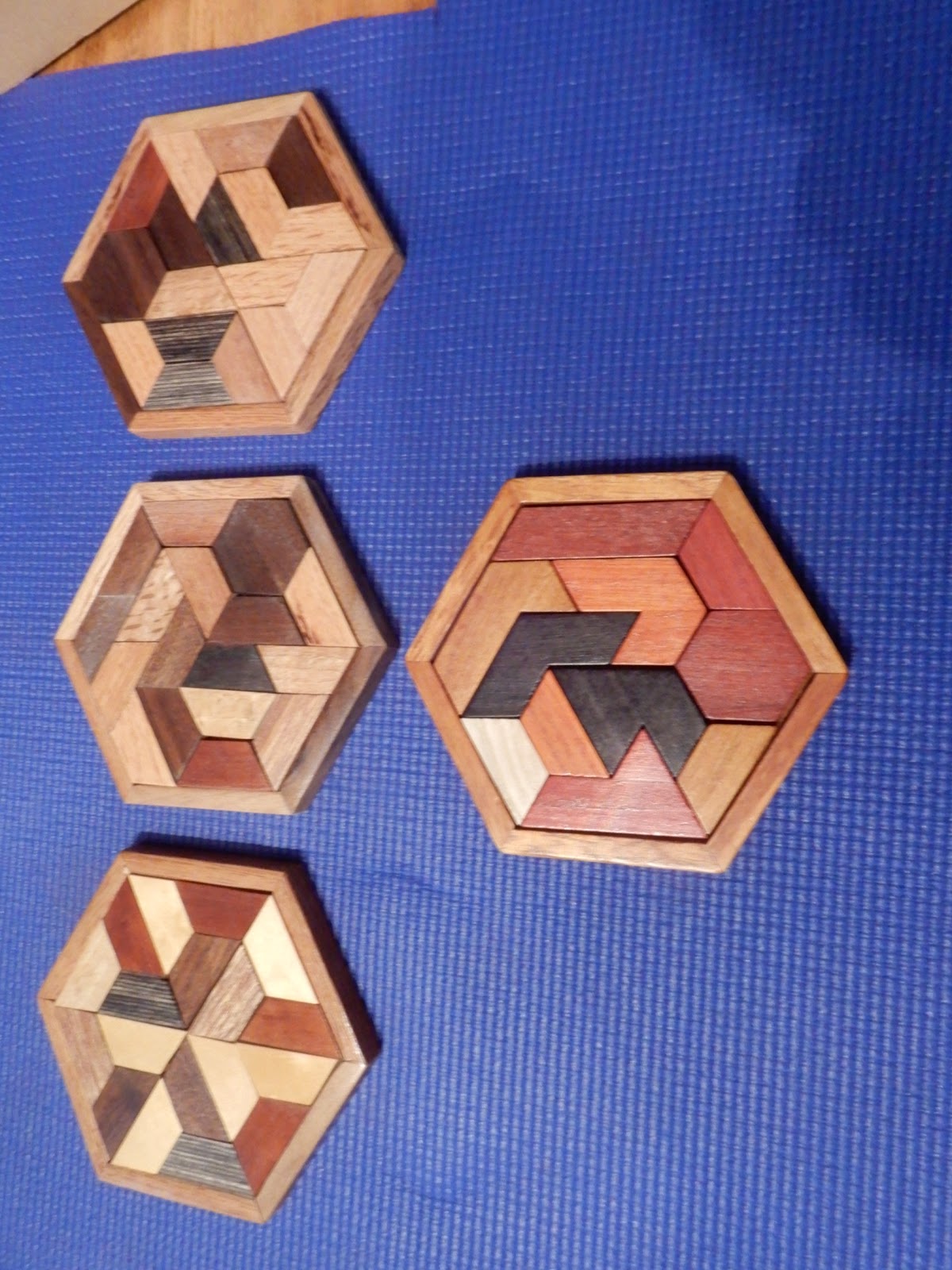
Below is another seemingly simply jigsaw-like puzzle.  After I ordered one online, I made three "clones" (another reason to do wood works) with different configurations with varying degrees of difficulty. Deceptively easy but not quite. And the peices are enclosed in a hexagon base - my favorite polygon. The same six-sided structure that is the favorite of bees to construct their honeycomb.


Friday, September 27, 2019

Eulogy for Common Sense

Common sense had already sustained a thousand blows and lacerations.  It is time for its last rites and its eventual funeral. The long battle it endured lasted for at least a generation  now.  Its many attempts to fight back was akin to stopping the ebbing of a one-way tide that  had been receding for decades now and leaving behind a drying sand - now almost devoid of a living thought. Its last line of defense - critical thinking - is crumbling and quickly giving way to a horde that can only be described as capably doing nothing but engage in group think. If common sense is on life support it is now a matter for society in particular and for all of civilization in general to pull the plug. Yes, we can pray for a miracle but prayer is now too another collateral casualty.

Common sense is dying from small blows and often lacerated with very little blood. It is now punch drunk from a jab here, a jab there, and body punches that merely stagger the senses without really causing a knockout, not even  a knockdown. Common sense has not gone down for the count. At least, not yet. But it has already had recurring standing counts. And that is worst than being counted out entirely. It is a pitiful sight.

Here is one little jab. The New York public school system allowed  its students - the only one to announce it publicly -  to skip classes to attend a climate change rally. We should not have a problem with that ordinarily, except that the school system, based on 2017 data, lags behind many states in student proficiency in reading and math, described along with several other states as having, "Performed significantly lower than national public" average.  Common sense could only gasp.  Why let these students spend one day away from the classroom at all. Classrooms where prayer is no longer allowed  and chocolate milk is now also removed from the school cafeteria (yes, New York City did it) have become a battleground where children are the innocent bystanders.  

These young kids, not trusted to make decisions on what they eat or drink (sodas removed from school vending machines) by its own government (not their parents), are deemed smart enough to play a role in climate change debates. These are the same youth that its government will not allow to drive, vote or buy alcohol and other restricted items. It was common sense that determined these guidelines a long time ago.  Now it looks on helplessly when these kids who ought to be allowed to enjoy a good part of their youth playing dodge ball (now prohibited during school recess) or develop critical thinking for themselves are practically driven to believe their world will end soon.  They've been protected by safe spaces, made to fear "toxic masculinity", confused by the expanded definition of gender and bathroom assignments, etc. School system, prohibited from allowing prayer to insure that freedom of religion is adhered to, also abandoned civic classes from its curriculum, yet it may endorse one set of political views that are passed on by its teachers to students with unrelenting barrage and impunity . 

Common sense is looking for refuge in adult minds because they should know better. But even that is now a notion that is in doubt. Higher education that used to provide a mental vaccine against the decline of common sense is no longer home to reason. The same adult  minds now use their local legislature to re-label a felon, an ex-convict, as "justice involved" person or, get this - a "returning resident".  How nutty is that? This whole idea of sanitizing these labels is exemplified by the San Francisco legislature to, among other things, identify a juvenile delinquent as "young person impacted by the justice system".

Below is an actual quote from the San Francisco Chronicle:  

"The language resolution makes no mention of terms for victims of crime, but using the new terminology someone whose car has been broken into could well be: “A person who has come in contact with a returning resident who was involved with the justice system and who is currently under supervision with a history of substance use.”


In other words, someone whose car was broken into by a recently released offender, on parole with a drug problem".

Got that? This is what it has come down to. The rabid social liberalization of labels really does nothing to improve people's lives, whether you are a victim of crime or a criminal. Another laceration to common sense.

I do not wish for this to happen but imagine when we get to the point to call a murder victim as a "life-deprived person" while the murderer is a "life-terminating agent". Let's not be too sure to get this past the liberal wagon ride. Does it make the homeless feel better about their situation if they are  labeled instead as "persons in-between-residency", such as someone who is in between jobs is for the moment - jobless?

We mourn the deathly malady that now plagues common sense.  If it must indeed succumb to the inevitable extinction then the least we can do is to eulogize it.

Common sense.  You had a good run.  For centuries you kept civilization upwardly mobile; you gave birth to the Magna Carta; you provided us the platform from which democracy was launched; you made sure decency triumphed over barbarism, hard work is rewarded for those who toiled, sympathy over greed and compassion was more sensible than hate. In short, you made civilization a workable environment within the bounds of reason, free of the touchy feely that we are now enjoined to adopt, lest we offend someone or something. 

We bid our goodbye. We celebrate the memories for keeping us within the guidelines of true sensibilities and a balanced view of a logical world by improving the human experience for centuries but, alas, we are offered in your stead the fantasy of safe spaces, the crying rooms, university curriculum and programs that defy critical thinking by launching a multi-million dollar program to study mindfulness, creating the equivalent of a "Kindness Institute". 

We can only ask or wish that when perhaps we finally get tired of all of these, that you will come back. If and when that happens humanity will be well served once again. If not, then indeed this is goodbye.